For a young me, comic books and adventure stories were nothing short of sacred at that age. I’d instantly try to emulate what I’d read and sit down to write similar stories where the characters portrayed qualities like honesty, kindness and discipline – childishly quoting what characters had said in books and trying to follow on that in real life. Secretly, I’ve always thought that those comic books and novels nurtured my young sense of right and wrong.
*****
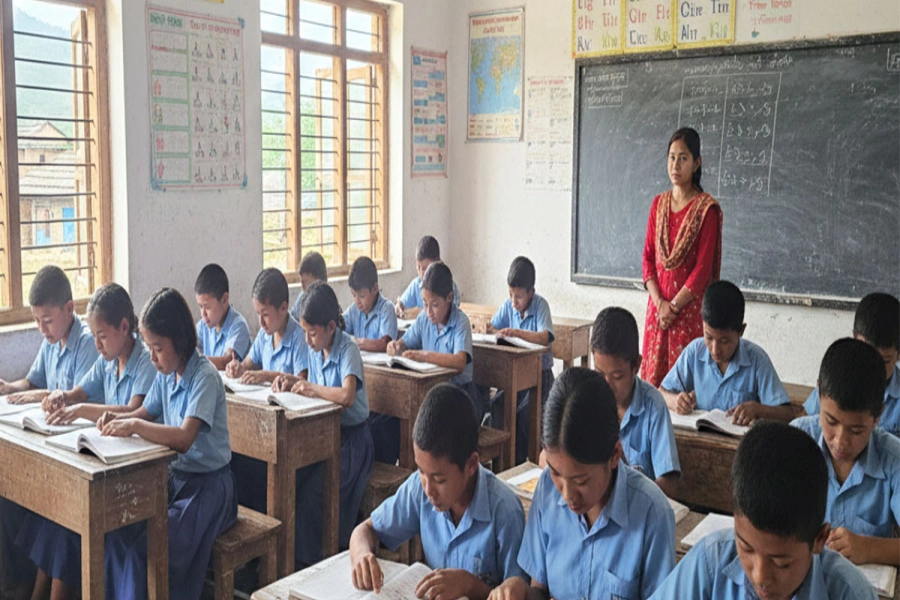
Fast forward to more than 20 years later, and I found my beliefs vindicated in Christine Stone’s workshop on the importance of reading to and for children. Ms. Stone is an educator who has been in Nepal for many years now and is the author of many popular children’s books. I watched and took notes as she helped a roomful of teachers, both from Kathmandu and a sizeable number representing schools outside, to discuss and define the importance of reading for children.

As the educators listed out the essential qualities in a story that would benefit students most, I found myself ticking them off my own list. By the end of the session, it felt like we had hit upon a groundbreaking phenomenon that could revolutionize teaching a classroom of young students – developing a reading culture. Or had we?
Encouraging a reading culture and teaching children to absorb the good from them, alongside learning grammar and spelling, is something that’s been around for as long as teaching itself. The best lessons that everyone remembers are almost always explained through story-like incidents, capturing a person’s imagination first, enabling him/her to remember the lesson easily later. It’s just not a concept that’s ever taken off in the Nepali education system which promotes rote learning.
*****
Not that there’s no room for it as demonstrated by the clear conclusions reached at the end of the 6th International Teacher’s Conference (January 3-5, 2010) at Shuvatara School, Kathmandu.
Organized by Saraswati Training and Resource Center (STRC) with the theme, “Peace, Respect and Partnership in Nepali Education,” the three-day conference held extensive discussions on these topics and much more. STRC was jointly established 17 years ago by Rani Gurung Kakshapati, founder director of Shuvatara School in Kathmandu and by Kath Maltzahn, founder principal of Merrivale School in Melbourne, Australia, and is supported by a wide network of people from and outside the education sector.
With world-class educators from Australia and India besides Nepal, the sessions conducted ranged in topics from ‘Socio-emotional learning for children’, ‘Crossing borders and bringing respect back to pedagogy’ to ‘Peace education for children in conflict’ and ‘Sister School Projects’. Every session facilitated by these education field veterans provided teachers here with an eye-opening experience at sharing problems as well as ways to work towards solutions for students everywhere. As was expected, parallels were easily drawn between issues that were relevant to students in Nepal and abroad, making the talks even more productive.
Imparting moral lessons to children as well as getting them interested in classroom activities is clearly an issue in all classrooms. Stone’s session on “Teaching Values of Peace, Tolerance and Compassion through Literature” and Jenny Green’s session on “Designing Tasks for the Communicative Classroom” together reinforced the fact that establishing a reading culture in children is the best way to kill two birds with one stone – an interactive classroom, and a great teaching method. Nothing captures a young mind like a story he or she can relate to.
The general outline was: Choose a story that’s rich in characters as well as with good, wholesome content. Let your students or your children point out and explain their interpretation of the message of the story. Help them relate to these stories in their own lives with examples of similar situations. Now, build activities around these stories that help children improve vocabulary and grammar.
*****
If this method sounds really simple and do-able, that’s because it really is. Why then haven’t we adopted this system?
Apart from the addition of a few new courses, the curriculum for Nepali students, right from classes one to ten has remained unnecessarily bulky and pretty much unchanged. Policymakers in Nepal in all sectors, including education, have failed to embrace change and modify the curriculum accordingly.
What have we ended up with, then? Bigger school buildings, basketball courts and dining halls? Check. Smart uniforms and English speaking students? Check. Students who are taught the values of hard work, discipline, honesty, kindness, and who we hope will make responsible citizens? Not really. It really is high time the government took steps to designing a curriculum that doesn’t force schools to sprint through it to complete it on time.
What we need is something that allows time for interactive discussions, project works that compliment the course of study and teach students life skills such as leadership, public speaking and teamwork, among others. And reading can be an important activity if used creatively. It’s not like adopting it would cost a fortune. Great reading material for children is available at cheap prices. There are libraries that are great resources. Where there’s a will, there will be a way.
*****
But changes won’t happen overnight. The development in time of a strong reading culture in young children would go a long way in creating not just successful people but people with values and great work ethics. Looking at the state of the state – the constant bickering between the country’s parties and leaders, or the ever growing random acts of violence in the streets today – this seems to be the need of the present.
Related story
What is Kathmandu reading?