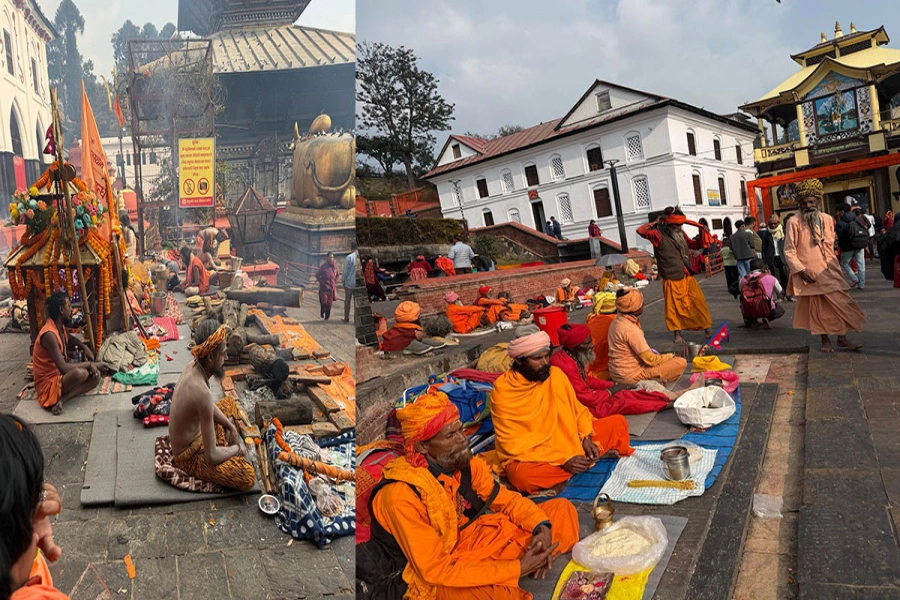
While hundreds of sadhus, including Naga babas who roam stark naked, have already thronged Pashupatinath temple complex, ordinary pilgrims from various countries, especially India, continue to arrive in the Kathmandu Valley for Shivaratri festival. [break]
Apart from India, pilgrims from countries like Malaysia and Indonesia that are predominantly Muslim nations have also bought tickets that would allow them to worship lord Shiva without having to queue up, according to Pashupatinath Area Development Trust (PADT).
"We are expecting pilgrims from many countries where the Hindus have been living," says Shyam Shankar Jha, Senior Director of the PADT. "We have been working for the past few months to make this year´s festival a grand success."
A 251-member committee led by Minister for Culture, Tourism and Civil Aviation Posta Bahadur Bogati has been formed to organize the festival. The committee has also formed several committees under it.

Sadhus enjoy lunch. (Photo: Keshab Thoker)
On Sunday, pilgrims will start flocking to Pashupatinath temple to worship lord Shiva from very early morning. Unlike in the past years, pilgrims will be allowed to worship the Shivalinga for the whole night till Monday morning.
All four doors of the temple will be opened for the devotees to worship the Shivalinga. "Only in the hours of daily prayer, we will close doors in eastern, northern and southern parts of the temple," says Jha. "The western door will remain open, though."
One million devotees
Number of devotees, Sadhus and mere spectators, who throng Pashupatinath temple on the occasion of Mahashivaratri festival, has been increasing every year.
"It´s becoming bigger and bigger every year," says Prem Hari Dhungana, secretary of a subcommittee (donation collection and ticket arrangement) formed by the PADT to organize the festival. "Managing the ever increasing size of devotees of devotees is becoming a challenge."
According to PADT, over one million devotees are expected to visit Pashupatinath temple this Shivaratri. "This number does not include Sadhus and spectators," says he. "Beside devotees and yogis, thousands of people flock to Pashupatinath temple just for fun."
For those who do not want to spend hours in long queues to pay obeisance to the Shivalinga, which is located inside the central temple of Pashupati complex, PADT has been arranging tickets for the last three years.
"Once can easily worship the Shivalinga after buying a ticket of Rs 1,000," says Dhungana. "They need not queue up to enter the main temple."

Sadhus wander around Pashupatinath Temple premises. (Photo: Dipesh Shrestha)
The PADT´s decision to sell tickets for those wanting to avoid queues has been criticized by many as a pro-rich move. However, Dhungana defends it as a pragmatic approach to manage the festival.
"Many devotees from outside Nepal want to return home the day they arrive in the Kathmandu valley to worship the lord Shiva. It would be very unpractical on our part to force them to queue up for hours," says Dhungana. "Tickets are meant for such devotees."
According to Dhungana, the PADT has arranged tickets for 3,000 devotees this year. "Over 500 tickets have been booked in advance by Saturday," says he. "We hope all our tickets will be sold out."
Naga babas add glamour
Sadhus have always been an integral part of Shivaratri festival in Pashupatinath. And, more Sadhus are expected to flock to Pashupatinath for Shivaratri festival this year. As this year´s Shivaratri festival takes place just one month after the Kumbha Mela in India, more Sadhus are likely to visit Pashupatinath.
According to Ramesh Kumar Upreti, secretary of a subcommittee formed by PADT to manage Sadhus, nearly 4,000 Sadhus have already thronged Pashupatinath by Saturday for Shivaratri. "More Sadhus are expected to arrive on Sunday," says Uprety.
The number of Sadhus who have turned up at Pashupatinath till Saturday is already higher than last year´s. Only 3,100 Sadhus had arrived for last year´s festival.
"Hundreds of thousands of Sadhus flocked to the confluence of Ganga and Yamuna rivers in Prayag of Uttar Pradesh, India just one month ago," says Uprety. "As Pashupatinath is one of the holiest shrines not very far from Prayag, more Sadhus are coming to Kathmandu this year."
All Sadhus are not the same. They belong to different sects of Hindu religion. And, most fascinating of them are Naga babas, who add glamour to the festivals.
Naga babas wander about stark naked. They smear thick layers of ash, color and rudrakshas on their skin. Naga babas are deemed to be religious soldiers and the sect was established by Aadi Sankaracharya to protect the purity of Hindu religion. Therefore, Naga babas hold a special place in Hindu religion.
Unlike in the previous years, the local administration has banned Sadhus from selling marijuana in and around Pashupatinath temple complex. However, they themselves are free to smoke marijuana.
Guthi Sansthan, a government body that governs all social and religious trusts in the country, provides travel expenses to Sadhus for their return home. PADT has also started providing supplementary travel expenses for Sadhus from last year.
"Sadhus had been complained that the travel expense they had been getting was inadequate," says Uprety. "So the Guthi Sansthan decided to supplement whatever money the Sadhus were receiveing."
The amount Sadhus receive depends on their status. While some Sadhus are heads of famous religious shrines in India, a majority of them are ordinary yogis or sanyasis. “Some Sadhus hold important positions like Mahamandaleshwar, Mathadhis and Pithadhis in famous Hindu shrines of India," says Uprety. "We have to consider their position while distributing travel expenses."
Before the abolition of monarchy in Nepal, some Sadhus used to get skins of tigers, leopards and deer. With the end of the monarchy, Sadhus no longer receive such precious gifts.
----
VOX POP
On the eve of Mahashivaratri, Republica´s Pratibha Rawal chatted with some Sadhus in Pashupatinath to find out why they prefer to celebrate this festival in Kathmandu rather than anywhere else in India.
Siwa Das, 58
Banaras, India
Shivaratri is celebrated in our country, too. But I prefer to visit Nepal for Shivaratri as Pashupatinath is above all other Hindu shrines. And celebration of Shivaratri at Pasupatinath is bigger than anywhere else. People from around the world gather in this temple to celebrate this auspicious occasion. We smoke ganja as part of the celebration as Lord Shiva himself allows us to do so on the day. I am here for a week and will enjoy my stay here with other friends from Banaras.
Sunil Ramdas Katahari, 42
Maharastra, India
Mahashivaratri is only the occasion for people like us to visit Nepal. Our extreme faith toward Pashupatinath attracts us and during this festival we not only get chance to worship our lord Shiva but also share our feelings. And I think ganja is not compulsory in this festival but those who like it they can have it. Though it´s only my second time, the temples, Nepali language and people all seem very familiar.
Shivaji Giri, 65
Bihar, India
We sadhus just like to travel from one place to another. So, during Shivaratri we come to visit Nepal and celebrate our great festival Shivaratri by worshiping lord Shiva. I am eagerly looking forward to the day. Huge crowd turn out, different kinds of shops and ganja are the best part of this festival. We´ll return to our country after the festival is over.
Related story
PADT bid farewell to sadhus who graced Pashupatinath (Photo Fea...


-1778465739.webp)