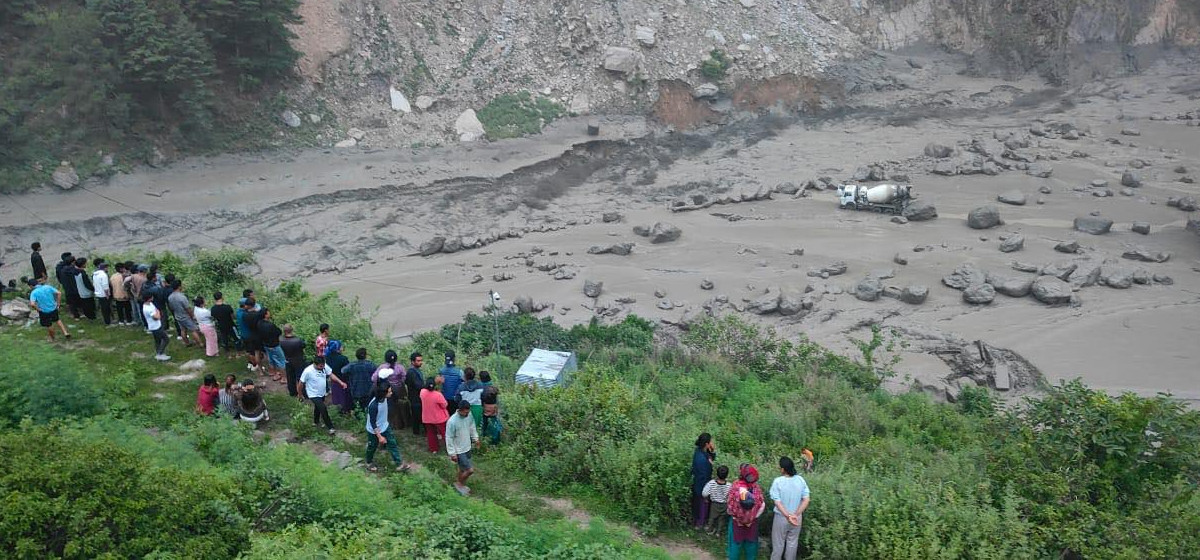
In the midnight of July 28, 2015, a 22-hectare forest came crashing down on the Khahare stream—which drains into the Fewa lake along with Firke and Harpan streams—leaving behind a trail of death and devastation in Bhadaure Tamagi VDC, Kaski district. Death counts vary. Around 11 people died in that disaster, some locals shared with a team of journalists, UNDP and EbA officials on an inspection of conservation measures focused on the Fewa and the Panchase region, while others say 17 people perished when the nature unleashed its fury on a peaceful village deep in sleep.Luckily, Manapati Bhandari (80), a local, was away from the scene of disaster, a village of more than 250 households, on that fateful day. Though ill, the father of three daughters and one son, rendered homeless due to the April 25 mega-quake, was in Kayarbari village working his fields. Many others were not as lucky as Bhandari, as security agencies and local people found in course of rescue operations.
Six months into the disaster, villagers remain as ill-prepared as they were on the midnight of July 28, 2015, as we found during our weeklong visit that started at the end of December, 2015. These days, the Khahare is a thin sliver of water lost almost in a bed of boulders and sand, but that's what all seasonal streams look like during the dry season. Come the rainy season and they wreak havoc.
Tanka Prasad Subedi, chair of Majthum Karkiko Tahara Conservation Committee, says two things saved most of the 250 households on that fateful day—gabion walls and bamboos. According to some people, the walls and the bamboos date back to 1980. People like Subedi feel constructing gabion walls and planting bamboos can go a long way in mitigating the effects of disasters.
He says landslide control measures in upper riparian regions are a must for conservation of the Fewa. "Focusing only on Fewa conservation will not serve the purpose."
Gopal Bahadur Gurung (58), a conservation activist from Arthar Dandakharka, Parbat district, says the tendency to build roads in every village, without taking into account fragility of young mountains, is akin to inviting natural disasters. He says roads in the hills are triggering landslides and flooding, thereby putting human settlements downstream at high risk and increasing siltation in the Fewa. And how right he was: When we were returning to Pokhara after a trip to the Panchase peak, we saw development and destruction going on at the same time. Close to Bhadaure Tamagi VDC-5, a construction crew was repairing a road section close to the Harpan Khola, shut due to landslide debris falling from a forest.
Bhandari, who lost his home and paddy fields in the disaster, complains people are gobbling up funds in the name of Fewa conservation, leaving victims like him high and dry.
Another villager, Bhagwati Sharma Bhandari, district governance expert, LGCDP, says infrastructure must be constructed on either side of the stream to minimise the loss of lives and property.
When the state and non-state actors fail to protect them from disasters, spiritually-inclined people like Sharma Bhandari turn to the almighty. That is what they did on that fateful day. They prayed to Siddha Baba, whose temple adorns a hillock nearby.
After surviving the worst, many of the survivors feel they owe their life to Siddha Baba. They have established a Pathshala, a school where Sanskrit scriptures are taught, for preservation of their religion. They worship the deity regularly, thanking him for protecting them and asking him to continue to do so in coming days.
Rebecca Gurung, field support associate at the EbA—Ecosystem based Adaptation in Mountain Ecosystems in Nepal—says there's a risk of another disaster in the coming monsoon.
The EbA, involved in nature conservation in the region along with the Federal Ministry for Environment, Nature Conservation and Nuclear Safety, UNEP, IUCN and the UNDP, has proposed constructing four check-dams—one each at Khahare, Ghatichhinda, Pame and Khapaudi—to mitigate the effects of a monsoon-triggered disaster and conserve the Fewa by controlling heavy siltation that the three rivers cause.
Worryingly, check-dam project construction, a component considered crucial for mitigating the effects of a monsoon-related disaster, remains on paper. Delay in starting the project, estimated to cost around seventy million rupees, has given rise to fears that the coming monsoon may unleash yet another disaster, causing incalculable losses in terms of human lives and infrastructure.
Conservation agencies and locals have planted broom grass and other plants upstream to control landslides. But haphazard construction of roads cutting through forests has increased the instances of landslide, putting villagers downstream in great peril. As if this were not enough, the fuel crisis resulting from the Indian blockade has increased deforestation, accentuating the risk of landslides and flooding.
In the absence of credible disaster mitigation measures from the state and non-state actors, people like Sharma Bhandari have no option but to turn to some supernatural force in times of natural disasters. With disasters hitting ill-prepared settlements around the world with increasing frequency, even gods have their hands full these days. Nonetheless, let's hope and pray that Siddha Baba responds to collective prayers of devotees like Sharma Bhandari whenever natural disasters occur.
The author is a Kathmandu based journalist
Related story
Living with fear