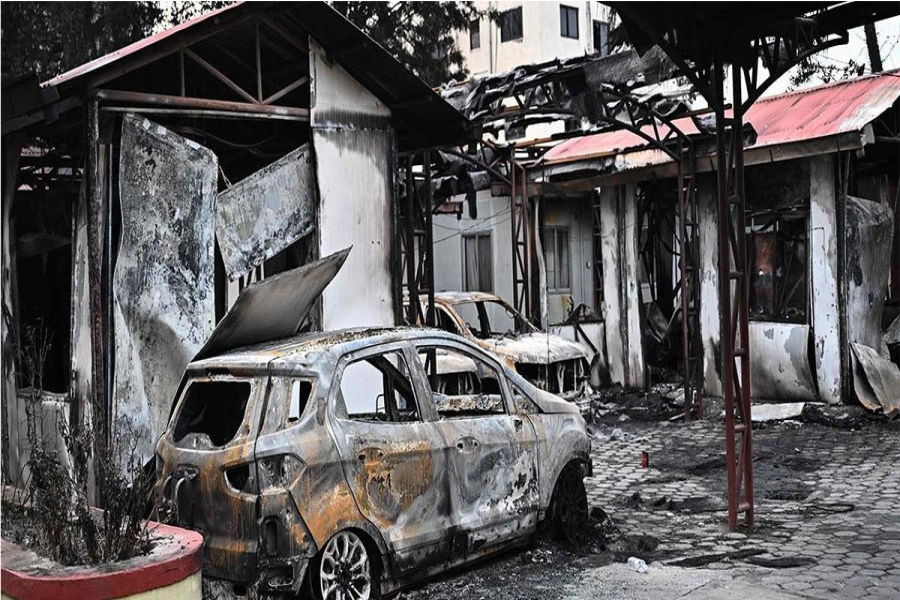
The frightened locals were happy that the building damaged by the April 25 earthquake was being finally demolished. But the narrow street leading to the building proved a major hurdle for the demolition team.
They could not transport their equipment through the street to the site and the demolition work had to be halted even though the task was too urgent.Another squad deployed for demolition at Mitranagar, Balaju, faced similar problem. They too could not pass their dozers, cranes and excavators through a congested street and had to return without carrying out the demolition work.
At a time when shortage of tools and equipment are already slowing the building demolition work in the Kathmandu valley, congested roads in many parts of the valley are proving major stumbling block in carrying out the task, said Kathmandu Chief District Officer Ek Narayan Aryal, who is also the chief of District Disaster Relief Committee "That's why our demolition teams have been able to raze only six houses in the district in a week," added he.
He said the demolition teams are forced to spend a lot of their time looking for ways to take the equipment to the site, delaying the demolition work across the the valley.
A committee formed by the government had deployed over 2,000 engineers who singled out over 1,500 buildings in the Kathmandu valley as dangerous and recommended the district committees in all the three districts inside the valley to immediately demolish the structures.
But the narrow roads, a consequence of haphazard urbanization, have been hindering the task in all the three districts.
"It seems the demolition work needs to be carried out manually in the areas with narrow roads," said Aryal.
Related story
Reconstruction of buildings burnt in Gen-Z movement to be compl...