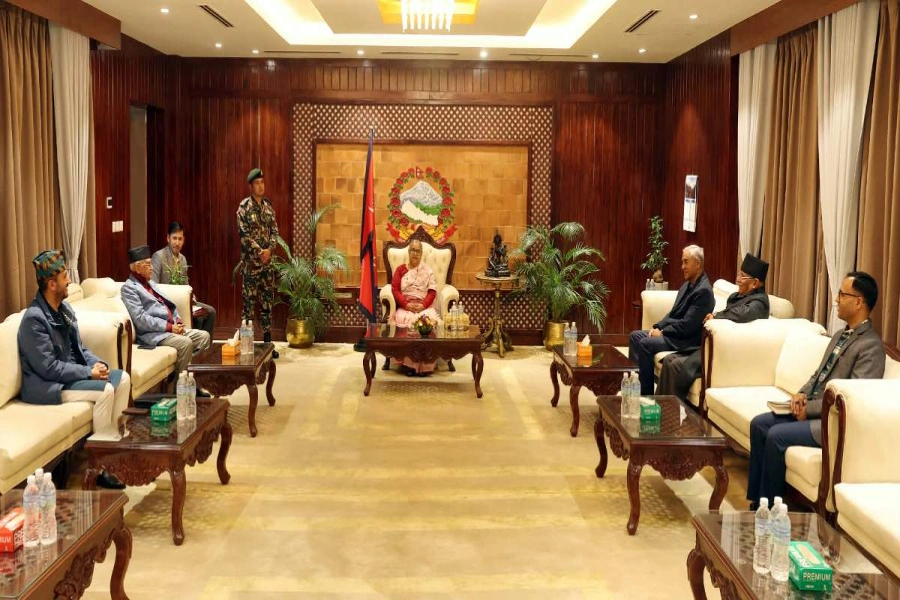
All of us have our own biases. These biases are dependent upon our gender, ethnicity, language, financial background, age-group, sexual preferences and you name it. Whenever decision makers are a homogeneous group, because of the homogeneity in their biases, the agreement, though easy to reach, is often unfavorable to the group absent from the decision-making body.
Diversity in leadership will result in agendas that Nepal can relate to. There will then be sharper debates among competing ideas. The policies that emerge out of these debates will be much more centric towards Nepal as a whole.
Take, for example, the recent government budget that provides a reward of Rs. 50,000 if one were to marry a widow. The bride is now thinking: Was it the Rs 50,000 or his affection that made the groom take the plunge? The hopeful groom now has the onus to prove to his bride that extra cash had nothing to do with his decision!
We all know that the intention of the policy was a good one; but, would such a crude objectification of women have occurred if there had been more females participating in decision making, especially if any of them had been widowed herself? A group of females devising a plan would perhaps have come up with a better idea; maybe a massive public relations drive to get rid of the stigma against marrying a widow. This is just one of the many examples of how a lack of diversity among decision makers can distort policy.
One can make a long list of Nepal’s government policies that have been driven by biases of one group, favoring only that group and alienating the rest. Some of these decisions have turned out to be very costly to the nation. Denial to use local language for local governance, denial of citizenship to Madhesis, denial of equal share in property to women and the recent ruling against the legality of our vice president’s oath taking in Hindi are just a few of them.
It is ridiculous to believe that these policies were some kind of conspiracy but it is equally ridiculous to believe that it was all a matter of chance. The scientific explanation would be that it was the homogeneity in ethnicity, caste, language group, financial group and gender of the decision makers that increased the severity of their biases, ultimately leading to policies that were out of touch with a vast majority of Nepalis.
It is not a stretch to argue that these one-sided biased policies of UML, NC and Shahs made way for Maoist takeover. Compared to the other parties, the Maoist party still has the most diverse leadership. Not surprisingly, they have consistently come up with the ideas with greater public support and, predictably, their ideas have prevailed. The concept of having a secular, republic and federal Nepal all originated from the Maoist politburo. How is it that these winning ideas never occurred to the grand old men of the grand old parties? It can’t be that the leaders of our grand old parties are morons.
There is an utter lack of diversity in the leadership of UML and NC. This has created a problem so severe that they repeatedly come up with a vision for Nepal that is out of touch with the majority of Nepali citizens. Many say that these parties do not have a vision but chances are that they do have a vision, albeit one that is going to let down a whole lot of Nepali citizens—and they are scared to publicize it. For instance, leadership of these parties perhaps have an idea of what kind of demarcation of provinces they would like but neither of these proud national parties have published their map but the Maoists have.
Genuine diversity in leadership position is no longer a luxury but an absolute necessity. The sooner these parties realize that, the better. Genuine diversity in leadership will result in agendas that a diverse Nepal can relate to. There will then be sharper debates among competing ideas. The policies that emerge out of these debates will be much more refined and more centric towards Nepal as a whole.
So far, the concept of diversity has been portrayed by many as one group wins and the other loses phenomenon. For instance, the demand for proportionate recruitment of Madhesis in the army, executive and judiciary has been trivialized simply as greed for power on the part of Madhesis and identity politics on the part of Madhesi leaders. It is true that achieving 33 percent Madhesi representation in all areas of government right away is impractical. But to appreciate the spirit of this idea is crucial. To trivialize their demand as an inept lot looking for employment would be repeating the mistakes of the recent past.
It is prudent to believe that diversity actually is a win-win situation for all. To consider diversity as power-sharing to pacify temporary uprising would be erroneous. Instead, diversity ought to be thought of as a necessity to counterbalance inherent biases.
And because the purpose of diversity is to counterbalance biases, diversity of all types is necessary. We need diversity among decision makers in terms of ethnicity, gender and financial condition, to name a few important ones. Let us work towards having boardrooms filled with decision makers whose composition resembles the group they intend to serve in terms of their background. Only then can we reach a prudent policy decision.
In an era of ever-increasing realization of individual rights, embracing diversity is a modus operandi for survival. Any group, be it a political party, or a non-government organization, or a profit-making institution, with decision makers that do not resemble the group they intend to serve is walking the path of losers.
Related story
Great Leadership: A Road Less Traveled