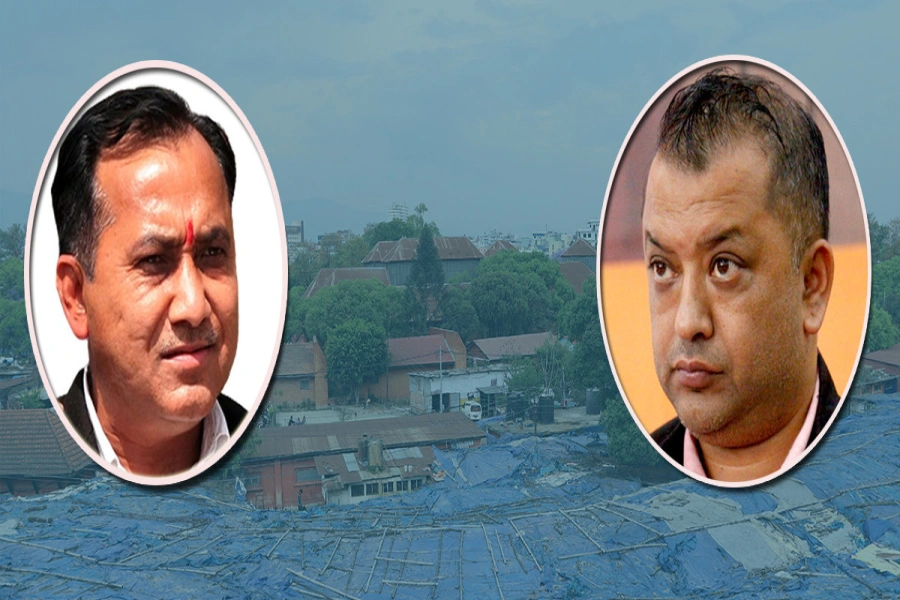
But what we Kathmanduites saw, when the Maoists of Nepal were arrayed before the cameras in their first-ever exposure at a press conference in the capital, were almost the exact opposite of the imageries of the world’s revolutionaries we were accustomed to. It was finally confirmed that “Prachanda” was indeed Pushpa Kamal Dahal, the leader of the Maoist leaders. He of Chitwan looked like Joseph Stalin of Georgia. Baburam Bhattarai, next to the Numero Uno, looked like a Nepali bureaucrat. CP Gajurel could be a Pradhan Pancha in the old days. Krishna Bahadur Mahara did not look like the schoolteacher he once was. Janardan Sharma’s goatee helped him pose like a South Asian jholawala intellectual. Dinanath Sharma looked like a clever clerk on the lookout. Ram Bahadur Thapa Magar “Badal” was a ditto Kim Il Sung, only younger and handsomer.
Hisila Yami of Newar Kathmandu and Hill Brahmin Pampha Bhusal, the two lady Maoist politburo members, no less, were the twin personae of Jiang Qin in their Cultural Revolution pantsuits and short and low-maintenance hairdos.
But more than anything else, I was most surprised by the facial smoothness of the Maoists seated on the dais. All were clean-shaven, with neat haircut and bangs, and in clean clothes. The shirts, trousers and jackets – quite a far cry from jungle-green fatigues and camouflage of guerrillas – suited them with natural ease. Above everything else, I was awed by their glowing cheeks in pink health, in diametric contradiction of the Kathmandu-based politicians and party in power – gathered at the august venue to welcome and negotiate with them – whose countenances showed liver spots and their skin made pallid by the push-pull harassments and political tensions of Kathmandu and its pollution. Whereas, the Maoist men and women had unblemished facial skin, as if they had been pampered with Fair & Lovely cream long before coming to the rendezvous. Or were they given cosmetic treatments in advance by TV makeup artists for the glare? Or did they always apply sunscreen and wear solar hats while storming enemy fortifications and bunkers? Whatever, but the Maoist high commanders coming in from the cold had the healthiest skin and most glowing complexion I have ever seen. Perhaps it was true that Mother Nature, in which the Maoists had blended themselves for so many years, nurtured them so beautifully and healthily.
It soon transpired, however, that the top echelon of the Maoists spent their years in foreign redoubts of air-cooled rooms and sunshades, with creature comforts and necessities provided for. It was home away from home, and the Maoists with the strategy of safe distance and inferred immunity lived in the NOIDA in Delhi or in Siliguri in east India, while their indoctrinated guerrilla fighters had it out against their fellowmen in Nepal. It was known only much later that their leaders were remote-control Maoists planning and executing their GPS putsches from across the borders. This should explain the stainless gloss on the fonts of those exclusively sheltered Maoist masters who revealed themselves in Kathmandu that particular day some three years ago.
To be fair, there were some Maoist commanders who ventured out and experienced the consequences. Mohan Baidhya Kiran was apprehended in his safe house in Siliguri and incarcerated. So was CP Gajurel in Chennai. At home, Matrika Yadav and Suresh Ale Magar were put in the slammer. When they were released, the stains and burns of what they were made to go through inside were visible on their faces and bodies. Emerging lopsidedly from jail and then walking unsteadily and displaying grimaces and traumatic expressions suggested the humiliation and strains and even torture they received inside the prisons, and they still show these gaunt signs today. It is obvious they were not given the privileges of political prisoners in the cells and were treated as common criminals in the stockyards. These venturing leaders do not look as healthy and whole as the other Maoists who were ensconced in comfortable sanctuaries. It is not surprising, therefore, that there is a deepening difference of commitments between those who dared to go out and the ones who thought it best to stay put. No wonder, then, that these four particular Maoists and their loyal followers are onto themselves a distinct faction within the seeming Maoist sodality. On the ostensible issues of Communist socialist principles and practices, the two rupturing camps seem to creating even deeper chasms and more precipitous gorges between them. The cool and becalmed surface belies the undercurrents of lava within the Maoist firmament. RIM and COMPOSA are not amused at the duplex that Nepal’s Maoist Movement has become. Admittedly, this is merely the first hints of the Maoist foretastes to come before the final endgame; hence, it is best to freeze this side of the story right here.
But all Nepali Maoists are unified in their Communist Manifesto, only their methods are at variance with between the two cliques. “Maoists” spells out as murderous and menacing (M), attritions and appropriations (A), obfuscation, obstruction, and oppression (O), intimidations and anything bordering on the illegal (I), subversion and sadism (S), tyranny and transgression (T), and subtraction (S) of Nepal into a Maoland.
The Maoists in power and heading the government have also managed other “M” mechanisms in tow – maiming, mutilating, and muscling, and milking for money and munificence. The Maoist miasmas continue, and there is no end to the mirage.
Nepal has been chronologically failed by Ranarchy, Panchayat polity, and multiparty democracy, then dictatorial monarchy, and now Maoism. But like every system, Maoism is also a god that has failed in Nepal, despite the historic mandate the Maoists received from the voters at the last Constituent Assembly – no less! – Elections polls. The Maya called Maoism has in fact been a Nepali Cassandra whirling in her own vortex.
What is left now, then? Perhaps waiting for the goons is the next best option left at present. Where art thou, Big Bully Brothers?
Related story
10 mind-blowing Maya Angelou Quotes