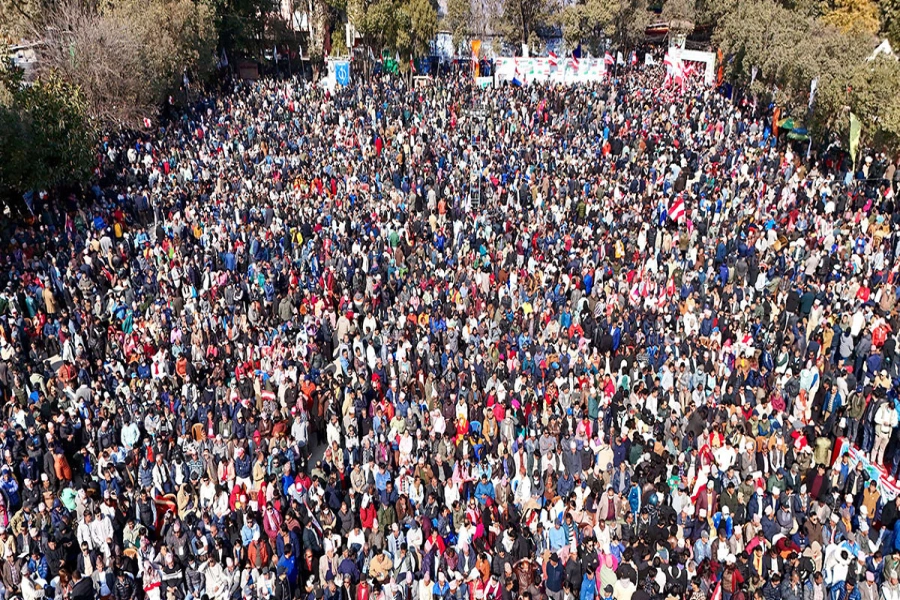
The revolt in Tarai-Madhesh began in an innocuous manner. A few bourgeois Madheshis, fearful of their position in a Maoist-dominated political order, gathered at Maitighar Mandala in January 2007 to register their opposition to the interim constitution. They ritualistically burnt copies of the newly promulgated charter. The protest was meant to be symbolic. Quite a few agitators gathered to voice their hostility towards ‘pahadi domination’ had imitated dress and address of their supposed oppressors down to officious Dhaka Topi and ponderously courteous hajur pronoun. Insecure intelligentsia and irrepressible media blew the event out of all proportion even as the government went on a confrontationist mode. However, the spark that lit the pyre of upheaval occurred in the roadside town of Lahan along the East-West Highway.
Years of discontentment erupt in an uprising even when it appears like a bolt from the blue to the establishment. The Unknown Rebel of Tiananmen Square who challenged the might of Communist Empire in 1989 was as much a product of the democratization wave sweeping the world as the discontentment of alienated Chinese youngsters.
Self-immolation of street vendor Mohamed Bouazizi in Tunisia heralded the stillborn Arab Spring, but the ground beneath the feet of dictators in the region had begun to slip soon after the arrival of occupation forces in Iraq. Madhesh Uprising flared up when an unknown Maoist cadre shot Ramesh Mahato, a 16-year boy of Siraha who had probably joined the protest rally out of youthful exuberance.
Identities of perpetrators of carnage in Gaur, where nearly 30 Maoist cadres were brutally killed on March 21, 2007, have not yet been conclusively established. However, the suspicion that Madheshi Janadhikar Forum may have had a hand in the massacre delegitimized the vanguard of Madhesh Uprising. Once victims were seen to be no less vicious in their retaliation than their oppressors, the moral high ground of resistance movement was lost. After Gaur, Madhesh became a playground where politicos wrestled with each other in the heat, dust and mud to gain an upper hand. The agenda of federalism and inclusion was established, but the will to get them implemented had been severely undermined.
It is impossible to ignore the achievements of Madhesh Uprising. The awakening forced all mainstream parties to choose Madheshi candidates in the election for the first president of the republic. Presence of Madheshis in the legislature as well as the executive is sizeable even though the same cannot be said of the judiciary, the bureaucracy, the academia, the diplomatic services, the armed forces, the media, profit sector enterprises or the flourishing NGO industry. There is a long way to go before Madheshis can claim to be equals in a country where they have been systematically ‘othered’ for centuries.
Failures of post-uprising politics are equally glaring. The tenant and farmhand of Tarai-Madhesh have not been able to benefit from the good fortune of Madhesh-based parties.
The Madheshi youth remain as externalized as ever. The destruction of Chure hills and deforestation of Charkoshe Jhadi continues unabated. There have been some Madheshi leaders in every government formed after the CA elections, but none of them succeeded in securing special packages for Dalits, women and the landless of the region. The hope that criminalization of politics would wane with the return of normalcy has proven illusory. There has been no let up in the shunning and slander of Madheshi activists.
Understandably, voices for a second uprising in Madhesh have begun to be heard. However, a sullen silence often greets all such calls. Apparently, leaders have lost ears of the masses.
Discredited vanguard
When the Madhesh Uprising began, the country was still reeling from after-effects of the aborted Maoist insurgency and misguided royal-military rule. Parliamentary parties stood discredited. The civil society and the media were perceived to be as exclusionary as other state organs. Three kinds of people jumped into the fray to fill the leadership vacuum during the winter of discontent in 2007 in Tarai-Madhesh: The conformists, the arrivistes and the dregs of society. Many of them still claim to speak for the masses, but the sheen of innocence has worn out. Having seen their true colors, few Madheshis believe their leaders anymore.
The first to jump on the bandwagon were the conformists. Decades of humiliation that a few Madheshi civil servants and professionals had suffered during Panchayat had created a well of resentment. The scorn heaped upon Madheshi politicos by mainstream parties in 1990s had infuriated them further. It burst out during a movement meant to restore the dignity of their origin. However, cut out from their roots, they felt more comfortable with a secondary status in salons of Kathmandu than in the intellectual wastelands of Tarai-Madhesh. Politicos, professionals and bureaucrats of yore took a dip in the uprising to wash away their sins. They have little interest in enlarging their constituency and will do everything under their command to limit the competition on the ground.
The establishment in Kathmandu loves sanitized Madheshis of the conformist class as they give an appearance of inclusion without challenging fundamentals of the existing order. The color that the personas of Hridayesh Tripathi, Mrigendra Kumar Singh Yadav or Ramchandra Raya bring into drawing rooms of the social elite is priceless.
When used as an adjective, arriviste has pejorative undertones. Not so when it’s used as a noun and refers to upstarts who pretend to belong where they have just arrived. Such people are often ambitious and can be ruthless in pursuing their interests. In their heydays, NC and UML leaders had identified and trained Madhehsi youths that they thought would be trusted lieutenants without posing any challenge. Girija Prasad Koirala groomed Bijaya Kumar Gachhedar and Jayprakash Prasad Gupta. Madhav Kumar Nepal nurtured Upendra Yadav, Jitendra Dev and Mahendra Yadav. All of them have been taught to think, talk and behave like their preceptors and be illustrious specimens of ‘Nepali First’ patriots. Assumed identity is always stifling. Ambitious arrivistes found freedom in Madheshi identity. However, many are still not comfortable with the idea of identity politics. It is difficult to overcome decades of indoctrination and relate to commoners on an equal footing.
The lumpenproletariat is attracted towards any insurgency like moth to fire. For the fallen nobility, an uprising is an excellent opportunity to reclaim their honor. The disgraced intelligentsia exploits a revolt to rehabilitate itself in society. All such elements discovered that the politics in Madhesh was not mature enough to discriminate between activists and dregs. The masses have begun to suffer their excesses but can do very little to break police-criminal nexus. Those who live ‘off’ identity politics rather than ‘for’ the politics of dignity find dregs useful tools.
Emergent leadership
When the next uprising erupts in Tarai-Madhesh, the existing leadership would be the first target of the masses’ ire. The uprising in 2007 had anti-Maoist and hence rightwing undertones. The support structure to sustain such politics for long is not in place. The Madheshi diaspora has very little clout and is too enmeshed with entrenched elite to back a protracted struggle for equality and dignity. The media is as unfriendly towards Madheshis as ever. Even the chain of FM radio station controlled by Rajendra Mahato has to depend upon NGO-fronts of UML to survive. Unlike mainstream parties—NC and Golchhas, UML and Chaudharys or Maoists and Jyotis—Madhesh-based groups do not have wealthy benefactors. The Madhesi intelligentsia lacks the combativeness of Janjati activists like Krishna Bhattachan or Mahendra Lawoti and has no equal for status quo polemists such as Prakash Chandra Lohani or Chitra Bahadur KC.
Most leaders of armed groups in Tarai-Madhesh were initiated into politics by Marxist-Leninist apparatchiks. Jaykrishna Goit worked with Manmohan Adhikary and trained with Mohan Baidya. Nagendra Kumar Paswan (a.k.a. Jwala Singh cut his teeth into ‘Male-Mandale’ brand of nationalism under the tutelage of UML militants and Maoist desperados. The ideology and political schooling that prompted them to flaunt weapons also prevented them from politics of hate. The new crop of leadership may not be as circumspect.
Despite the brouhaha over tools of communication like Facebook and Twitter, Muslim fundamentalists led the uprising in Egypt and the suffering of Madheshi youngsters in West Asia is preparing them for retaliatory politics on home ground. Oppressors everywhere look disconcertingly alike. Hindu fundoos of Haryana, Punjab, Gujrat and Maharastra—regions of India that absorb a huge Madheshi labor force—are not teaching tolerance. It is difficult to predict the trigger—an upheaval in West Asia, communal flares in Gujrat, economic slowdown in Malaysia, it could be events as distant as that—which brings enraged masses out onto the streets of Tarai-Madhesh. The leadership that would emerge from the ranks would be completely different from the complacent corps of yore that looked towards Girija Dajyu, Sushil-da, Madhav Comrade or Doctor-saheb for inspiration.
Related story
20,000 tons of waste extracted from Bagmati in five years