Excerpts:
myrepublica.com: What is the rationale behind opting for a directly-elected prime minister?
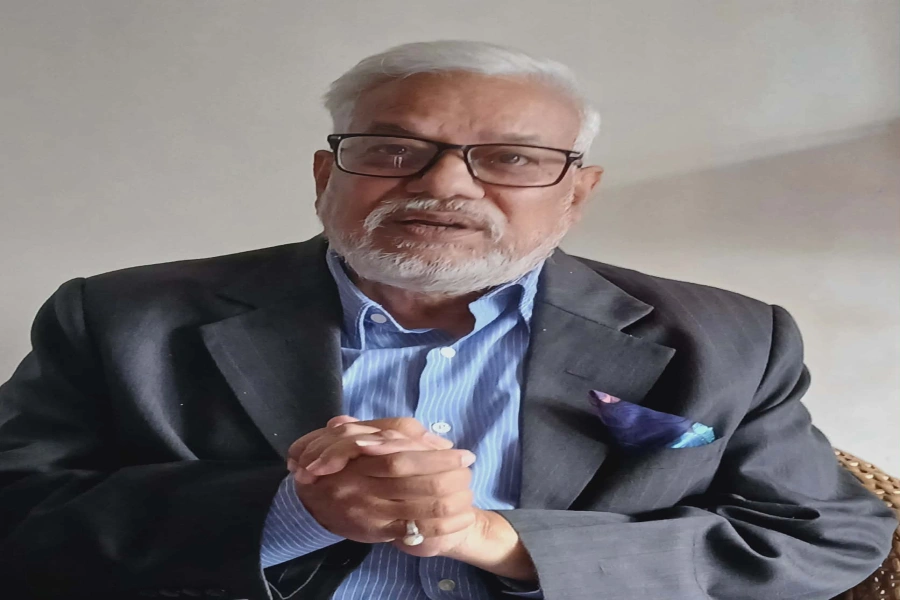
Gyawali: The country needs a strong government as well as a strong system. Our party’s conclusion was that this is only possible through a directly-elected prime minister and an indirectly-elected president.
For about 14-15 years, we experimented with the Westminster system. It has its own merits, no doubt. However, it was never able to ensure a strong and a stable government. In the existing system, the prime minister always has to worry about maintaining the support of a certain number of parliamentarians. The demerits of this system can be countered by a strong prime minister.
"I don’t think the issue of the system of governance will create too many problems. I am confident that we can come to a meeting point on this issue. The biggest challenge is to come to a consensus on the model and structure of federalism."
We cannot go for an all-powerful president because democracy is still in its nascent stage in Nepal. In such a country, there are chances that the power might be misused by the president and that s/he may become autocratic. The room for check and balance is minimal. The army will be under his control. It is about giving almost all the rights to him. This might take us toward a totalitarian system.
Second, our society is diverse wherein there are a lot of marginalized communities who would want to see a head of state from their community. If we opt for a directly-elected president, for at least another 50 years, you cannot imagine a person from a marginalized community becoming a president. Even to imagine a woman becoming a president would be far-fetched. In a country like the US, which calls itself the champion of democracy, it took 230 years for a non-white to become a president.
But, if the president is ceremonial, we can ensure their representation. This will give them a sense of ownership toward the state. Hence, for check and balance we need a ceremonial president and for a strong government, we need a directly-elected prime minister.

myrepublica.com: In such a system, how will you ensure that a directly-elected prime minister does not become autocratic?
Gyawali: There are three ways in which we can stop the prime minister from becoming autocratic.
First, the parliament can act as that force. Okay, the parliament cannot remove the prime minister through a simple majority. But if he works against the country or the constitution or if his actions invite serious national problems, then it can impeach him.
Second, the head of the state can be a counter to his wrongdoings. Yes, the decisions of a directly-elected prime minister have to be largely implemented, but at least the president can ask him to rethink his decisions.
Third, the judiciary can be empowered to check and balance his activities.
myrepublica.com: If you cannot push for your system of government, would you opt for a powerful president as proposed by the Maoists or will you side with the Nepali Congress (NC) to retain the supremacy of the parliament?
Gyawali: Both systems have their own merits and demerits. However, at a time of transition, we need a strong government and for that the better option would be a ceremonial president. If the country had not been in a phase of transition or if we had a long history of democracy, we could have opted for a presidential system but because of the current complexities we have opted for a directly-elected prime minister.
The bottomline is that we need a strong government and a stable system. If we make the president ceremonial, the government will be strong but the system will be at risk. Again, if we opt for a parliamentary system, the system remains comparatively stable but the government becomes weak.

Dipesh Shrestha
myrepublica.com: With so many divergent views on the model of government amongst the top political parties, will it be possible to draft the constitution on time?
Gyawali: I don’t think the issue of the system of governance will create too many problems. I am confident that we can come to a meeting point on this issue. The biggest challenge is to come to a consensus on the model and structure of federalism. This issue will be very difficult to resolve as the differences on this are no longer limited to the political parties. There are a lot of other groups who have become active.
myrepublica.com: One of the major issue on which there has been a lot of differences is the integration of the Maoists’ People’s Liberation Army (PLA) into the Nepal Army (NA)? What is the main problem and, in your personal opinion, what is the solution to this?
Gyawali: There are four major documents that guide this issue: Comprehensive Peace Accord (CPA), Agreement on the Monitoring and Management of Arms and Armies, Interim Constitution and the June 25 agreement between the seven political parties.
When the seven parties came to an agreement last year, it meant that we accepted that some form of integration has to happen. Having said that, we also have to keep in mind that rehabilitation is equally important. Before integration, every individual has to be given a choice to opt for rehabilitation and s/he should be given an attractive package to do that. Those who want to opt for integration have to meet the standard norms of the security forces.
"We told him (the prime minister) that (the murder of Prachanda Thaiba) can become an issue that may ultimately compel us to quit the government."
The problem is that some groups are going against the spirit of the agreement. For example, the Maoists say that they have fought a war and, simply on that basis, all the 19,000 plus combatants have to be integrated. That is not all. They even say that Pasang (Nanda Kishor Pun) should be made the Commander in Chief of the NA. This makes clear that they want to destabilize the security forces and increase their influence there.
On the other extreme are some leaders of the NC who say that they won’t allow integration of a single Maoist combatant into the NA. This is wrong because in one way or the other we have already accepted the existence of the Maoist combatants. However, the integration should not in any way dilute the professionalism, neutrality and apolitical nature of our security forces.

Dipesh Shrestha
myrepublica.com: Talking of agreements, do you think the CPA is still valid in the current changed political climate or does it call for revision?
Gyawali: Yes, it is still valid. Maybe we need to revise a few points but broadly it is still valid. It is still the masterpiece of all our agreements. The problem is not the agreements; it’s the lack of implementation. Yes, it may demand a separate explanation on issues like integration and regarding the formation of the Truth and Reconciliation Committee. We just need to add those.
myrepublica.com: Has your party been rethinking its association with the Maoists in the government following the killing of Prachanda Thaiba allegedly by a Maoist cadre?
Gyawali: This incident has made us very serious. If the Maoists read our concern as a temporary emotional reaction, they are completely wrong. The incident has shocked us. This is not an isolated incident. This is a part of a series of such incidents.
We understand that during a period of transition, such incidents do happen sometimes. What has worried us is the way in which the Maoists tried to dilute the incident. We adjourned our extremely important Central Committee meeting to send across a strong message. We gave a memorandum to the prime minister which was a kind of an ultimatum. And we told him that until the guilty is apprehended, the constituent assembly or the government will not run. We told him that it can become an issue that may ultimately compel us to quit the government and urged him to think on time. We warned him seriously.