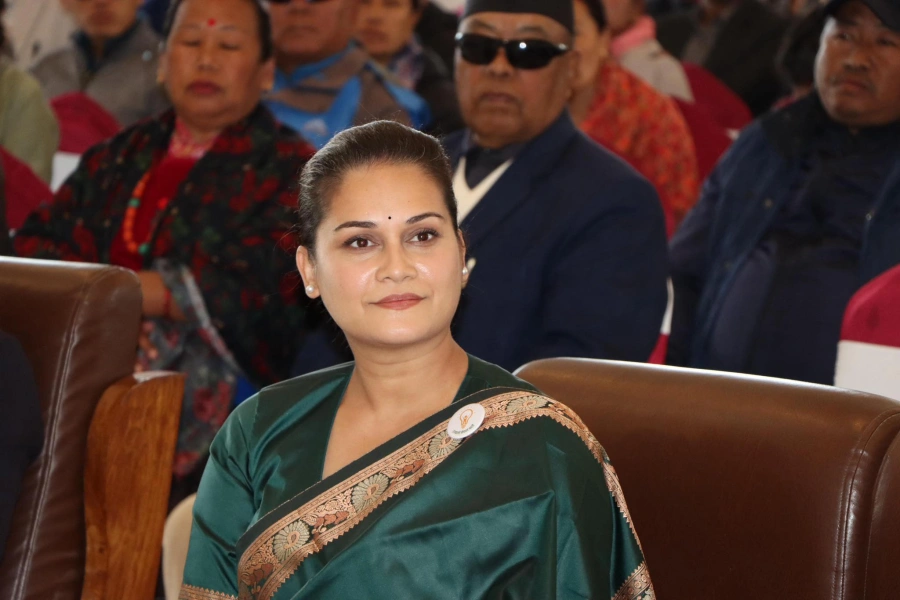
Santamaya Limbu, 83, better known here as Karsangeni, has a sorrowful tale of her short-lived love and marriage. She is one of the two living war widows of Gurkha soldiers who went missing in the Second World War. After so many decades, she is yet to believe that her husband died because she could not see the mortal remains of her spouse.
“I do think he’s alive, somewhere,” she says.
After her husband went to war, Santamaya came to Sundarpur with her father Dilliraj. This small village was a dense forest back then. She built a house and started a new life. As time passed, others also came to settle here. They started calling her Karsangeni because she came from Kurseong (Kharsang) of Darjeeling in India. This was how the locality she lived in was named after her – Karsangeni Chowk.

Love in the time of war
“Don’t go anywhere tomorrow,” her father told Santamaya one rainy night in Kharsang, as she was preparing to sleep. “Some people will be coming to see you.”
Santamaya did not understand what her father meant. She did not bother to understand it, either. She went to bed.
Santamaya could not go out with her friends to play around the next day. She was led to a nearby river by her mother. After a quick dip in the water, she was given a set of new clothes brought by her father a couple of days back. He wanted her to stay home the whole day. In the afternoon, some of her closest friends visited her. They flattered her by saying she would no longer remain lonesome. It spelt what was likely to happen.
It had become clear by then that Santamaya´s parents wanted to marry her off. In the evening, some strangers turned up in the courtyard with customary bottles of moonshine. Among them was a young boy clad in a newly tailored jacket. He kept throwing furtive glances at her as others engaged in chatting. She quickly figured out that he was the boy she was to get married to. Although not a prince charming, he was not unattractive, either.
“We looked at each other,” recollects Santamaya. “This was all we were allowed to do. It wasn’t the age of love marriage in which boys and girls frequently go on a date before marrying. We didn’t get to share our feelings and thoughts even once. Whatever my father decided was the final say on me and my family. Our parents mutually fixed the date of marriage.” She knew later that she was the only one who was absolutely unaware of the marriage. “Even he (her fiancé) knew it,” she says.
In fact, the young man had seen Santamaya somehow and brought his parents along to ask for her parents´ positive nod.
“He himself disclosed it to me later when we got married,” she says. The boy was from the same village Santamaya´s family had settled in some years ago. Originally, her family was from Panchthar in eastern Nepal. Her father settled in Kharsang after his retirement from the British Army.
The young man’s name was Baburaj Limbu. He was home on his first three-month furlough from the British Army in India. It was when he spotted beautiful Santamaya and dreamt of marrying her. He was, as Santamaya says, of average height. However, his body was taut and solid. He always bore an innocent look on his egg-shaped face. “His calm yet witty way of talking occasionally drove me crazy,” she recounts vividly.

After marriage, they went to Darjeeling which was the ancestral home of Baburaj. But they could not stay long there. He was recalled to his platoon.
“We spent barely a couple of months together,” she says. “He had to rejoin his platoon all of a sudden as a deadly war was about to begin.” He left Darjeeling the next day. “I went with him to the train,” she says, “I wept as he boarded it.”
The war did not start immediately. Baburaj came back to Darjeeling after 10 months. The couple enjoyed the happiest moments in their lives. They went to the bazaar and took one black and white photo in a studio. “There weren’t enough places to hang around, unlike today,” she says. “We, however, enjoyed our togetherness very much.”
But the war was not averted. It was just postponed for some time. Baburaj was again called back. He had to leave his bride for the second time. Santamaya expected him to come back again, as he did before. But the war had already spread across the world.
Restless nights
After Baburaj left, there was not a single night when Santamaya could sleep properly. She woke up suddenly in the night and remembered the moments she enjoyed in the company of her dearest one. She expected someone would tell her about the war. “But I heard no real news,” she says, “only rumors and speculations from the locals.”
The British Army had established a recruitment centre in nearby Ghoom. Santamaya went there everyday, asking officials about the whereabouts of her husband. She learnt that Baburaj´s platoon was deployed in Burma. “There was no actual word from the Army about his wellbeing,” she says.
Nine years elapsed in the frantic wait and search for Baburaj after the war. Only then did the British Army declare that those who did not return from the war were declared dead. “There was no particular confirmation of all such cases,” she says. “The blanket declaration of all missing soldiers as dead was an attempt to get rid of their widows like me.”
In 1950, the British government provided Santamaya a monthly pension of Rs. 16. Today, she gets Rs. 7,000 per month. She now lives in her nephew´s home.
“Though my husband was declared dead,” she says, “I still find it hard to believe that he is so.”
Santamaya has heard that many Gurkha soldiers who went missing during the war settled in Burma and some other countries. “My husband maybe one among those,” she says. “Sometimes, I imagine him coming to meet me with the same innocent smiles of his.”
She says she would not have complained even if her husband died on the battleground. Death, she says, is always there for an honest and brave soldier. But the way in which the British dealt with Baburaj´s death that makes her sad. “The British government should’ve given me the details of my husband even if bringing back his remains wasn’t a doable thing,” she says.
Dead and in the dark
Gurkha soldiers have helped Britain to expand its colonies all over the world, creating the saying that the sun never set on the British Empire. However, those very soldiers were never given due respect. Hundreds of thousands of Gurkha soldiers died fighting for Great Britain. But their sacrifice mostly remained in the dark.
Many Gurkhas went missing in action. But Britain never told their relatives waiting for their homecoming in Nepal about what happened to them. Santamaya´s is one case that unveils the ugliest side of Britain’s civilized and humanitarian face. Even those who became prisoners of war were compensated much later – in the first years of the 21st century!
There is no solid data on how many Gurkha soldiers died or went missing during WWII. Roughly, 60,000 allegedly died or went missing in the many campaigns and theaters of the last world war.
In the meantime, Santamaya Limbu, 83, waits for her Baburaj to return even after nearly 70 years since she last saw of her young beloved. It is still all quiet from the Burma Front in the November of Santamaya’s years while she counts her days in the Karsangeni Chowk of Sundarpur in southeast Nepal.
She is still waiting for her Gurkha!
Related story
The Eternal Wait