


KATHMANDU, April 12: While seeking votes in the parliamentary elections, the Rastriya Swatantra Party (RSP) promised to expand the country’s economy to 100 billion US dollars, or roughly 150 trillion rupees, within five years. Voters backed that promise, giving the party a near two-thirds mandate. A government has now formed under the leadership of senior figure Balen Shah. The question hanging in the air: Can Nepal really double its economic size in such a short time?
The current size of the economy stands at about 61.07 trillion rupees, around 46 billion dollars. That means the target requires almost doubling the economy in five years. Finance Minister Swarnim Wagle, an economist, now holds the responsibility. Whether the goal becomes reality will depend on governance, investment growth, economic reforms, job creation, production, and infrastructure delivery.
The National Planning Commission has set a more modest target, projecting the economy to reach around 80 to 85 trillion rupees by fiscal year 2025-26. Meanwhile, global institutions are not exactly brimming with optimism. The World Bank projects Nepal’s growth at 2.3 percent in 2026, while the Asian Development Bank estimates 2.7 percent. That is roughly half of last year’s 4.6 percent growth. The government had aimed for 6.5 percent this year, but protests and geopolitical tensions have likely dragged that down.
At this pace, doubling the economy looks more like wishful thinking than policy. The ruling party has promised to maintain a 7 percent annual growth rate. However, unrest and attacks on industries have shaken private sector confidence. Arrests of political and business figures in the name of good governance have added to uncertainty, even as a stable majority government offers some reassurance.
Public debt hits Rs 2.8 trillion mark
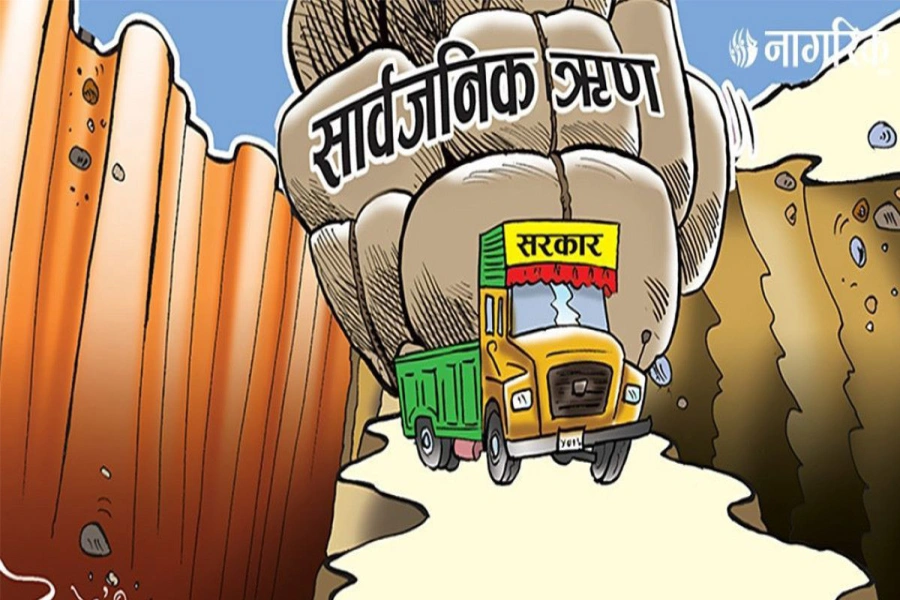
Sustained high growth demands large-scale domestic and foreign investment, along with higher productivity and expanded exports. Nepal’s past performance suggests that policy promises alone will not cut it. The economy still leans heavily on foreign employment and remittances. Without structural reforms, even if the economy grows in size, its sustainability will remain questionable.
Economists argue that the goal is not impossible, just painfully difficult. Professor Dr. Shiva Raj Adhikari from Tribhuvan University says the target can be achieved, but only with serious effort. Strong governance across sectors and timely completion of major projects will be essential. He also stresses the need to strengthen both government and private sector capacity.
Experts highlight key areas that need attention: industrialization, export promotion, agricultural modernization, tourism expansion, energy production, information technology development, and attracting foreign investment. Former National Planning Commission Vice Chair Dr. Prakash Kumar Shrestha points out that writing ambitious goals is easy, but execution is what matters. Increasing both domestic and foreign investment and working with urgency will be critical.
The government claims it will create an investment-friendly environment through administrative reforms, anti-corruption measures, and policy stability. It plans to prioritize large industries and push structural reforms in production sectors to boost exports and reduce imports. Still, Nepal faces limits in energy, infrastructure, skilled labor, and market access, all of which complicate industrial growth.
Agriculture, despite employing a large share of the population, suffers from low productivity. Yet, it holds room for improvement. Tourism remains another pillar with strong potential, though infrastructure gaps, service quality, and weak international promotion continue to hold it back.
Energy, especially hydropower, offers a major opportunity. With abundant water resources, energy exports could significantly contribute to the economy. But delays in projects, lack of investment, and limited regional market access remain obstacles.
The digital economy, outsourcing, and startups are also part of the plan to create jobs and earn foreign currency. With IT service exports already growing, this sector shows promise.
Finance Minister Wagle has pledged to improve the investment climate, simplify and make the tax system transparent, control public spending leakages, and promote a production-based economy. Some reforms have already begun, at least on paper. The government insists that policy improvements and reduced bureaucratic hurdles will accelerate economic activity.





