“Jibuwa (Rudra Shumsher J B Rana, maternal grandfather) was a man of mettle and a gentle and just human being. … His father (Bir Shumsher J B Rana) had served as a prime minister. In no time, he joined the people’s war and became an integral focal point. He organized an efficient army while in exile and was fully supported by local people as well as his loyal comrades. In an effort to bring democracy to this century-long rule (Rana dynasty 1846–1951), he, as bada hakim of Palpa, was responsible for organizing and preparing the western region of Nepal during the revolution of 2007 BS.” — Chapter: Childhood in Exile.
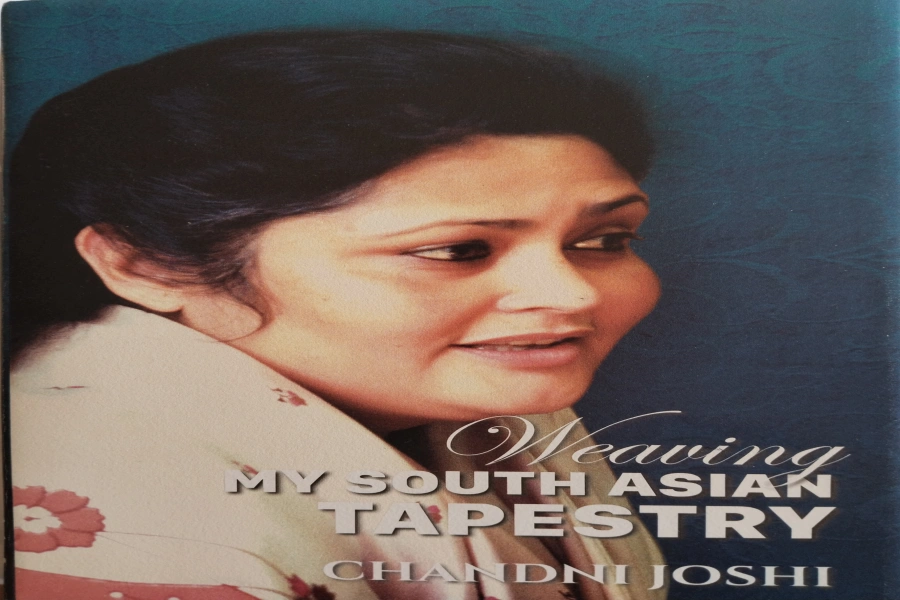
Chandni Joshi’s memoir, Weaving My South Asian Tapestry, transcends a typical life story. It is her fascinating work, greatly inspired by her maternal grandfather, the exile Rudra Shumsher Janga Bahadur Rana, who was barred from becoming prime minister. His influence on her life was significant, shaping her into a woman of substance devoted to a meaningful purpose. His daughter, Chhetra Rajeshwari Devi Chand—an unsung freedom fighter—was a proud mother. She was instrumental in teaching her to live with determination, compassion and human dignity. The book also discloses embedded historical facts on the Rana dynasty, palace ethics, hardships during house arrest and their impact on a child’s mind.
Following the exile, as bada hakim of Palpa, Rudra Shumsher’s properties in Kathmandu were confiscated, including Charbhuja Durbar (Bahadur Bhawan)—now the Election Commission—SAARC Secretariat and the area up to Rani Pokhari. After the successful 2007 revolution, he was awarded the title ‘First Field Marshal of Nepal’, a lifelong honorary position for his contribution to bringing democracy to Nepal. Being close to King Tribhuvan, he could have asked for his properties back but chose not to. Though it was unfair to leave him and his family homeless, he did not complain. Chandni says he was a mahatma, a living sage, who inspired her to navigate turmoil with grace and dignity. He was genuine, wise, tolerant, forgiving and generous, and served Mother Nepal in the best way he could.
Philanthropist and BlinkNow Co-Founder Maggie Doyne’s memoir se...

Chandni, known as the one “keeping the Beijing torch alive”, has widely shared her success stories on women’s rights, the fight against gender discrimination and her ground-level experiences in her 422-page memoir. Enriched with passion and dedication as a women’s rights activist and office holder, her contribution has influenced and inspired millions of lives at all levels. Undoubtedly, the book should be useful for researchers, women’s rights advocates, bureaucrats, diplomats and leadership career builders. It provides guidance on balancing personal relationships with professional obligations without compromising one’s dignity. It is also a collection of stories of commitment, courage, wisdom and hope. She expresses great respect for individuals and institutions that supported her in her professional and social work and during her difficult times.
Chandni’s most painful experience was the loss of her caring husband, Mohan Raj Joshi, and loving daughter, Prerana (Moni—derived from Mohan’s “Mo” and Chandni’s “ni”), in the Thai Airways crash near Kathmandu on 31 July 1992. Yet with boldness and conviction, she rose from this abrupt tragedy, transforming her pain into a source of strength to uplift women—especially those affected by gender-based violence, trafficking and exploitative conditions faced by home-based workers. She still feels the silent support of both her deceased loved ones, symbolized by the twenty-five extraordinary night-blooming cereuses (Brahmakumari flowers) on their twenty-fifth death anniversary, planted by Mohan thirty years earlier. Her daughter Sristi and son Pranaya are now her backbones. They also composed a beautiful poem for her on the final page of the book.
A touching moment in the memoir is her meeting with Dr Samira, a medical student at Faisalabad Medical College, who resembled Moni. They met at Karachi airport while Chandni was in transit, a few months after the fatal crash. Unknowingly, Chandni stared at her, and Dr Samira approached her with a box of chocolates, saying, “Sorry, I didn’t mean to stare at you, but you really resemble someone I know.” Just before the flight, she hurried back and unexpectedly asked, “Who is this person who resembles me?” Chandni replied, “My daughter.” When she asked where her daughter was, Chandni said, “I just lost her.” Since then, Chandni’s family has remained connected with Samira, who considers Chandni her only parent, having lost both her biological parents.
Remarkably, her career turning point was her shift from teaching to government service. She fought her battle on her own, proving herself a sincere, dedicated and capable officer at the Training Material Production Centre (TMPC) and Women in Development (WID), although her father Jung Bahadur Chand was a secretary. Initially, she hesitated to lead a women’s development office, believing she lacked expertise. However, inspired by her senior, Shyam Prasad Adhikary, she accepted the challenge. He told her she had a “Midas touch”. Since then, she has been unstoppable.
Her steadfast advocacy and policy interventions successfully mainstreamed gender and women’s rights issues vertically and horizontally, yielding significant results. She initiated the Production Credit for Rural Women (PCRW) and institutionalized Women Development Officers (WDOs), leading to self-reliance, empowerment and sustainability for the triple-disadvantaged rural women deprived of basic services and facing discrimination due to caste, class, gender, religion, ethnicity and culture, supported by more than a dozen international agencies.
Her first experience with an international agency was with Plan International. Unlike in government jobs, she also learned typing and driving. This proved advantageous in her UN work, where she implemented projects focused on women’s empowerment and gender equity across South Asia and beyond. In her roles with the Women Development Division and as Regional Director of UNIFEM, she used her expertise on violence against women (VAW) and the plight of female victims and disaster survivors to influence world leaders. Among them were Kofi Annan, Boutros Boutros-Ghali, Barber Conable (World Bank president), Bill Clinton, Abdul Kalam, Atal Bihari Vajpayee, Rajiv Gandhi, Dr Manmohan Singh, Pervez Musharraf, Benazir Bhutto, Mahinda Rajapaksa, Hamid Karzai and Abdul Gayoom.
Despite severe risks, Chandni maintained her integrity. Although soft-spoken and humble, she remained uncompromising in her principles. In 1983, as National President of Nepal Jaycees, she was granted an audience with Her Majesty Queen Aishwarya at the Royal Palace, accompanied by her board members (I was one of them). The Queen, also chair of the Social Service National Coordination Council (SSNCC) and extremely powerful in Panchayat politics, tried to persuade Nepal Jaycees—an international organization dedicated to democratic leadership development—to join the SSNCC, despite strong resistance among members. With full decorum and respectful language, Chandni firmly explained why Jaycee members were unwilling to join. At that moment, although she was struggling in her government job, she risked her career and life without compromising the principles of the institution she served voluntarily. Now, she is retired but not yet tired.


-1200x560-1774606010.webp)
-1200x560-1783685616.webp)