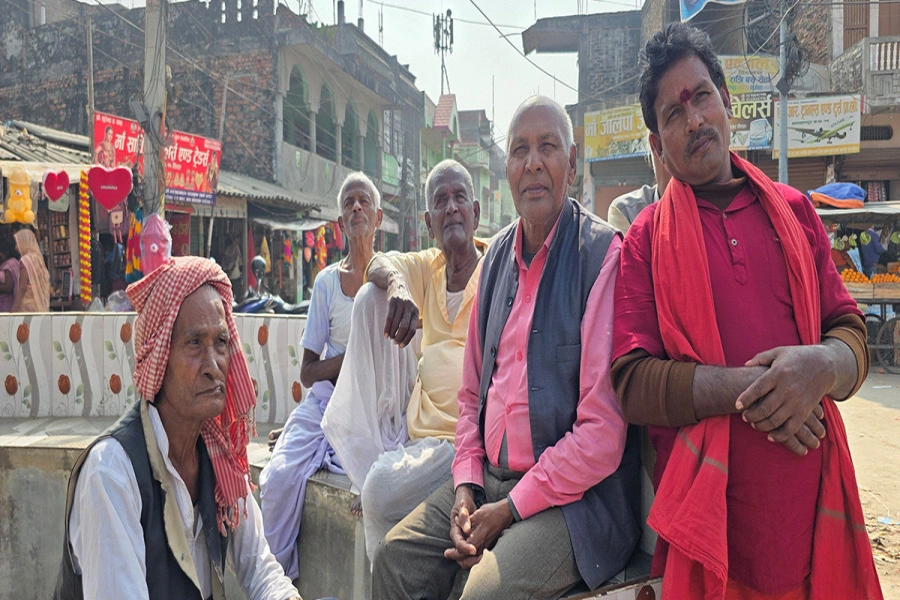
The presence of former labor minister Sarita Giri and former ambassador Suryanath Mishra made the program lively. Wherever two politically inclined individuals share a dais, they can’t resist the urge to run down each other. Their subsequent discomfiture creates merriment in the audience.[break]
The interaction last week also became a venue for returnees from West Asia to air their grievances and a forum for grassroots politicians to hit back at the gross ineptitude and crass corruption of government officials entrusted with the task of facilitating labor export.
Acrimonious tone of comments didn’t dampen the spirit of the Joint Secretary from Kathmandu who fielded questions with a degree of equanimity that only bureaucrats are capable of showing when faced with uncomfortable questions.
During lunch, a few participants were heard requesting activists and journalists for copies of photographs of the program. Answers appeared almost nonchalant and uniform: Photos would be posted on Facebook.
Janakpur isn’t too well known for being technologically savvy. However, social networks have apparently caught the fancy of upwardly mobile youngsters even in the mofussil.
Unbeknownst to Gutenberg addicts, the media in Nepal has made it to the Planet Cyberia without much fanfare. A study made public recently claims that 97% of journalists frequent Facebook while 40% utilize Twitter and 99% access Google search engine.
Gmail is the most popular email with around 93% users; followed by 44.3% for Yahoo; and 30.2% still sticking to Hotmail. Admittedly, these findings are based on merely 192 respondents—out of over 8,000 members affiliated with the Federation of Nepalese Journalists—but they do indicate that for a certain category of scribes, trawling the Net has become an indispensable part of their professional life. Reliability of the source, however, remains questionable: Only 30.7% of respondents considered contents of social networks trustworthy.
Intrigued by the report, the urge to explore what was being talked about at town squares of Cyberia became impossible to resist. In the lingo of finicky Facebook users—discerning Faboos—unwarranted visitors are ‘stalkers.’ But a surprisingly large number of accountholders encourage occasional visitors to scrutinize their posts.
The Twitter is even more open. To be sure, there are a few accounts that display ‘protected’ sign but they belong to marginal players of the mainstream media. Twitteratis seem happy to share their 140-character insightful wisdom with whoever would care to look for them on the Web.
Digging contents delivered into mailbox through umpteen number of listserve that go straight into junk folder proved more excruciating. Unlike pithy pronouncements of Twitterati or random remarks of Faboos, self-important mailers using listserve appear to think that the truth has been revealed to them and it must be expressed in full detail.
Some of it may have to do with age. For some reason, relics of Gutenberg era seem to prefer group mails—shooting at bunches of bananas has greater chance of hitting a target—over posting on social networks, which is akin to firing into a forest with the hope that it will hit a fruit-bearing tree; shake it and a coconut will fall over the head of a bystander.
Journalists tend to think at the speed of their typing. That could be the reason why quite a few of them are on Twitter, have a Facebook account, manage to post on their blogs and participate actively in listserve discussions.
Meanwhile, they must be doing something to earn their keep at whichever media organizations they work. At least, links of their professional work is invariably shared in the Cyberia.
Activists—a synonym for employees in the NGO sector in Nepal—are probably the largest group on social network sites. What they want to be monitored by their patron INGOs or donor agencies, they post in English while frustrations are poured out in Nepali. Consultants are also fairly active, but their accounts are often accessible only to their target audience.
Frivolous contents
The educated section of the “leisure class”—a phrase that Thorstein Veblen coined way back in 1899 to describe and propose a theory of conspicuous consumption—loves to discuss political, social, and cultural issues.
Sometimes, they assume idealistic tones and lofty position on common concerns because they are seldom the ones required to walk the talk. More often, they are dismissive of whatever is happening around them.
The phrase “chattering class” captures the spirit of this perky public in its full splendor. The twitterati is more voluble and less committed. In every other way, the twittering class is the cyber version of the chattering class, and terms like “chatterati” and twitterati can be used interchangeably.
Between the chatterati and the twitterati, however, technology makes a crucial difference. The chatterati usually articulates its views with the kind of image it would create in the public mind.
The attitude of the twitterati can be summed up in an untranslatable Nepali expression that appears again and again (They should qualify it with a hash tag for the convenience of stalkers!) in different posts—Baal Matlab. Roughly, it means, “Who cares” not as a question but a statement. Indeed, who cares?
Faboos don’t face the character constraint of twitterati, but even they seem to have a pronounced preference for directness and a distinct aversion for abstraction.
In addition to inane outpourings over issues that many seem to know little about, several posts—among the ones examined at least—appear like giant echo chambers made up of glass where Faboos shout “Look, how beautiful I am” oblivious to claps or jeers of spectators.
Blog posts are made by people who think they know more about certain issues than most others, and the world must take note of their wisdom. Unfortunately, most of their sermons fall like autumn rain on a tropical forest.
Even literary blogs are no exception unless a blogger is discussing others’ works, which not many do. There are certain “experts” too who blog, but even their posts are full of inanities.
The most frustrating reads are mails received through listserve. Dominated by alienated Nepali Origin Professionals (NOPS), these group emails stink of hatred for their countrymen who fail to recognize their genius.
A surprisingly large number of parents of NOPS left languishing in their homeland seem to have imbibed the values of their overseas progenies (Or, the transfer of beliefs could have been the other way round) and have no good thing to say about anything other than “Mount Everest is in Nepal” and the “Buddha was born in Nepal.”
Democracy for them is anything that excludes Maoists, Madheshis and Janjati activists. A particularly vocal votary of controlled democracy was proposing a government made up of “people like yourself and myself and the good people among whom we move” to extricate the country out of current political quagmire. And no, that’s not a rephrased sentence; it’s an exact quote from a group mail sent to the kind of “public” that thinks only it knows what is best for the rest of “them” peoples and plebeians.
Marginal players
The only good thing about cyber activism is that its impact upon politics is yet uncertain. Handbills precipitated the overthrow of the Ranas and the restoration of the Shahs. Handheld microphones were instrumental in the landslide victory of the Nepali Congress in the 1950s.
Safe communication through US-installed telegraph stations in far-flung districts helped Mahendra coordinate his police and military campaigns against NC rebellion throughout the sixties.
Were it not for the expansion in telephone network—connections were routinely denied to NC supporters—the hoodlums of Panchayat would have found it impossible to rig the Referendum and consolidate themselves through Pancha rallies.
Most people have forgotten it now, but photocopies were extensively used to circulate the message of the People’s Movement. Fax machines of sympathizers helped agitators send their version of unfolding events abroad. However, what made protests widespread were the cassettes of stirring speeches made at Chaksibari.
When cassette players at barbershops started playing Chandrashekhar’s lectures, there was no way the regime could extend itself without co-opting its critics.
Word of mouth was extensively used in the spread of the Spring Uprising but who knows what role satellite phones of the Maoists played at that historic moment?
Without VCDs of the Nepalgunj atrocities, the Madhesh Uprising would have failed to take off; and had it not been for FM stations in the Tarai, the blast of mainstream media would have easily blown away the flight of Madheshi aspirations.
Faboos may take some credit for the death of the Constituent Assembly, but it was the aggressive campaigning of mainstream media, particularly of a certain media house that enjoys broad-spectrum dominance, which actually killed the sovereign institution of the republic.
Users of social media, however, did achieve a remarkable success in May 2010 when their network succeeded in mobilizing a huge mass of White Shirts at Basantpur to save the retrograde regime of Madhav Nepal from intensifying Maoist onslaught.
Pushpa Kamal Dahal got the message when reports about the presence of Black Boots below White Shirts reached him and he lost no time in recalling the mass agitation.
Apparently, the Basantpur show of strength was a fluke, even if not a conspiracy, because all subsequent Faboo rallies—of May 2011 and May 2012, for examples—have failed to replicate its success.
The impact of twitter revolution in Egypt too has been grossly exaggerated. It was probably the exasperation of the military brass with the whims of ageing Hosni Mubarak, impatience of the international community (Read United States of America) with an increasingly ineffective dictator in controlling the spread of Islamism, and the rising discontent of the masses against a government that did little other than perpetuate itself, which brought down one of the most stable regimes of the Arab world.
Subsequent elections showed the marginality of cyber activists when their coalition called Continuing Revolution finished last at first-stage polls with less than 400,000 votes.
With better organization, Islamist parties together polled 5.8 million votes to secularists’ 2.3 million. Even moderate Islamists—contradiction of terms notwithstanding—performed better than the warriors of Cyberia.
It may be a small consolation, but there is little need to be alarmed with the rants against Maoists, Madheshis and Janjatis that resonate in the echo chambers of Cyberia.
Probably, they are not town squares, after all. In any case, it is a combination of political agenda, organization, commitment of cadres and quality of leadership that ultimately succeeds in changing the course of history. Meanwhile, verbal acrobatics and showmanship in salons, whether of the real world or Cyberia, are amusing diversions.
Lal contributes to The Week with his biweekly column Reflections. He is one of the widely read political analysts in Nepal.
Related story
Bhaktapur attracts most tourists among Ktm Valley’s Durbar Squa...