“Compared to last year, we anticipate the production of paddy and maize to fall by 14.2 percent and 10 percent respectively this year,” said Prabhakar Pathak, spokesperson for the Ministry of Agriculture Development (MoAD), disclosing the finding of preliminary projection report on food output for 2012/13. [break]
The report, which is still to be made public, suggests that the total paddy output is expected to drop by 720,000 tons this year compared to 5.07 million tons -- all time high production -- recorded last year.
Likewise, maize production is anticipated to drop by around 164,000 tons due to insufficient rainfall during the farming season.
“This loss in production of paddy by 720,000 tons (or 432,000 tons of milled rice) and maize by 164,000 tons (131,000 tons in edible state) will eventually lead to a loss of 563,000 tons of net edible foods this year,” Pathak told Republica.
- Impact of shortage of fertilizers, drought
- Paddy production to drop by 14.2 percent, maize by 10 percent
- Food demand to reach 5.3 million tons
- Key producer districts reported less than 65 percent plantation
- Production area decline 140,000 hectares
Officials attributed the drop to severe shortage of chemical fertilizers during plantation season and long spell of drought along with insufficient irrigation facility.
Paddy and maize are the key cereals of Nepal. But some 46 percent of total agriculture land is rain-fed. And productions were hit because the country recorded average rainfall of just 61 and 87 millimeter in June and July this year, whereas it was 110 and 96 millimeter respectively last year.
Owing to drought and fertilizer scarcity, the total paddy plantation areas itself shrank, said Pathak.
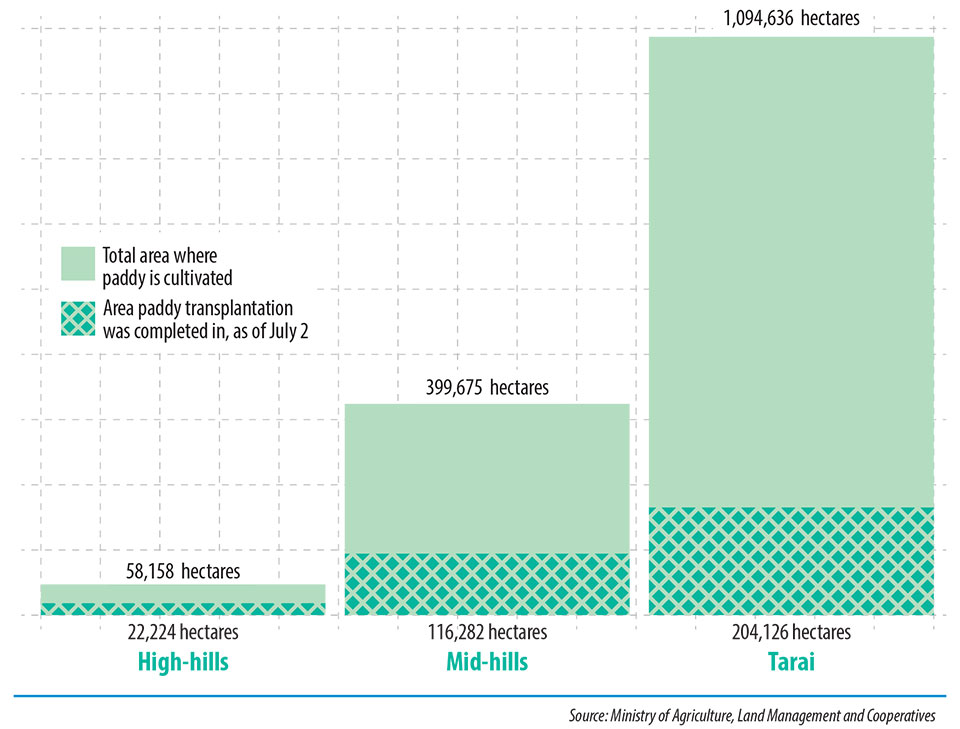
According to the report, farmers planted paddy in just about 1.38 million hectares, which is a decline by 140,000 hectares compared to a total area in which paddy was planted last year. “Plantation was done in just about 91 percent of the paddy land this year,” it reads.
The paddy plantation area declined mainly as Dhanusha and Siraha -- key paddy producing districts -- reported plantation in just 49 percent and 50 percent of paddy land. Similarly, plantations in Mahottari and Saptari were done in just 60 percent and 65 percent of paddy land respectively.
Last year, the four districts reported almost cent percent plantation. As a result, total production of major cereals -- paddy, maize, wheat, millet and buckwheat combined -- increased by 9.8 percent to 9.45 million tons, enabling the country to enjoy a food surplus of around 886,000 tons in 2011/12.
Contrary to drop in output, the report says demand for cereals could rise by 100,000 tons to 5.3 million tons this year.
“We will not face food scarcity if the winter crops remain normal. But in the context of climate change we can´t rule that out. Even if situation is normal in winter season, at least 27 districts will face food deficit this year,” Pathak added.
Related story
Rains inflict 30 percent loss to paddy crops output in Chitwan