But in recent times, Nepalis are also seen wanting to romance the mountains. More and more young people are interested to experience Nepal’s unchallenged beauty that unfolds beyond the hustle and bustle of urban cities and semi-urban boredom. [break]

Wandering over the hills and far away, one stumbles upon surprises at each turn. From a bird’s-eye view of the landscape to spiritual encounters with the people who keep alive the hill culture, a walk in the mountains makes one ponder and with each step, the heart grows fonder.

Arpan Shrestha/MyRepublica.com
Walking in the secluded geographic frontiers stirs the soul as trails unfold a wide range of terrains, from the subtropical jungle to windswept desert in relatively easy ascents. Along the trail, relaxation comes in plenty as well run teahouses and lodges take your orders and provide warm shelter.
And as the evening sinks in, few of the world’s highest bars bring the sky a little closer and one clinks glasses, first to the Gods and then to the people who have brewed it right. Beneath the foothills of the Himalaya then, conversations begin, “Look at the stars, they are twinkling.”

Arpan Shrestha/MyRepublica.com
One such place in the foothills of the Himalaya, which hardly finds any mention in travel guides and is often lost in travelogues as just a springboard for major trekking destinations, is Chisapani. A great destination itself, it offers spectacular mountain views and both the sunrise and moonrise. Here’s myrepublica.com’s rough guide:
what to bring
Boiled sausages and eggs, chana paratha, aaluu sandheko wrapped in silver foil as our breakfast along with oranges, energy bars, refreshing chewing gum, two water bottles, a thermos, ID cards, little cash, warm clothes, cameras and basic toiletries packed in our backpacks, we boarded the local bus to Sundarijal from Chabahil sporting shades and shoes comfortable to walk with.
[Bus Fare: Rs. 15 per head]
the sundarijal road
Catching the early morning bus so that the ride is less crowded and our trek point reached earlier. This way, the first uphill can be easily heeled before noon.
From Chabahil, the 60s Mercedes minibus straddles the old route to Tibet, now paved but full of potholes en route Boudha and then to Jorpati where it makes a relaxed pit stop to get as many passengers without any traffic personnel in sight.
Here onwards, city residents get to experience a bus ride the Nepali way. There are people on the roof too as the road rumbles towards the extreme north-eastern corner of Kathmandu.
As Guru ji (bus driver) adjusts the rear view mirror and puts on a folk tape to play, the bus gradually darts away from the honks and dunks of the city. The khalasi (ticket boy) then with his torso arched a little outside the bus shouts out, “Sundarijal Express.”
The air is fresh and it feels like driving through a corridor that runs deep through hills and mountains as sounds and sights get clearer. Four km up the road, we quickly pass Nepal Medical College and the ancient pilgrimage site of Gokarneswar, dedicated to Lord Shiva and all along a sprawl of carpet industry and hulky iron pipe that supplies much of Kathmandu’s drinking water from the sacred Bagmati River.
Further beneath the foothills of Shivapuri hill are quiet fields and the small Newari village of Gokarna as wheels unfold a nice country ride. The historical B.P. Koirala museum where the Panchyat regime once imprisoned political leaders in the military camp is also on the way.
sundarijal
Five km past Gokarneswar, we cross the military area and soon reach Bagh Bazaar, where a small conglomeration of petty businesses have vacated their shops and have instead swarmed the nearby parking lot where an infant is amusing all by walking on giant sticks. It is the same kid who has been performing his dare devil stunts all over the capital and here he is doing his thing with the sticks.
We quickly jump off the bus and do our last minute shopping as on the trail, we knew we would not find any teahouses. We then fix the backpack’s hip belts and head on for a walk to remember, uphill towards Sundarijal.
A popular destination for picnic goers and day trippers, Sundarijal, 15km from Kathmandu with its steep uphill alongside the cascading Bagmati makes a good weekend hike and for trailblazers, a unique trailhead to the Helambu, Langtang and Gosaikunda region.
mulkharka gaon
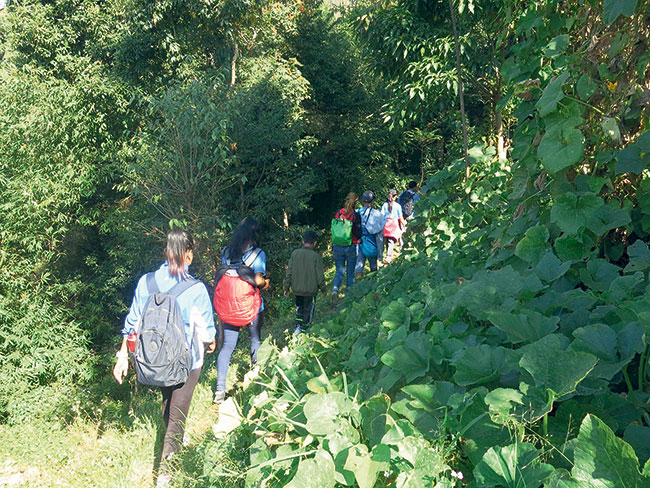
Walking at our own pace, we stop whenever and wherever we feel like. Of course we were taking it easy but catching up with old friends over a course of time takes a new high in the teeming nature.
Forty-five minutes later, we enter the Shivapuri National Park where an official registers visitor’s name and issues an entrance ticket that needs to be tucked safely throughout the trip.
[Park Entrance: Rs. 10 per head for Nepalis]

Arpan Shrestha/MyRepublica.com
Related story
Banking offense case filed against Chisapani Hills View Resort...

Here onwards, the trail slithers away to the protected watershed and up towards a Tamang dominated Mulkharka Gaon. In between are plenty of breakfast and sun bathing points and we couldn’t wait any longer to relish the homemade delicacies. Remember that all along the trail, no teahouses exist so carrying some food and drink is recommended.
the moonrise walk
Energized and not littering our breakfast point, we set off on the long winding road. Again, taking it easy, we walk at our own pace and stop whenever and wherever we feel like. The nature’s drama of dramatic uphill and downhill, sun and shade continue to take us deeper to its abyss as sights and sounds get clearer and louder.

Arpan Shrestha/MyRepublica.com
As vistas open up, the sweat and walking alternates with the sweet taste of oranges and water. Philosophy is in the air as the nerves fine tunes from the charging beneath the soul. Each step, still a giant leap for mankind here in the Himalaya. Soon, Kathmandu drifts away from sight and as the sun falls west, blue hills and orange skies appear above a tranquil lake that appears out of nowhere.

Arpan Shrestha/MyRepublica.com
[Plan a little sunbathing by the lake while returning. Excellent views of Himalaya are in store and an early morning stroll from Chisapani for a sunrise could bring out all of your soul]
The mountains then extend their arms and welcome us to where we rightfully belong. Eyes are on a feast, while we go easy with our cameras. Memories, the exposures sure bring but what is to the eye can never be found in a picture. The way-panoramic view of the north-eastern Himalayan range then follows you on your right while the skies are hues of orange, violet, blue and grey in the west. Faraway, in the north-west, a peak plays hide and seek.

Arpan Shrestha/MyRepublica.com
We alternate. Walking and briskly stopping for the mind-expanding views all around. We want more but we hurry as the first star appears in the sky. Heartbeats pulsate as the pace increases and the breeze develops into a mild blow. An hour and a half to reach Chisapani, what unfolds then is beyond words. A small piece of white peeps out from a nearby hill and grabs our attention.

Arpan Shrestha/MyRepublica.com
It is the moonrise and a full one. For the first time in our life, we witness it right before our eyes. A whole big moon, it brings smiles to our hearts and our pace is in indulgence again but after a short hiatus, we move on. Distant singing then rings our ears as a turning reveals a small village on a nearby ridge. The lights are on and a small fire is lit and children are singing.
chisapani
As the singing gets louder, we hurry towards the bonfire. Locals spread the chair for us and we order tea and biscuits. Warmed up and eased out on the chairs, we fix our accommodation and order tongbas for a kick and a regular Nepali set meal for dinner.
The hosts are kind and friendly and so are the children who are with us by the fireside. One of them tunes up the madal and drums a little beat on our request and on inquiring, Milan, a young kid and the son of a neighboring guest house says, “The Mountains will greet us in the morning. You’ll see the Ganesh Himal, Annapurna and even Everest if the weather is clear.”

Arpan Shrestha/MyRepublica.com
The night seems young though the clock is working beyond 10 and as we call it the day, the trek recollects in tranquillity. The sleep is warm and what more you could ask for on a night like this. In the morning, the sun is right outside the window as the morning sky emerges out of the dark abyss. Milan is right and another indulgence begins its roll as we sip warm cups of tea and bite on fresh doughnuts.
Then in a nearby shop, we stock up for the hike downhill and all this time, we have the lake in mind. We order Rara noodles for breakfast and pack off for the trip back home. The walk down is beautiful as we pick another trail to Mulkhara Gaon. The trail is shorter and interesting views are in store while a stream follows all the way down to the village.
Soon, the air smells Kathmandu as we descend down to Sundarijal from Mulkharaka and the mini-trek concludes. Has it?
accommodation
The cost of lodging is negligible. Bargain and a room with attached bath can be fetched for Rs. 200 but informing the hosts beforehand for the availability of hot water is recommended.
Solar panels give decent light and you can call back home with the CDMA and Spice cell service.
food & drink
There’s very little else to spend money on besides food and drink and the menu with the standard Nepali cuisine and a few international delicacies are reasonably priced.

Arpan Shrestha/MyRepublica.com
And for God’s sake, if you are in the mood to drink, please try tongba, which is possibly the only alcoholic beverage in the world that’s not drunk rather sipped in through a straw. A millet based drink, it’ll keep you warm and a good kick follows the exotic taste of this mountain drink.
word of advice
It is important to reenergize yourself from time to time and this is done best by drinking lots of water but remember, sip by sip. Higher up in the route, plenty of natural spring water flows by and it is relatively safe to refill the bottles but just to make your defence stronger, carry water purification tablets. Nothing beats iodine.
Minor injuries like knee strains are normal while walking downhill. Carry knee pads to support your weak knees and a mild balm to apply before hitting the sack. To prevent ankle sprains, put on your hiking shoes or better are the boots that enhances the grip too. Blisters are also normal so make sure you have your feet dry. Take extra socks and false skin are popular these days.
Don’t forget your torchlight. Our hosts were glad to offer us their solar tuki (tuki marra) but it is always wise to carry one’s own and bringing a sleeping bag is a nice idea. Keeps you warm just in case the guest house is running out of blankets.
The Shivapuri National Park has set aside numerous waste management sites at several points. Please make sure you manage all litter at such designated places only. And nature’s call has to be attended in nature. Be discreet not to offend anyone.
Don’t indulge in walking at your own pace and stopping whenever and wherever we feel like. We are not saying you would but you could.

Arpan Shrestha/MyRepublica.com
arpan@myrepublica.com