Every generation finds its own language of power. Some write it in manifestos, others in poetry, and now, in code. Last September, Nepal’s youth spoke in a new tongue. What began as a protest over corruption, social media ban, and broken promises swelled into a digital uprising that toppled a government in forty-eight hours. The Gen Z revolution of September 8 and 9 was not led by any party or a single figure. What the world mistook for chaos was, in truth, the first rehearsal of a future-networked democracy.
Every revolution once had a poster. Nepal’s own history had Prithvi Narayan Shah, the unifier who imagined the nation; B. P. Koirala, the democratic poet who dreamed of liberty from his cell; Madan Bhandari, whose ideology lit a generation; and Prachanda, who carried rebellion from jungle camps to the gates of power. These faces gave revolution a human shape. For those born in the twentieth century, power was visible. It stood on balconies, made speeches, and could be toppled when the crowd grew loud enough.
When the Pattern Broke
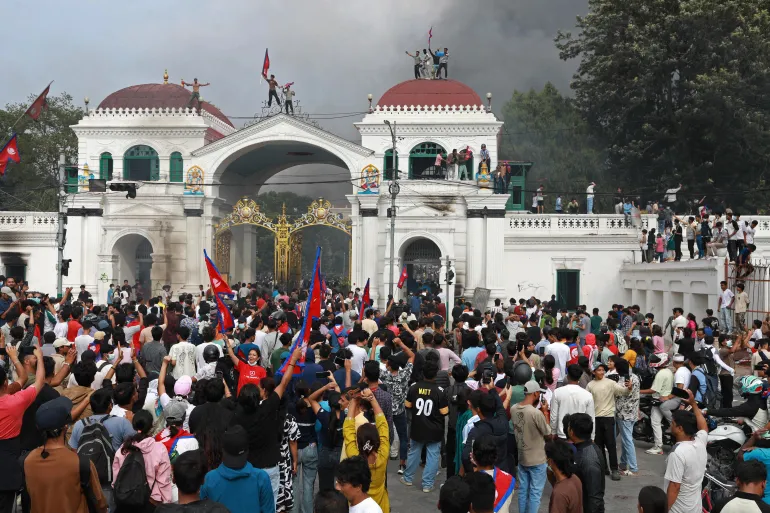
That pattern shattered on September 9, 2025. On that day, Nepal’s Gen Z turned their frustration into a synchronized uprising that no one could command or contain.
In less than twenty-four hours, Nepal’s government collapsed beneath a tide of anger and grief. Nineteen young protesters were shot dead; the toll has since risen past seventy. Parliament, the Supreme Court, and Singha Durbar burned through the night as sirens wailed and glass shattered. Kathmandu filled with smoke, disbelief, and the acrid scent of revolt.
And yet, amid the wreckage, one question echoed louder than any chant: Who is leading this?
The answer was no one, and EVERYONE.
Searching for a Center
For the old guard, the absence of a leader felt impossible. They searched for a familiar name, a villain, a mastermind. Convinced that power must have a face, they whispered again of “foreign hands.” They could not imagine that hundreds of thousands of young Nepalis, without hierarchy or political party, could act together by choice.
Kathmandu joins UNESCO Creative Cities Network for film

In truth, what they were witnessing was something new. The uprising found its shape in a Discord server called Youths Against Corruption. There, thousands argued, laughed, and drafted fragments of the future. There were no podiums or manifestos, only debate and persistence. After days of conversation, a consensus emerged: more than seven thousand users voted to nominate a former chief justice as interim prime minister.
For those who remember 1990 or 2006, it seemed unreal. Where were the committees, the marches, the men with megaphones? But the revolution had moved online, and it was learning to breathe through screens.
A Movement Without a Banner
The change spreading through the network had no flag, no slogan, no center. It moved like breath, invisible yet undeniable. What the old called chaos, the young saw as design. They grew up in worlds where strength lies not at the top but in the links between.
Coordination, for them, grows from participation, not command. Their discipline is rhythm, not fear. What looks like a disorder is quiet choreography.
The myth of foreign hands endures because the old order cannot grasp decentralization. It fears the shapeless. Yet this generation speaks not through one body but through thousands of connected minds. Power no longer descends; it circulates. The yearning for self-rule has moved from parliaments to glowing chat servers in the night.
What is unfolding in Nepal is not anarchy but evolution. A generation is learning to govern itself without masters, proving that connection itself can be a form of order.
Carne Ross, a British writer, and political thinker known for advocating decentralized and participatory forms of democracy argues that both representative democracy and capitalism have failed to address the growing crises of inequality, environmental collapse, and political disillusionment. He believes that waiting for politicians or institutions to reform themselves is futile and that ordinary people must take responsibility for creating change.
Ross envisions what he calls a “leaderless revolution,” where power grows from collaboration among individuals rather than authority imposed from above. In a deeply interconnected world, he argues, meaningful transformation must begin at the local level through collective action and mutual accountability. This requires a shift in how people understand democracy and themselves—not as passive voters or consumers but as active participants in shaping society. Through such everyday acts of cooperation and self-governance, Ross suggests that humanity can move toward a more authentic, inclusive, and humane political order.
The Language of Participation
Nepal’s youth are not dismantling authority because they despise the republic. They are doing it because it no longer fits their tempo. They live in real time, not ritual time. Their trust flows sideways through transparency, not upward through hierarchy. They do not wait for leaders to represent them; they represent themselves, line by line, in shared digital space.
Consensus is slow, messy, and fragile. Yet it is also profoundly human. The long arguments inside a Discord thread are not unlike the discussions our grandparents once held beneath a banyan tree. The tools have changed, but the instinct to decide together endures. The old guards are extremely worried because they cannot jail a single leader to collapse the movement. There is no head to cut off, no figure to silence. The crowd has learned to think, speak, and act as one without surrendering its individuality.
When people look at this moment, they do not see collapse; they see continuity. The same poetic current that once ran through Siddhicharan Shrestha’s revolutionary verses now flows through these digital assemblies. The same courage that drove B. P. Koirala to defy his jailors now animates voices demanding transparency. History does not vanish; it mutates. Every act of rebellion carries an echo of the last.
Technology, often accused of making us colder, has in this instance made politics more intimate. The new networks are not an escape from emotion but an expansion of it. They connect outrage to empathy, solitude to solidarity.
The old order feels uneasy because it still measures authority by altitude. It believes power must tower above. But the new order grows outward, not upward. It is built of signals and conversation, not decrees and signatures. The shift is not only technological; it is moral. Command is giving way to collaboration.
This is why Nepal’s upheaval matters beyond its borders. It is not just a local rebellion; it is a prototype for how governance might evolve in the networked century.
The Future of the Leaderless Revolution
The leaderless revolution in Nepal is not chaos but a rehearsal for a new political age. It is a movement where leadership is shared, decisions are collective, and accountability belongs to everyone. Its survival depends on maturity: clarity over charisma, trust without hierarchy, and unity amid disagreement.
If this spirit endures, Nepal could prove that consensus can govern as effectively as charisma once did. The revolutions of the past marched behind faces and flags. The revolutions of the future will move through networks and ideas, guided not by leaders but by purpose.
What we are witnessing today among Nepal’s Gen Z is the living embodiment of that shift. They have grown up online, fluent in transparency and allergic to empty authority. Their politics unfold in real time through live streams, group chats, and digital assemblies where no one commands but everyone contributes. The state finds itself powerless because it cannot jail a single leader to stop the movement. The crowd has learned to think and act as one without surrendering individuality. Their rebellion is not about overthrowing the republic but about updating it to match the rhythm of their lives.
The greatest irony of our time is that those shaped by the old world of centralized governance are still searching for a single leader, a hidden mastermind, someone to match their familiar script of power. They do not realize that there is nothing hidden at all. The old guards and their watchdogs are still trying to find the leader, the hidden hand, the foreign power they can blame.
The leader they seek is the digital network itself, transparent, collective, and alive, a force born in Nepal’s smart generation but destined to echo far beyond its borders. This network does not march under one banner or obey a single voice. It grows through trust, through shared purpose, through the courage to act together.
The next age of revolution may be quieter and more humane, a revolution built not on the rise of one but on the awakening of many. It will be written not in manifestos but in the living code of participation, a politics that breathes through connection rather than command.