Twenty-five centuries ago, a young prince walked away from his palace in what is now southern Nepal and disappeared into the forests of northern India. His name was Siddhartha Gautama. History remembers him as the Buddha, the Awakened One. Under a tree in Bodh Gaya, he discovered truths that would outlive empires: that compassion could be practiced, that detachment could liberate, and that freedom must be found within before it can be claimed without.
From that ancient awakening, an idea began its slow journey across continents. It reached Sri Lanka, flowed through China, touched Thailand, Myanmar, Cambodia, Vietnam, Korea, and Japan. It carried no armies and demanded no tribute. Nepal's first world-changing export was consciousness itself.
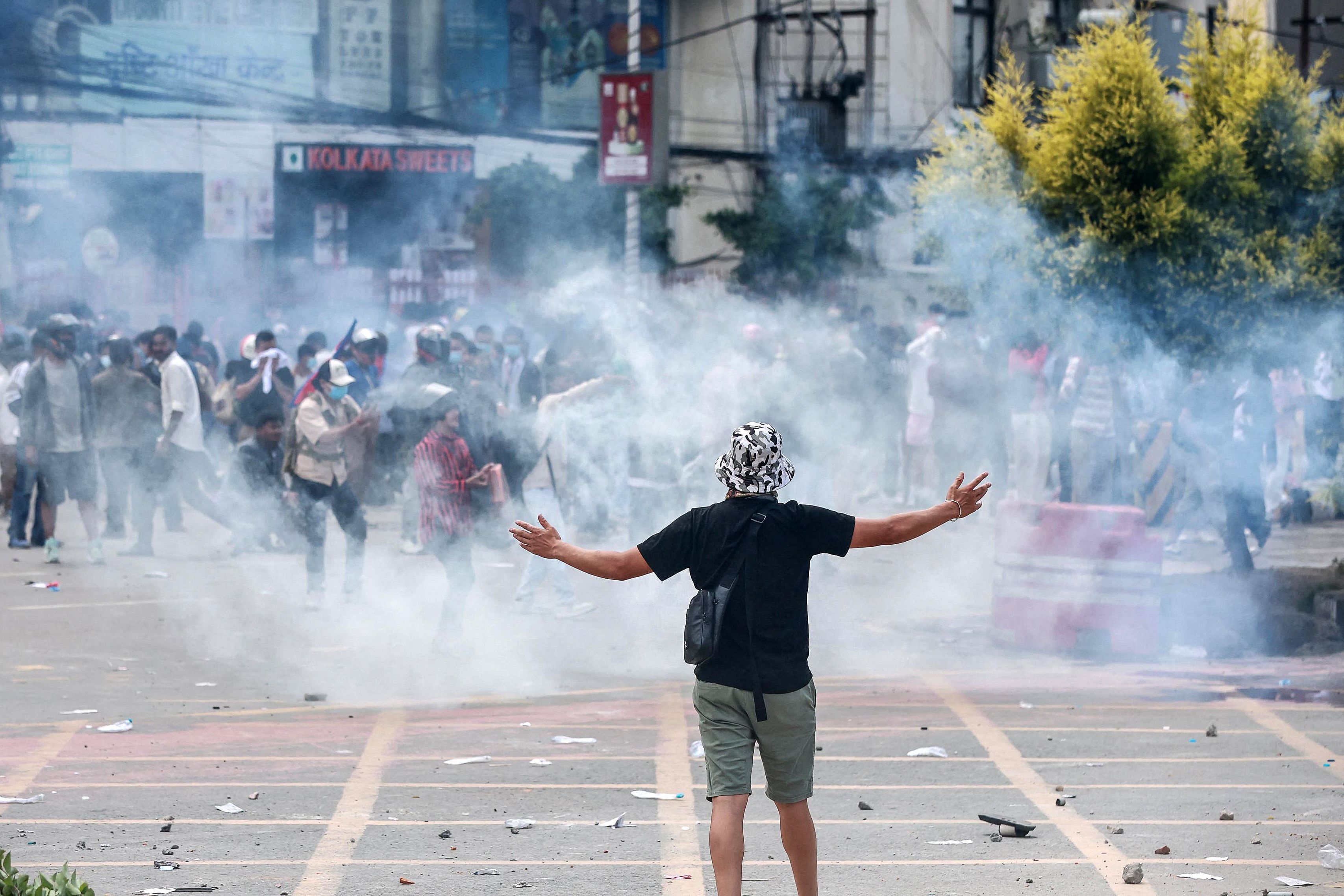
This autumn, the same soil witnessed another kind of awakening. But this one began not in silence beneath a bodhi tree but in the blue glow of smartphone screens and the acrid smoke of burning government buildings. When Nepal's aging leadership abruptly banned dozens of social media platforms in early September, ostensibly to "maintain order," they did not realize they were lighting a fuse that had been building pressure for years.
By Monday morning, thousands of students filled the roads surrounding parliament. By Tuesday afternoon, Prime Minister K.P. Sharma Oli had resigned. Twenty-four hours. That is how long it took for Gen Z to topple a government that had seemed immovable. Foreign observers called it a world record for political turnover. Nepal, often dismissed as a quiet corner of the Himalayas, had just sent a signal to the entire planet.
At least twenty-two protesters died in the chaos. Hundreds more were injured. Outside, teenagers in surgical masks painted "We Are Awake" on the blackened gates of Singha Durbar, the central government complex. Some formed human chains around military compounds to prevent looting. Others climbed onto rooftops waving the Nepali flag, singing the national anthem as ministries burned below.
When dawn came, Kathmandu looked like the aftermath of a storm. Charred vehicles and broken glass glinted in the weak morning light. Soldiers guarded every major intersection. The air smelled of wet smoke and collective disbelief. Yet beneath the debris, something irreversible had shifted.
For the first time in decades, young Nepalis felt their voices carried weight. What began as a protest against digital censorship ended as a mirror held up to the entire nation. In those twenty-four hours, they tested and toppled an order that had resisted change for generations. What they discovered was not only political power but moral clarity.
The Digital Sangha
The Buddha once gathered what he called a sangha, a community of seekers bound by shared purpose and mutual support. In September 2025, his descendants formed their own version of that ancient community, but theirs lived in the cloud. They met not in monasteries but in encrypted chat groups, coordinating not through sermons but through livestreams and shared location data.
Their organization was spontaneous, their discipline collective. They had no appointed leaders, no published manifestos. They moved as a single organism, guided by something closer to shared consciousness than traditional command structures. Each smartphone became a sensor. Each social media feed became a heartbeat. When riot police advanced on one group, warnings rippled instantly to others across the city. When hospitals ran low on supplies, donations appeared within hours.
Belgian theorist Michel Bauwens once wrote that "the next Buddha will be a collective." He imagined enlightenment not as the revelation of a solitary monk but as something that could arise through networks of distributed awareness, wisdom shared across many minds rather than bestowed from above. In Kathmandu last September, that idea found its first full expression.
Tree house and fishing in Yalambar

The protesters operated without hierarchy yet maintained extraordinary coordination. They reacted to injustice the way a body reacts to pain: instantly, collectively, as a single unified response. The Buddha of the twenty-first century is not a solitary figure in meditation but a generation learning to act in synchronization.
The Middle Path, Digitized
Yet even a collective Buddha must find balance. By the second night, as fires spread through government districts, the same passion that united the movement began threatening what it had created. Anger, however justified, was hardening into something more dangerous.
But then something remarkable happened. The same social networks that coordinated the protests began circulating a different kind of message. Influential voices within the movement called for restraint. Videos went viral showing young protesters forming protective rings around government employees leaving their offices, ensuring their safe passage. When looters tried to ransack the national museum, students blocked the entrance with their bodies.
This was the Middle Path that the Buddha taught 2,500 years ago: the discipline of compassion over fury. Their restraint became its own kind of awakening, quiet proof that the hardest lesson for any revolution, ancient or digital, is not how to rise together but how to remain whole once you have.
By Wednesday evening, the immediate crisis had passed. The government had collapsed. The streets, while still tense, grew quieter. But the questions remained: What comes next? How does a leaderless movement become functional governance? How does collective awakening translate into sustainable change?
Nepal's Second Export
Within days, the world began paying attention. Protests inspired by Nepal's Gen Z erupted in Madagascar, the Philippines, and Georgia. A Nepali flag appeared at demonstrations in Tbilisi, where student activists explicitly cited "the Nepalese scenario" as proof that decentralized digital resistance could succeed. In Paris, Seoul, and even Ladakh in northern India, solidarity marches echoed the chants that had filled Kathmandu's squares.
The ancient routes of cultural exchange, once traveled by Buddhist monks and Silk Road merchants, found their modern form in fiber optic cables and viral TikTok videos. The same spirit that once carried Buddhism across Asia was now carrying the idea of collective awakening into the connected world.
Nepal was teaching again. But this time, the lesson was not about religion. It was about realization.
Where the Buddha offered Four Noble Truths, this generation lives by four unspoken principles that seem to guide their movement:
One: Suffering exists, but it need not be endured alone. Connection transforms isolation into strength.
Two: True leadership is service, not status. The moment someone claims authority, they have already failed.
Three: Freedom is not a destination but a practice. It must be renewed daily, defended constantly, reimagined continuously.
Four: Awareness without action is merely observation. Compassion demands response.
These principles moved across borders faster than any ancient doctrine ever could. What once traveled by foot and handwritten scroll now moves at the speed of the internet. Yet the moral pattern remains unchanged.
The Uncertain Road Ahead
The aftermath remains uncertain. Kathmandu is still in mourning. Government ministries sit in ruins. The political vacuum is vast and dangerous. Elections loom. Old power brokers circle, waiting for opportunity. The euphoria of victory is giving way to the hard work of reconstruction.
Critics call the uprising chaotic and naive. They worry about mob rule, about the wisdom of crowds, about whether a generation that grew up on Instagram is mature enough to govern. These concerns are not entirely unfounded. Revolutionary energy rarely translates cleanly into stable governance.
Yet every civilization begins with questions that seem naive at first. What is suffering? Who decides? What are we willing to risk to be free? The difference now is that these questions are being asked not in remote monasteries but in public squares, on livestreams watched across continents. The search for truth has gone public.
The first Buddha sought compassion through detachment, withdrawing from the world to understand it better. Gen Z seeks compassion through connection, believing that isolation is the enemy of understanding. A teenager in Pokhara lights a candle for the fallen protesters. A student in Paris shares the image. An activist in Tbilisi adds a caption. Each act seems small, but together they form what looks like a neural network of empathy.
The sangha has gone digital. Yet its aim remains timeless: to turn awareness into action, to transform personal awakening into collective liberation.
Two Awakenings, One Truth
In Lumbini, pilgrims still circle the ancient stone pillar that marks the Buddha's birthplace. Monks still chant beneath prayer flags faded by the same Himalayan sun. Two hundred miles north in Kathmandu, fresh graffiti glows on blackened walls: "We Are Awake."
The words bridge two eras, two methods, one essential truth. The first awakening freed individuals from the illusion of permanence. The second is freeing collectives from the illusion of powerlessness. The first unfolded in silence beneath a tree. The second unfolds in noise and smoke beneath a cloud of data. Both begin with the simple, revolutionary act of seeing clearly.
Michel Bauwens was not speaking metaphorically when he predicted the next Buddha would be collective. He meant that the next stage of human consciousness would arise from shared awareness itself, from many minds seeing as one, connected and amplified by technology that makes empathy scalable. A collective, in this sense, is not merely a crowd but a field of consciousness that forms between people, a space where wisdom becomes possible without requiring a single enlightened teacher.
Nepal was once the cradle of one kind of enlightenment. This autumn, it became the birthplace of another. The story that began in Lumbini twenty-five centuries ago did not end in scripture or temples. It is being rewritten on the screens and streets of Kathmandu, frame by frame, post by post.
The world may call it a protest. Nepalis know it as something older and deeper. The Buddha's teaching was always about collective liberation disguised as individual practice. You cannot free yourself while others remain in chains. You cannot awaken alone while the world sleeps.
This time, the awakening did not take centuries to spread beyond its birthplace. Within twenty-four hours, the collective spirit that toppled a government in Kathmandu echoed in cities from Antananarivo to Manila, from Tbilisi to the boulevards of Paris. What began as outrage became a signal of possibility, proof that awareness can move faster than fear, that connection can defeat isolation, that the next Buddha might not be waiting to be born.
It might already be here, distributed across millions of screens, speaking in a thousand languages, learning to see with ten million eyes.
And it is, finally, awake.