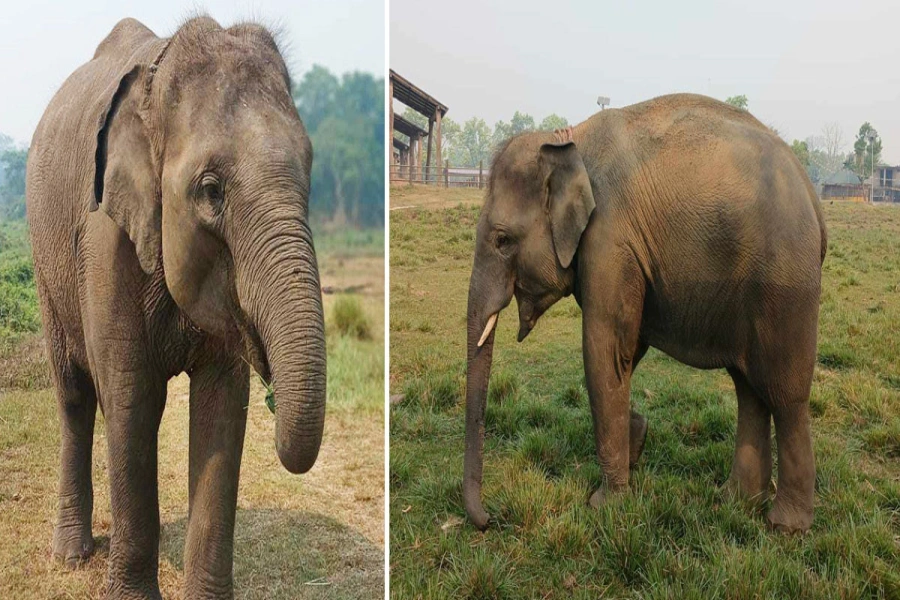
CHITWAN, Jan 6: Once, Nepal depended on other countries to supply elephants for forest patrols and wildlife protection. Today, the country has achieved a remarkable milestone: elephants raised in Nepal’s own breeding center are now being gifted to friendly nations, a sign of both conservation success and diplomatic goodwill.
A recent example of this achievement is the case of Rudrakali and Khagendraprasad, two elephants sent to Qatar as official state gifts. While the gesture reflects Nepal’s growing expertise in elephant conservation, it has not been without controversy.
In Chitwan, activists have long demanded better treatment for elephants, calling for them to be freed from chains and for their basic rights as wild animals to be respected. Critics argued that sending elephants far from their natural habitats goes against the principles of animal welfare.
Despite the opposition, the government prioritized diplomatic protocol and the symbolism of state gifts. On December 17, Rudrakali and Khagendraprasad, born at the Chitwan National Park’s (CNP) Elephant Breeding and Training Center in Khorsor, were flown to Qatar via cargo plane.
The history of Nepal’s elephants is a story of transformation. When the CNP Elephant Breeding and Training Center was established in 1985, Nepal faced a severe shortage of elephants for patrolling its national parks and protected areas. Dr Ganesh Pant, Senior Conservation Officer at CNP, recalls, “To address the shortage, Nepal once practiced a kind of barter: we gifted four rhinos to friendly India, and in return, we brought sixteen elephants.”
Army conducts air patrols in sensitive areas of Rolpa and Rukum

Records show that Nepal has raised wild-caught elephant calves, received gifted elephants from Thailand, imported two elephants from Myanmar (Burma), and purchased some from local Terai landowners to strengthen forest security. According to Manpuran Chaudhary, Head and Section Officer of the CNP Elephant Breeding and Training Center, Nepal initially brought in 20 elephants from India, Thailand, and Myanmar to establish the center.
From those 20 elephants, the breeding program has blossomed into a model of self-reliance. Since its inception, 68 elephant calves have been born at the center. “This is Nepal’s only elephant breeding center,” says Chaudhary. “The elephants born and trained here are relocated to other protected areas, such as Parsa National Park, Banke National Park, and Shuklaphanta National Park in Kanchanpur, depending on need.”
Caring for these gentle giants is an immense responsibility. An adult elephant consumes approximately 15 kilograms of rice, 1.5 kilograms of sugar, 25 grams of salt, and around 150 kilograms of grass every day. They are taken to forests during the day to graze and fed three times with grains.
Breeding is heavily dependent on wild male elephants. At the Elephant Breeding and Training Center, bulls like Ronaldo, Govinde, and Dhrube are crucial contributors. Female elephants carry their calves for 22–24 months, and currently, seven elephants at the center are pregnant.
However, Chaudhary emphasizes that more female elephants are needed. “Nepal no longer depends on other countries for elephants. Each year, five to six calves are born here. Yet, in comparison to the availability of wild male elephants, the number of females is still low.
At least 20 adult females are required to maximize births, but we currently have only 17, including calves.” If the center reaches 20 adult females, up to 10 calves could be born annually, enough to meet the country’s needs.
Kiranraj Rijal, an elephant expert and technician at the National Trust for Nature Conservation, shared detailed insights into elephant conservation in Nepal. Of the total 185 captive elephants in Nepal, 91, or roughly 50%, were born within the country. Of the 105 elephants under government protection, 76 were locally born, while in private care, 2 out of 7 and 13 out of 73 were born in Nepal.
In addition, around 27 wild elephants remain in Nepal’s forests, with another 120–150 elephants crossing over from India’s border areas. Rijal warns that shrinking habitats and growing human populations could trigger more human–elephant conflicts. “Without proper protection,” he said, “in a decade or two, elephants may survive only in zoos or as statues.”
Experts emphasize that conserving both wild and domesticated elephants is essential, not only for biodiversity but also for human safety. Elephants play irreplaceable roles in emergency rescue, flood and landslide response, controlling problematic wildlife such as tigers and rhinos, forest patrols, and tourism promotion. Both government-owned and privately kept elephants are considered national assets, and Nepal’s progress in breeding its own elephants represents a major achievement.
The journey from importing elephants to gifting them internationally reflects Nepal’s commitment to wildlife conservation and national pride. Sending Rudrakali and Khagendraprasad to Qatar is more than a diplomatic gesture—it is a symbol of decades of dedication, careful planning, and the country’s growing capacity to protect and nurture one of its most majestic animals.
In a world where elephant populations are declining, Nepal’s success demonstrates that collaboration among government agencies, local communities, and wildlife experts can create a model for sustainable conservation.