He brings out the plight of the “poverty-laden” people of remote areas and the need to include them into the mainstream of development.[break]
He identifies the government as one of the key actors in this process.
The main motivating force in this volume is that the author has made an endeavor to confer the voices to differently-abled groups by attacking the blooming culture of preferential treatments, nepotism and bootlicking that are unfathomably rooted in Nepali society.
For many readers, the charm of Shrestha’s writing lies in the vistas it opens on remote villages through the metropolitan areas like Kathmandu.
On the one hand, Shrestha has offered a detailed account on Nepal’s apprehensive social, economic, cultural, and political circumstances, and on the other, he has provided a ground-level examination of various places of Nepal – from pastoral to metropolitan areas.
He has tried to provide a vivid portrayal of the real Nepal which cannot be found in any other source. His writing transitions from a mediocre standard to achieving some essence of quality writing by the time you reach the last page.
Reflecting on the sentiments of people with different socio-economic locales, he tries to figure out the rustic way of life. Correspondingly, while writing about the backwardness of the country and the “unenthusiastic” scenario of Nepali politics, he evokes the emotions of a frustrated and pessimistic character of a tragic drama.
It does not sound ethical for an author to render information via pessimistic point of views; he should have tried to seek out glimmers of hope from his writing.
The chapter divisions on 16 different topics collectively offer a true narrative of rustic life – a mound of problems like water, food, health, education, etc.
The deconstruction of Nepali proverbs somewhere gives his title an interesting hue. But in most of the places, his disappointment regarding the country’s “tragic superiority,” amateurish conduct and impunity becomes apparent.
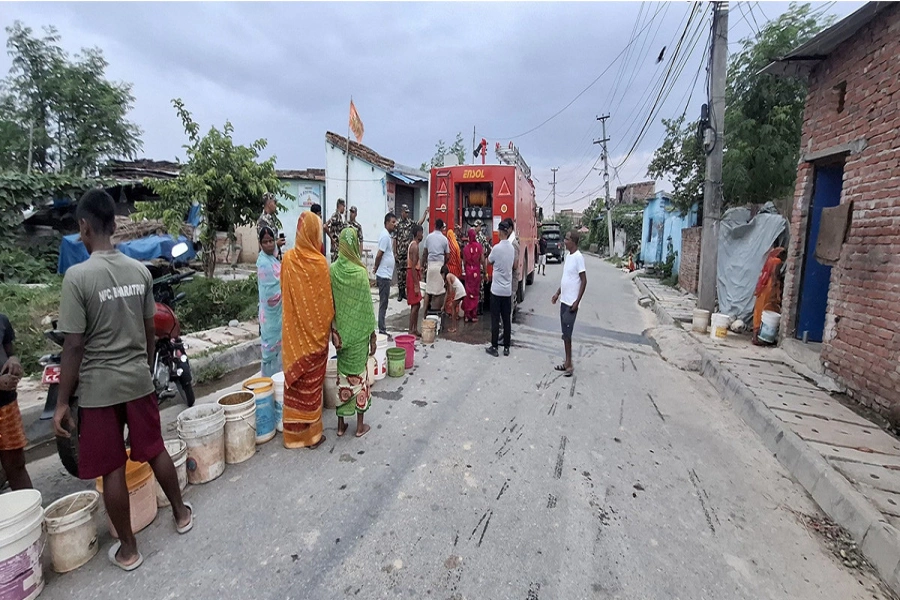
Those who are eager to know about the real picture of heartrending Nepal can read this book. We can say that the images incorporated here can be taken as a concrete proof about what Nepal looks like, which are able to voice out the real images of Nepal. Most of the pieces have upsetting details about what Nepal has undergone.
To reflect on the real circumstances of far-flung areas by the means of words is challenging per se, but while flipping through this book, it directly takes readers across miscellaneous cultures of pastoral Nepal, and hardships that far-off places put up with in their commonplace life.
Additionally, through the photos taken by Navaraj Wagle and sketches by Deepak Gautam, readers can gain additional information about Nepal’s rustic life. While looking at the book’s jacket, one sees a touching photo of a barefoot small boy with tattered clothes; wherein he is holding a sickle instead of pen, and a doko (bamboo basket) instead of schoolbag.
Undoubtedly, this is the barefaced fortune of Nepal and we Nepalis. Also, this very image of the boy in tatters can be taken as an analogy of the country’s enmeshed circumstances.
Another piece, “Peedit Mahila, Apahelit Balbalika’ portrays the actual predicament of women and children of Nepal, and at the same time, gives a feminist flavor to his writing.
He weighs the role of men and women by putting them on an argumentative beam balance. Correspondingly, in “Aaphai Rogiyeko Swasthya Chhetra,” Shrestha explores the distinction between the Dhami Jhankri (faith healer) culture and allopathic treatment.
What is more, he delineates the maternal-child health problems widespread throughout the country. In this piece, he also recollects the time when he was in Khandbari (Ilam) while he also writes about the curative system of Bir Hospital in Kathmandu.
Likewise, some titles offer accounts of the stupidity of our “political leaders” and others offer whimsical activities of the “conscious civilian.” These sorts of themes appear over and over again in his writings. He may be unaware that this causes the readers to be distracted.
Correspondingly, another piece called “Rajnaitik Pranaali” successfully captures the deteriorating situation of the political sphere in Nepal and the need to save it from worsening.
Shrestha’s writing catapults readers to the conversational frame and at the same time provides a smooth linguistic balance to his novel. In a sense, the leitmotif of this book goes across half a century of political and social cataclysm in Nepal, incorporating a distressing scenario.
Shrestha frequently focuses on nepotism as one of the most “chronic diseases” of our country and laments that there is no way out.
The perennial problem of individualism has left everyone defenseless when it comes to critically thinking about this situation. Sometimes, he frames his writing around a cadence through frequent usages of anaphora.
The chapter “Dalit Daliyeko Daliyai” attempts to shed light on the deeply rooted prejudices with reference to caste classification in Nepali society. Also, he compares and contrasts the Nepali “Dalits” to that of American “Blacks” by quoting lines from poet Laxmi Prasad Devkota’s “Muna Madan” – Manish thulo dilale hunchha/Jatle hundaina/Chhetriko chhoro yo pau chhunchha/Ghinle chhundaina.
He attempts to smear the stripe of segregation and disparity widespread in our societies.
He could have elucidated it more, together with some examples.
At times, the book also sounds like a tiresome travel account because of its repetitive, unbalanced and wishy-washy explanations. Sometimes, it also sounds like a lengthy and monotonous anthropological research paper because of its thick and superfluously microscopic descriptions.
Some readers can criticize this book on accounts of excessive ornamental rhetoric and lopsided and harsh commentaries on governmental bureaucracy.
Nonetheless, this book is worth reading because it offers graphic details of lower middle-class torment as well as satirizes political “leaders” who, after being elected, overlook their electorates.
Tersely, some readers can acknowledge this book as an inclusive photo collection of rustic to multicolored metropolitan Nepal.
<pranjali.sapkota@gmail.com>
Related story
NAC faces scrutiny for leadership vacuum in key safety departme...