There were two sets of people in my school. Set one: people who had heard of faraway places and travelled there simply because they happen to be from one of far-off places. Set two: people who had not been anywhere outside the valley. Interestingly, many from this latter group would have already travelled to many foreign countries. Back then these things did not mean much. Today too Kathmandu continues to seek solutions by looking towards its neighbor while turning a blind eye to events around the country. You guessed it correctly, I am talking about the events unfolding in Madhesh.Madhesh, to me, often looked like Punjab, the kind they show in Bollywood movies. With the lush green fields stretching as far as eyes could see, Madhesh would give a certain positive belief that we, in fact, are not as small as we would appear on the map. The plains always provided a sense of calmness as opposed to mountains and the dangerous roads we had to tread. As the winter vacation would set in, we children would gear up for a sojourn to Madhesh. Peeling off layers of pullovers as we moved west, for two months we would live the lives of royalties.
Madhesh was in fact a place that would give me a sense of 'wealth'. I remember being taken for a tour of rice fields and being told that it was our farmland. They showed miniature trees in far off horizon and told me that all the land my eyes could see was our property. The immediate and obvious comparison would be with whatever I had in Kathmandu.
The warmth in winter in Madhesh meant freedom. We could literally relive the summer again. This would also provide us with unique opportunity to select cow milk for breakfast and buffalo milk before bed. In the midst of all the vacationing, one fact always caught my attention. I pondered the role of Pahades, the people from the hills, and the way they existed in Madhesh.
They were there every couple of kilometers in the form of zamindars or landlords. For a schoolboy from Kathmandu whose household could barely afford a pet dog, these landlords seemed to own entire zoo. They had goats and cows and buffaloes and chickens. If not a zoo, they certainly did own an entire poultry and a dairy. The life they lived was from fairy tales.
It was the time when the king ruled the country. As a school kid I didn't think beyond 'optimizing' winter holidays. The village walls didn't have angry slogans. It was too much to ask us to imagine all the Madhesh burning as one, demanding rights and justice.
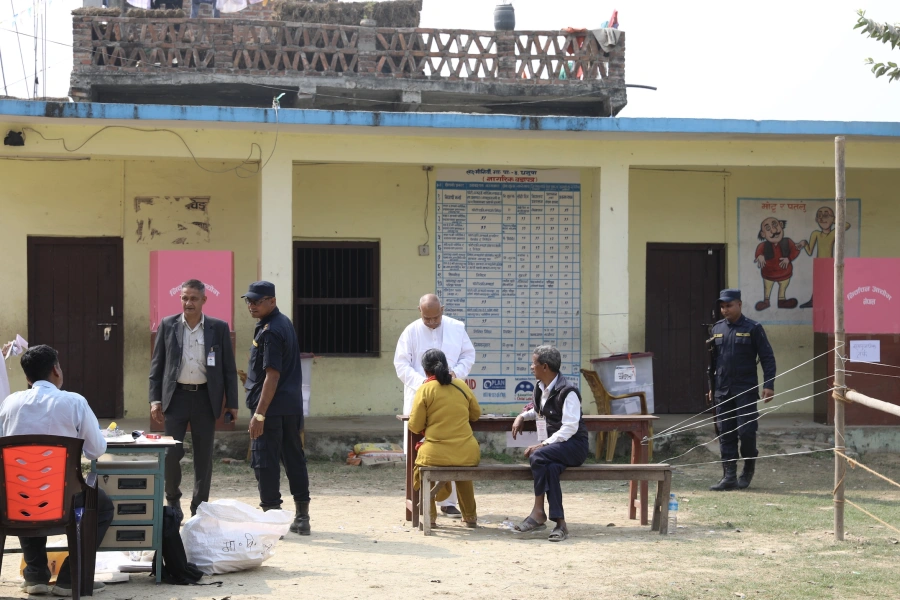
But one event I witnessed in my every outing always left me puzzled. Every morning as I would venture out to the main garden, I would see my grandfather seated in a big wooden sisaun chair sipping a glass of milk and more than a dozen people either silently listening to him or telling him their stories. It took him sometime to first understand the language, and second, to make sense of what was happening. As it turned out, villagers would gather to settle their disputes and he would play the judge dishing out punishment to guilty. Some punishments were even physical. Surprisingly, even the police personnel from a small beat nearby would come to attend such sessions. Rather than interfering in the 'hearing', they endorsed it.
There were times when I would get slightly confused what was happening. Not to allow myself to get bogged down too much, I forced myself to believe that it was all possible due to wealth. If a local Madheshi also had similar wealth, he too would be doing the same, so I thought.
The second interesting thing that always caught my attention was the workforce that he commanded. From the farmers in the field called 'Haruas' and their manager called 'Siruwar' to domestic helps and drivers, everyone was a Madheshi. The point here is that, unlike today, once you went to Madheshi heartlands leaving the highway to the north, you would not find many souls other than the Madheshis. Curiously, if you found someone who had migrated from the hills, they would inevitably be better off than local natives. That was also the time when not much of Madhesh was heard in Kathmandu.
A couple of Madhesh-centric revolutions have transformed Madhesh. While most of the landlords may still continue to thrive, their roles, I am told, has shrunk. Locals are no more led by people from the outside. So much so that even the country is led by one of them, along with the deputy. Almost every cabinet since has had significant number of powerful ministers from Madhesh, demolishing the earlier practice of Madheshi tokenism. The voice of Madhesh has never been so loud.
The event of last three weeks will certainly go into history books where "Madhesh" will resonate unlike ever before. The role of Madhesh after the promulgation of new, much awaited constitution will be different. Some may remember the struggle as one epic battle with the government to settle issues for once and all. To others, thanks to complete mishandling of the situation, it may be remembered simply as tumultuous months where Madhesh went on a spree of violence against the state of Nepal. There may be some who will not see anything beyond Madheshis as puppets, dancing to the interest of the southern neighbor.
Whatever the case, we all know that life will slowly crawl back to normal, just like it did after the mega-quake of April 26. Those who have been writing aggressively in different social media will soon start laughing at their own posts for the hatred is not deep rooted for the animosity to last long. And perhaps we would have seen the end all of all the Madheshi issues.
It's about time we got over the age old question of why towns and cities in Madhesh, despite their geographical "ease", are not developed. And more importantly, Madhesh today is certainly way different from the one I experienced in my childhood. There is a country waiting to come to terms with the aftermath of mega-quake. Time is running out. We are not even talking about development but basic reconstruction.
hiteshkarki@gmail.com
Related story
Madan Chitrakar’s ‘Nepali Art: Thoughts and Musings’ released

-69a940c05c766-1772700256.webp)