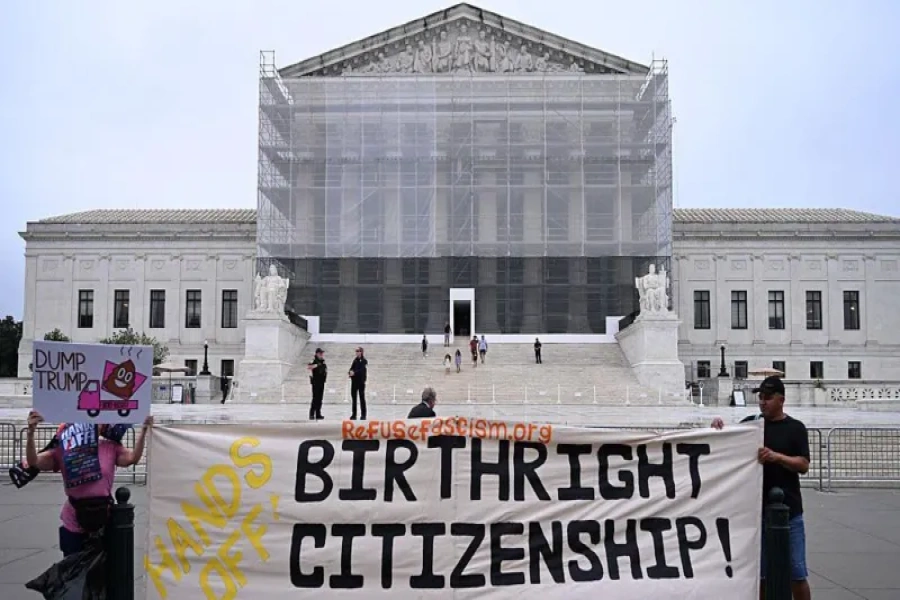
BOSTON, Oct 4: A federal appeals court in Boston ruled Friday that the Trump administration cannot deny citizenship to children born in the United States to parents who are in the country illegally or on temporary visas, further weakening the president’s order targeting birthright citizenship, the AP reported.
The 1st U.S. Circuit Court of Appeals became the fifth federal court since June to reject or block the measure, affirming that the 14th Amendment guarantees citizenship to nearly all children born in the United States.
According to AP, the panel of three judges upheld lower court injunctions that had already frozen the order, stressing that the plaintiffs were likely to succeed in showing the policy violates the Constitution.
The appeals court wrote that history and legal precedent give no reason to “break with our established tradition of recognizing birthright citizenship” and warned against tying citizenship rights to parental status rather than birth within U.S. borders, the AP stated.
Trump’s move to end birthright citizenship unconstitutional: Ap...

The order, issued on the president’s first day in office, would have ended automatic citizenship for children born to undocumented immigrants and temporary visitors. As AP reported, the ruling leaves the order blocked while lawsuits continue through the courts.
California Attorney General Rob Bonta, representing one of nearly 20 states that sued, praised the decision. He said the First Circuit had confirmed that the Constitution leaves no room for a president to restrict birthright citizenship, calling the order a “flagrant” violation of the Fourteenth Amendment. Bonta argued that the only way to safeguard Americans’ rights was to maintain the nationwide injunction, the AP added.
In a separate ruling Friday, another appeals court sided with groups including the American Civil Liberties Union, the New Hampshire Indonesian Community Support, and the League of United Latin American Citizens, according to the AP.
They challenged the order on behalf of families affected. The ACLU’s SangYeob Kim said the ruling reaffirmed that no politician can decide who is worthy of citizenship, emphasizing that the Constitution clearly provides protection for all children born in the country. The AP stated that the back-to-back rulings marked another significant defeat for the administration.
The White House said it would continue to defend the order and appealed to the Supreme Court in September, hoping for a definitive ruling by next summer. A spokesperson argued that lower courts were misreading the 14th Amendment and expressed confidence that the justices would reverse them. According to the AP, the Supreme Court already ruled in June that while judges generally cannot issue sweeping nationwide injunctions, exceptions exist in cases involving states and class actions, leaving room for further nationwide rulings against the policy.
Several district courts had already weighed in against the order. Judges in Boston, Maryland, New Hampshire, and California issued injunctions preventing the measure from taking effect nationwide. Appellate courts have since affirmed these rulings, creating a consistent pattern across jurisdictions. As AP reported, the cases all center on the Constitution’s Citizenship Clause, which says anyone born or naturalized in the United States and subject to U.S. jurisdiction is a citizen.
Plaintiffs argued that this principle is constitutionally enshrined and cannot be undone by executive order. They said the president’s attempt to strip citizenship from U.S.-born children based on parentage was unlawful and would disenfranchise hundreds of thousands. Government lawyers countered that the phrase “subject to U.S. jurisdiction” was narrower than traditionally interpreted.
But AP noted that legal precedent, including an 1898 Supreme Court decision affirming the citizenship of a San Francisco-born child of Chinese parents, strongly supports the plaintiffs’ case.
The ongoing dispute over birthright citizenship now heads back toward the Supreme Court, where justices may soon decide if the administration has the authority to redefine one of the most established principles of American constitutional law. The latest appeals court rulings underscore the judiciary’s skepticism of the president’s attempt to reshape citizenship rights by executive order, the AP reported.