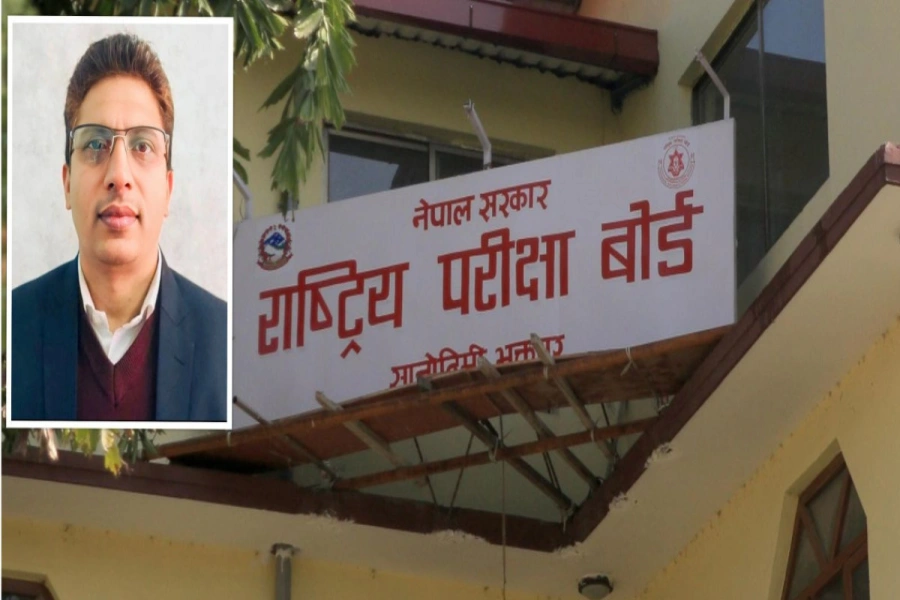
KATHMANDU, Jan 4: The Secondary Education Examination (SEE) is likely to be affected by the upcoming House of Representatives election scheduled for March 5.
With the Janak Education Materials Centre (JEMC) beginning the printing of ballot papers, the SEE—originally planned for the third week of March—is expected to face disruption, according to Tuka Raj Adhikari, controller of examinations at the National Examination Board (NEB).
Adhikari said the NEB is preparing to publish a revised SEE routine, taking the election into consideration, and that the circumstances may require the examinations to be postponed by a few days.
According to the NEB calendar, this year’s SEE was scheduled to begin on March 22. However, Adhikari said indications from JEMC that there could be delays in printing question papers have created a situation due to which the exams may need to be pushed back by a few days.
SEE exam schedule to be published by tomorrow

“This year, 517,000 students have filled out examination forms for the SEE, which included 72 subjects,” Adhikari told Republica. “As JEMC has long been responsible for printing SEE question papers, it has informed us that the process may be delayed by a few days as it will be engaged in ballot printing.”
He added that under the NEB calendar, JEMC is required to begin printing SEE question papers from February 13. “However, JEMC has also been assigned the task of printing ballot papers and to complete textbook printing before the academic session begins, and has therefore requested additional time,” he said. “As a result, the SEE Board will hold a meeting on January 19 and publish the revised examination schedule, rescheduling it by a few days while factoring in the election.”
Based on the March 5 election date and JEMC’s ballot-printing workload, Adhikari said the SEE exams may be pushed back slightly from the regular schedule.
JEMC will begin printing sample ballot papers from Tuesday. The centre has signed an agreement with the Election Commission (EC) to print a total of 41.6 million ballot papers—20.8 million each for the first-past-the-post and proportional representation systems—for 18,903,689 voters, according to JEMC Managing Director Yadunath Paudel.
Paudel said that since ballot printing, textbook printing and SEE question paper printing are all government responsibilities, the government must take an appropriate decision regarding the SEE timeline.
“The government assigned JEMC the task of printing 17 million school-level textbooks. So far, 14 million copies have been printed,” Paudel told Republica. “The remaining three million copies will be printed by the second week of February.
“Textbooks are being prepared in advance for Himalayan districts, where the academic session begins earlier,” he added. “Four machines are ready for printing 41.6 million ballot papers, 200 personnel have been kept on standby, and storage warehouses are fully prepared.”
Under the agreement, Paudel said, printing of 20.8 million proportional representation ballot papers must be completed between January 6 and January 23 in the first phase. “Printing of proportional ballots in black and red ink will begin on January 6,” he said. “After that, printing of an additional 20.8 million first-past-the-post ballots will commence.”
“Printing ballots, textbooks and SEE question papers—these are all government responsibilities,” Paudel stressed. “JEMC has 450 employees and sufficient machinery. However, as ballot printing will take time, it has become clear that printing SEE question papers within the scheduled timeframe—the third week of February—will not be possible.
“The SEE Board must take these factors into account before finalising and publishing the examination timetable, as textbook printing will continue until the end of February, and textbook and ballot printing will proceed in parallel.”