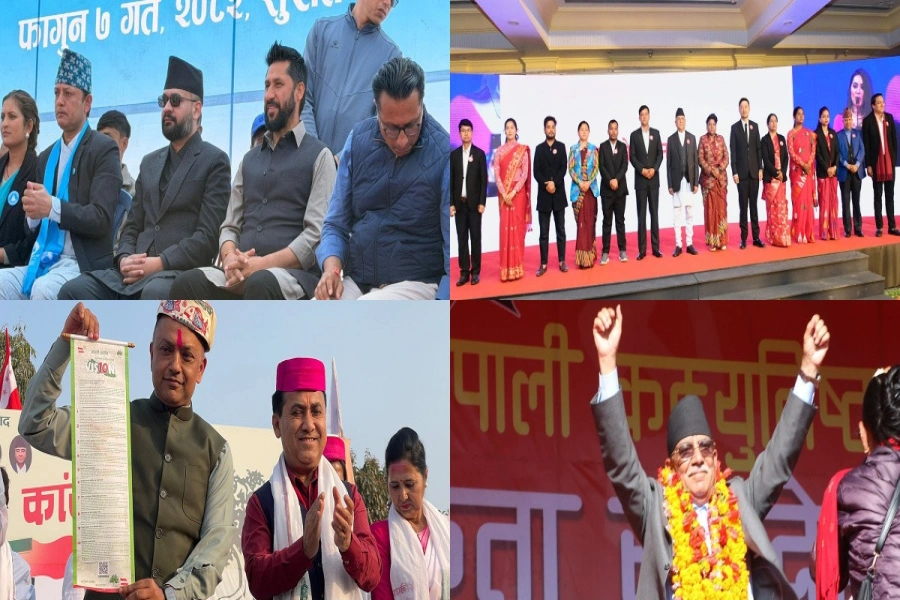
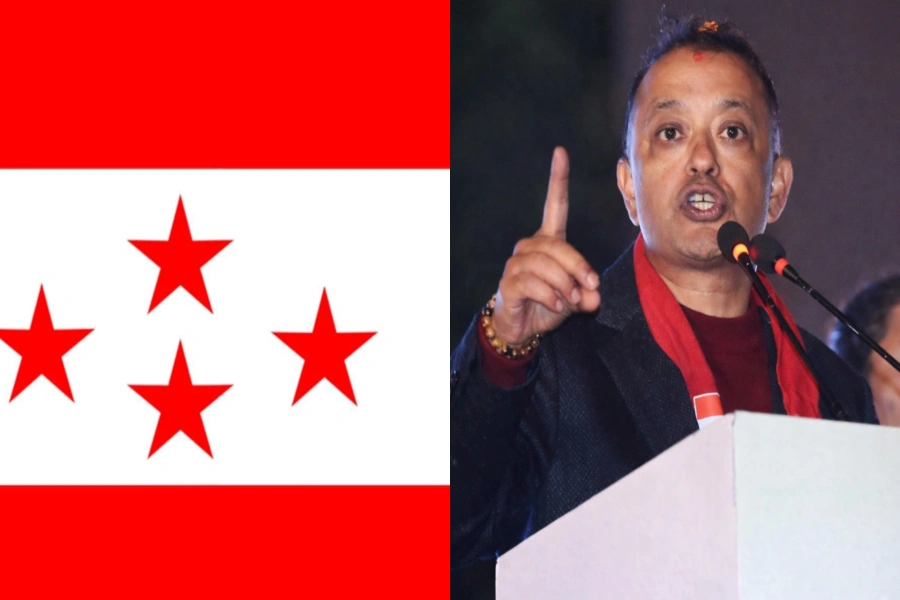
After Baburam Bhattarai severed his ties with UCPN (Maoist) on September 26, 2015, he has been campaigning for the formation of what he calls a new force, Naya Shakti. But why did he resign from the Maoist party in the first place and what does he hope to achieve through his new force? In an interview at his Sanepa residence on Thursday evening, Republica started by asking him about the reasons for persistent government failures in Nepal.
Related story
Naya Shakti in Parliament as Naya Shakti, TTPN-D unify

This was the time when we controlled leakages (chuhawat) and collected record revenue without changing tax laws. Compared to what I did as finance minster, I could not do much when I was the prime minister. Many have this impression about me. But the context and responsibility of these two positions were different. As the finance minister, I could focus on economic agenda. As the prime minister my chief responsibility was to conclude army integration and help with constitution-making. I could not do much on the economic front because perhaps I am the only prime minister in Nepal's history who was not allowed to present an annual budget.
Nonetheless, I take road expansion in Kathmandu and other cities as a mark of my success. Road expansion was in limbo since 1976. Nobody had dared to undertake this owing to various pressures. I had the vision to develop Kathmandu as a model city. So I took the initiative. I assured my juniors that I was with them every step of the way and they cooperated. The country's executive should have a clear vision, goal and priority. Then he should be committed to implementing his vision. But there are few such people in Nepal. Even if there are, they cannot serve out their full term. There should be stable government for at least five to 10 years. I still believe that if I can work for five years without any disturbance, I will be able to work per public expectation.
People are increasingly impatient at the shortage of such visionary leaders. What can we do?
Like I said, we lack political leadership with the vision for development and good governance. But that is only part of the problem. For the past 70 years politics in Nepal was focused on dismantling old feudal rule and achieving political rights. Economic development and prosperity could not be an agenda of our political struggle. Parliamentary system is another problem. We adopted the system that gave us a new government every six months. This is the reason I have been raising the issue of systemic reforms in government system.
But many countries have prospered under parliamentary system as well.
No country that witnesses government change every six months has achieved prosperity. If you are talking about European countries, parliamentary culture is established there. There is stability in this system. If you look at India, even coalition minority governments have served out their full term, whether it was Atal Bihari Vajpayee government or Manmohan Singh government. But not a single government has served out its term in Nepal since 1950. If we are to achieve development and economic prosperity and ensure political stability, we must adopt directly elected executive presidential system. Development and stability won't be possible without it.
Is this the reason you have been campaigning for a new force? Many doubt such a force will be viable in Nepal.
Many have concerns about why I quit the Maoist party and about why I am campaigning for a new force. There are specific reasons. The political process that started with the onset of the Maoist war in 1996 came a full circle in 2015 when the Constituent Assembly promulgated the constitution.
With it, Nepali society has entered a new phase of economic development and prosperity. The structure, modality and ideology of Maoist party are inadequate for the country's new development needs. We need to rise above narrow interests and devise policies and programs that suit Nepal. I quit Maoist party to make this happen. I will make good governance, economic development and prosperity key goals of the new force. I am, with the help of the new force, committed to alleviating poverty and ending unemployment within the next ten years.
Given your long association with Marxist and Maoist politics, how can we expect the new force to be any different?
Ideologies are means to ends. Humans invent them according to historical needs. But ideologies are not absolute. We used Maoist and Marxist ideologies to end the old system and open the door for a new political system. But now we are shifting from subsistence-based feudal agricultural economy to a new phase of capitalistic production. We cannot develop capitalistic production without promoting private sector, without foreign investment and foreign technology. And without a foundation for capitalistic development we cannot lay a foundation of socialism. We need to develop a new model that suits Nepal.
What makes you think your vision will materialize?
There are people of various backgrounds with me in this campaign. There are those who were active in past communist movements and others who contributed to various political movements, including the youth; those who are not associated with any party but who want to see development and prosperity. I believe such people will make for a good team to take this vision of prosperity forward. Only a new force with new vision can take the country out of the current crisis.
So far we have completed first phase of our campaign, which is public feedback collection. We will soon start the second phase. In this phase, we will give concrete shape to the policies and programs of the new force and form a preliminary committee to work as a transitional body for the next few months. This committee will undertake rigorous homework on policy issues and will collect public feedback from across the country. We will launch a massive nationwide campaign. Finally, we will hold a convention and announce the new force.
What will be the key agenda of the proposed force?
I believe unless we can ensure stability of government there will be no political stability, and without political stability there will be no development and prosperity. Therefore we must change our government form and electoral system. We need to make the legislative fully proportional. But we must have directly elected executive president. This will provide stability for at least five years. And the parliament will also be inclusive. If we cannot do this, there will be another revolution, and political parties will be forced to accept this system through constitutional amendment. The new force will push these twin issues through debate and discussions and mass movement, if needed. In fact, the key agenda of new force will be economic development and prosperity, and directly elected president for stability.
Many have queries about the new force. But the political problems we currently face are so big that people have no time to think about it. Once the blockade and the Madhesh agitation are over, national attention will shift to the debate over the new force. The new force is for all those who want change, development, property and good governance, who wish to keep mountains, hills and plains integrated, who want to develop the country by maintaining good relations with both our neighbors, and who are committed to preserving the country's sovereignty and independence. We aim to establish ourselves in national politics by correcting flaws in this constitution and serve the country through people's mandate. We take part in local, provincial and national elections.
Let's change tack. How do you evaluate Oli government's handling of the Madhesh crisis?
This government has failed to work according to people's expectations. The dialogue with agitating parties is not making any headway. All political parties in Nepal have revolutionary past. So we need to understand that revolutionaries come up with big demands first. It is the duty of the ruling establishment to weigh those demands, asses their viability and to address them. The government has failed to do so.
Once you projected yourself as a mediator between the government and agitating parties. What has been your role in the current crisis?
As the Chairperson of CA's Dialogue Committee, I had drawn the attention of parties to address the demands of agitating parties. I had warned that not doing so could invite foreign intervention. They did not listen. Even these days, I tell major party leaders to address Madhesh issue with urgency. I tell them that any delay could lead to a situation of the agitation spiraling out of control and going into the hands of extremists and foreign forces. This could lead to a dangerous situation. Ruling parties are not taking this seriously.
The clash of egos among India, Madheshi Morcha and ruling and opposition parties has made the problem worse. The agitating forces should change the modality of their protest, stop border blockade and concentrate their pressure on Kathmandu. India should also stop interfering in Nepal's internal affairs. The government, for its part, should give up its rigidity. All sides need to be flexible.
You said Madhesh agitation could lead to something dangerous. Are you hinting at a secessionist movement?
You cannot rule out this possibility, can you? Look at Sri Lanka, Kashmir and Bangladesh. Secessionist and separatist movements followed in these places when the governments failed to address people's genuine demands. When governments failed to take flexible and moderate forces into confidence, extremist and secessionist forces took advantage of the situation. There are a number of such examples. Therefore, there is real risk of extremist forces undertaking a dangerous secessionist movement that could ultimately invite foreign intervention, leading the country to a serious crisis. We must work for timely resolution of Madhesh crisis to avert this.
Do you think Madheshi Morcha's demands over province demarcations are unviable?
I don't think so. The agitating parties want Madhesh-only provinces but I am sure they will compromise. I see no reason why Jhapa, Morang and Sunsari should be in province 2. That demand is not reasonable. You could form a separate province comprising these three districts or you may adjust Madheshi/Tharu dominated constituencies of Sunsari and Morang into Province 2. Likewise, Tharu dominated areas of Kailai can be included in Province 5. The hill areas of Lumbini and Rapti could be included in Province 4. I believe demarcation dispute can be resolved through these options.
How do you respond to recent court decisions to reopen conflict-era cases?
One should not forget that the Maoist war did not end in a victory of any side. It ended with a compromise 12-point agreement that clearly states that all conflict-era cases will be investigated and resolved by transitional justice mechanisms like Truth and Reconciliation Commission (TRC) and Commission on Enforced Disappearances (CED). This spirit of the agreement seems to have been forgotten. An attempt is being made to scratch old wounds by bringing conflict-era cases under normal justice delivery system. TRC and CED can investigate conflict-era cases and recommend action in cases involving serious rights violations.
What is happening now is not in line with the principles of transitional justice. I fear its consequences will not be pleasant. The executive, judiciary and legislature should work together to resolve these cases in the spirit of past agreements.
Finally, how will you engage yourself in politics in the days ahead?
I had two dreams for Nepal. To establish a republic, which came true during my lifetime and I am very happy for it. My second dream is the country's prosperity and development. I will remain active in politics until this second dream of mine also comes true. In fact, I will work to make it happen. I believe this is possible in my lifetime. We can completely change the country's face in the next 15 years.
(Interviewers: Subhash Ghimire, Guna Raj Luitel, Mahabir Paudyal and Tek Narayan Bhattarai)