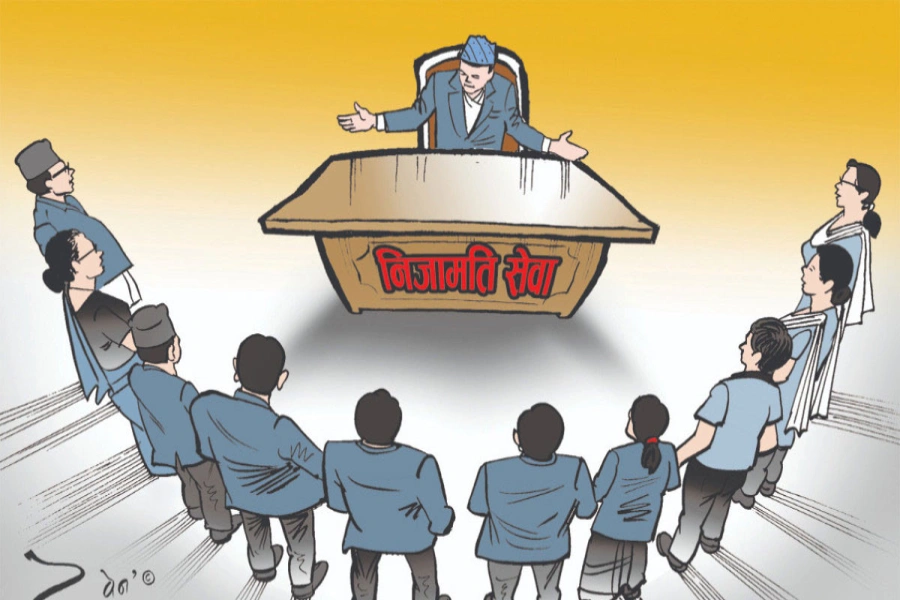
Police officials interviewed by myrepublica.com cited many instances as proof, albeit circumstantial, of the ´police-criminal nexus´. A few senior police officials agreed. They said they are working out a plan to address the situation. [break]
The officials said that some policemen are found to have been providing crucial information to the criminals, who are associated with different underground armed outfits and organized gangs.
Those who are under direct threat from criminals said the police-criminal nexus is key to the failure in maintaining law and order. Politicians and independent analysts also say this is the major reason for insecurity and impunity.
Policing in limbo
Given any serious investigation or operation, police officers are prone to be skeptical about their team members. The kidnapping of Rajesh Sah in Lahan in the first week of April was a repeat of this syndrome in Siraha.
Officials, who sought anonymity for lack of authority to speak publicly, said that investigators would oddly have to even change their routes--while tracking kidnappers --to avoid being noticed by fellow cops, as information was constantly being leaked.
"The kidnappers would learn about our maneuvers outright and start threatening the family of the hostage," said an official. “We face a huge problem in protecting informers and victims who seek our help.”
The gunning down of Kaushal Sahani, then president of the Tarai Army group, in Rautahat district in August 31, 2007 remains a handy example for officials when discussing trust among cops.
"All the team members were instructed to switch off their mobile phones before heading out for that operation," said an official.
Police intelligence officers, colloquially referred to as ´ghumuwas´, are often blamed. The plainclothes cops are alleged to have maintained close rapport with the criminals and thugs. Likewise, the uniformed cops, mostly deployed at units in the villages, are usually accused of showing reluctance to hunt for the criminals.
“The significant problem is within the organization itself. A certain section of cops entertaining criminals has created a serious situation of inaction in policing, and triggered groupism also,” said Superintendent of Police (SP) Sarbendra Khanal, chief of District Police Office, Dhanusha.
“Use of political power in transfers and other departmental maneuvers is the key problem,” he added. “We face a situation where people simply do not like to see a police uniform.”
Lila Nath Gimire, president of CPN (UML) Siraha, pointed out that the role of the police is one of the main reasons contributing to burgeoning terror in the Tarai. “I think that 10 percent of the blame has to be shared by the police,” said Chandra Kishor Jha, a political analyst based in Birgunj.
The industrial and commerce sectors also seem to be skeptical about cops who allegedly compromise their ethics for gain. “How could we believe that the police will ensure security when they are known to have been conniving with criminals?” said Bijaya Sarabagi, a Birgunj entrepreneur.
Policy failure
Policing started failing in the Tarai following the start of the peace process as the rehabilitation of police units that were destroyed or displaced during the insurgency was obstructed for several months due to protests by the Maoists, analysts say. And the criminal gangs mushroomed, taking advantage of this gap.
Analysts said that the policy of prioritizing cops of Madhesi origin during the belated rehabilitation process for police units in the Tarai has backfired. “It is now felt that the calculation of social adjustment backed by culture and language has failed,” they said. “Criminals are capitalizing on the weak policies.”
In Siraha district alone, 400 out of the 700 cops are of Madhesi origin. “It is felt that cops being locals is itself a problem for better policing,” said SP Ramesh Bhattarai, chief of District Police Office, Siraha.
Diagnosis and treatment
"Deploying cops in their hometowns or home villages is the main problem. They seem to have compromised a lot in their duties including in counter-terrorism work. So we have already rearranged nearly 50 percent of postings to ensure that cops would not have to work in their home districts," said Deputy Inspector General (DIG) Bhishma Prasai, chief of the regional police office in Biratnagar.
Prasai claims that there has not been any massive sabotage of the strength and image of the police due to this ´normal infiltration´. “I have never found that cops are directly involved with criminals,” he added.
Senior Superintendent of Police (SSP) Keshav Adhikari, chief of Zonal Police Office Narayani, said that the trend of connivance has decreased significantly following a series of actions taken against those who defied professional conduct. A few months ago, at least 70 ´ghumuwas´ were brought under departmental action in Narayani zone.
“We are going to address this problem soon with corrective measures,” said SSP Nawaraj Silwal, chief of Zonal Police Office, Janakpur.
(Ajit Tiwari, Mithilesh Yadav, Suresh Yadav and Upendra Lamichhane contributed to this report.)
Related story
Nexus cup U-16 cricket tournament from today