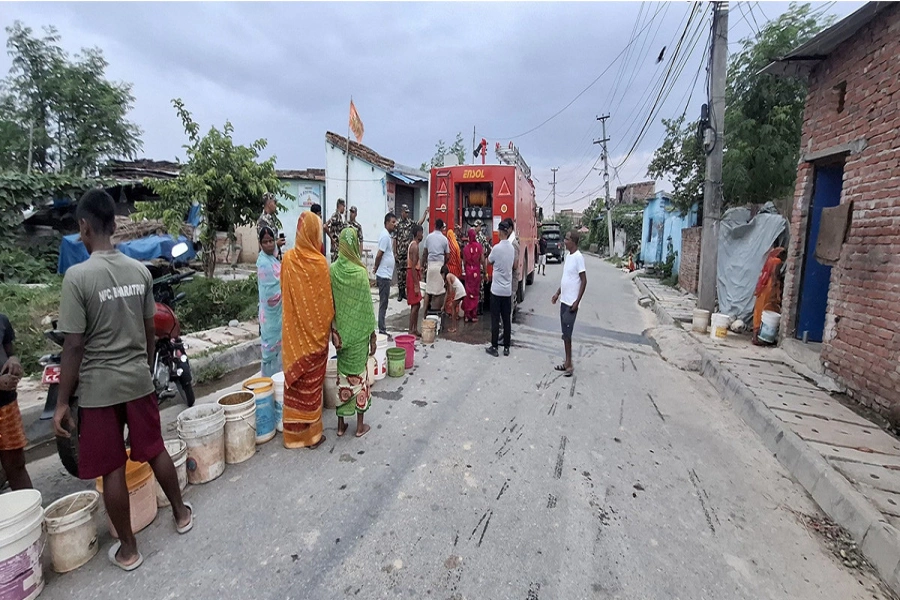
During the five-month-long "blockade" at Indo-Nepal border, the supply of fossil fuel and other essential items came to a grinding halt. Despite several attempts, Nepal could not import petroleum from China commercially. This owes primarily to the difficult geographical terrains and absence of oil infrastructure on Nepal's northern frontier. Moreover, there was no transit treaty and bilateral agreement to import petroleum products through business channels of two countries, with a guarantee of minimum purchase. It is against this backdrop that Prime Minister KP Sharma Oli is visiting China from March 20th. The visit comes after the blockade has eased and Oli claims to have cleared the "misunderstanding" with India.During Oli's visit, the two countries will strive to strike deals to allow both sides to develop infrastructure and facilities, on either side of the border. They are also expected to finalize a new transit treaty that would allow Nepal access to fuel-rich Central Asia republics through China. This would not only break Nepal's over-dependence on India on fossil fuel, but also ensure long-term strategic business security. Oli will try to convince the Chinese that Nepal wants good relations with China not only when there is some difficulty with India, but a relationship based on pragmatism and mutual benefit. He must also clarify that Nepal is not for improving ties with China so that it can do away with India. India will continue to be an important trade, investment and development partner of Nepal; and Nepal is neither willing nor capable of playing the "China card".
China itself is a rising superpower and it hardly plays into the hands of others. Hence it will be naïve to look to play the China card. It is in Nepal's interest to convince the Chinese that Nepal's permanent interest lies in enduring partnership with China. There is a clear need to upgrade road connectivity between Nepal and China. The "highway of friendship", as Nepal-China road through Kodari is referred to, remains closed following the 2014 floods and 2015 earthquakes. Both the countries must urgently reopen and upgrade that road to at least a four-lane all-season highway. The second border opening at Kerung also need to be upgraded with better road access from the Nepali side and better port facilities on either side.
Opening new road-links along Nepal-China border, including the Korala in Mustang, will be important as well. But it is Kodari and Kerung that really matter. Nepal can use increased Chinese aid and investment in upgrading of road links and port facilities. As a member, Nepal should also seek to access funds through the Asian Infrastructure and Investment Bank (AIIB) established under the Chinese initiative, especially for infrastructure that builds connectivity with China. Nepal should also explore opportunities for funding the "missing link" to South Asia in China's new Silk Road initiative.
Nepal borders Tibet, a sensitive province for China. Opening additional border points for connectivity can increase Chinese security concerns. Nepal must guarantee that such routes, once open, will not be conduit for anti-China activities. Nepal has a stated policy of not allowing its territory to be used against China's security interests and it has always supported "One-China policy". That support needs reiteration.
China operates in other countries through stable political pillars. That was the case with Nepal's monarchy, demonstrated by the fact that China welcomed Nepal's King Birendra to 10 state visits. Nepal's communist parties have majority seats in the legislature and are now part of the ruling coalition. Oli government must impress upon the Chinese leadership that irrespective of the political equation in Nepal, the country's China policy will always be based on Nepal's longer-term interests.
China has genuine concerns that agreements that it enters into with the Oli government may not be adhered to by successive governments, something that can sour relations. Oli must ensure this is not going to be the case and that Nepal and Nepali people, represented by political parties and the government of the day, are ready to enter longer-term partnerships with China based on mutual friendship and goodwill.
The Chinese railway is coming up to Nepal's frontier in a few years. That will be a game changer in strategic connectivity between Nepal and China. Nepal should look to extend that railroad up to Kathmandu and then to the southern frontier so that it can turn itself into a "transit state" between India and China. Nepal, India and China will all gain through a "trilateral cooperation" in terms of greater trade, investment, tourism and development. If that happens, India and China need not have agreements such as the one over the controversial Lipulekh Pass without Nepal's consent. Instead, Nepal could allow its other passes and routes for trade, pilgrimage and transit between India and China, provided there is atmosphere of trust and confidence between the three countries.
China is one of the world's leading economic and military powers and Asia's giant in every respect. Its leadership in the establishment of the New Development Bank under the BRICS initiative and the creation of the AIIB amount to an alternative financial architecture in the world. China today is one of the largest sources of outgoing Foreign Direct Investment (FDI). Chinese investment is reaching even far-flung places of Africa. In 2015, China became the largest source of FDI in Nepal, surpassing India. A huge cement factory is being built with Chinese investment. The China Three Gorges Corporation is expected to invest in the West Seti Hydropower Project (750 MW). Once completed, this is going to be a trend-setter as far as Chinese investment in Nepal's hydropower is concerned. Nepal should strive for more Chinese investment in hydropower. A bilateral investment protection agreement would go a long way in that direction.
The Chinese have a big presence in every South Asian nation. They are investing in roads, ports, airports and other infrastructure. It has 5,000-km long physical border with five South Asian nations. China's bilateral trade with India alone is approaching US $100 billion annually. With such high stakes, China is a natural aspirant for membership of SAARC. The region will gain from a strategic partnership with China.
Nepal and China can also upgrade their 1960 Treaty of Peace and Friendship, a changed version of which the Chinese had submitted to Nepal in 2008. Such a treaty must be done with a view to forging long-term strategic partnership for continuing mutually beneficial relations. Among other things, this will ensure enduring partnership on principles of peaceful coexistence and mutually beneficial economic relations.
China matters to Nepal as it does to the rest of the world. Nepal must strive to benefit from China's economic prowess and its international role, maintaining pragmatic and mutually beneficial relations based on our long-term strategic needs and interests.
China matters in the bigger scheme of things for Nepal, including for its strategic security, in securing uninterrupted supply of petroleum products and reducing over-dependence on India. Oli's visit is a great opportunity to start moving in that direction.
The author is former permanent representative of Nepal to the United Nations
Related story
What Nepal can learn from China