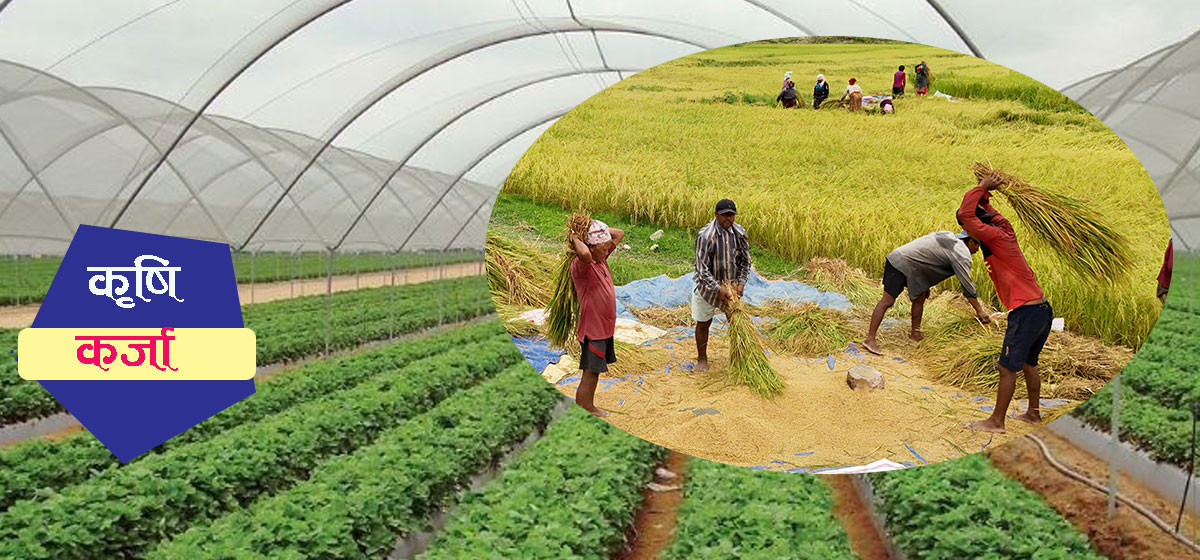
KATHMANDU, Nov 13: Among the 13 districts of Bagmati Province, Kathmandu ranks third lowest in terms of farmland. Most of its land is occupied by settlements and plotted housing areas, leaving very little space for agriculture. However, in terms of agricultural loan investment, Kathmandu ranks first.
A study shows that around 52.6 percent of the total agricultural loans disbursed in Bagmati Province have been invested in Kathmandu. This indicates a misuse of agricultural loans by non-farmers in areas where farming is minimal.
According to a study by Nepal Rastra Bank (NRB), a total of Rs 121 billion has been invested as agricultural loans in Bagmati Province, of which Kathmandu alone accounts for Rs 64 billion. The total area of land used for cereal and vegetable farming in Kathmandu is just 19,943 hectares. In contrast, Kavrepalanchok — known as a major vegetable-producing district — has received only Rs 5.17 billion in agricultural loans, despite having 590,662 hectares of farmland, about 29 times more than Kathmandu.
This clearly suggests misuse of agricultural loans. Farmer leaders also claim that subsidized agricultural loans are being used by influential people instead of genuine farmers. “The misuse is due to weak monitoring,” said Uddhav Adhikari, founding president of the National Farmers’ Group Federation. “The loans meant for producers are being used by traders instead.”
Rasuwa farmers embrace new technology

The government provides subsidized loans in the agriculture sector to promote agro- and livestock-based enterprises, aiming to increase production and employment. According to NRB, banks can charge up to 1.5 percent above the base rate on concessional agricultural loans.
Of the total agricultural loans in the province, Kathmandu accounts for 52.6 percent, followed by Chitwan (23.1 percent), Makwanpur (4.7 percent), Kavrepalanchok (4.3 percent), and Dolakha (0.5 percent). The data shows that loans are heavily concentrated in Kathmandu and Chitwan, while districts like Dolakha and Rasuwa — where most people depend on agriculture — received only 0.5 percent of the total loans. Likewise, Ramechhap received 0.6 percent and Sindhupalchok 0.9 percent.
According to NRB, Rs 550.6 million was disbursed in Dolakha, Rs 660.9 million in Rasuwa, Rs 3.77 billion in Dhading, Rs 3.6 billion in Nuwakot, Rs 2.87 billion in Bhaktapur, Rs 3.37 billion in Lalitpur, Rs 700 million in Ramechhap, Rs 1.97 billion in Sindhuli, and Rs 5.76 billion in Makwanpur.
Even though Kathmandu received nearly half of the total agricultural loans, Kavrepalanchok leads in cereal and other crop production with 16.9 percent. Similarly, Chitwan tops in vegetable and horticultural production with 21.3 percent, while Ramechhap ranks the lowest with 1.2 percent. Sindhuli leads in fruit production with 40.5 percent, and Makwanpur’s share is minimal. Makwanpur, however, ranks first in spice production with 25.7 percent, while Bhaktapur has the lowest with just 1 percent.
Agricultural loan investment has risen in the past year. As of mid-July 2025, loans disbursed by banks and financial institutions in the agricultural sector in Bagmati Province increased by 1.3 percent compared to the same period last year. The province accounts for 36.16 percent of the total agricultural loans disbursed across the country.
Banks claim that since most of their central and regional offices — which approve large-scale loans — are based in Kathmandu, the city naturally shows a higher share of agricultural loans.
However, the NRB report notes that increasing agricultural productivity through commercialization and modernization remains a major challenge. Fragmentation of arable land, a growing number of fallow fields, and the conversion of farmland into housing plots are reducing the availability of agricultural land.
For agricultural commercialization, there is a need to develop access roads. Farmers have long complained about not receiving fair prices due to the import of vegetables and fruits.
The study highlights the need to strengthen agricultural infrastructure, ensure easy access to technology, provide improved seeds and fertilizers, irrigation, and effective subsidies and credit to farmers. It also stresses the importance of improving the supply chain from farmers to consumers to ensure maximum benefits for both.
The study further notes that agricultural production has declined due to a shortage of labour, as young people continue to migrate to cities or abroad.
If local governments take the initiative to cultivate cash crops on fallow land in the hill districts of Bagmati Province, agricultural and livestock productivity could sustainably increase in the long term.