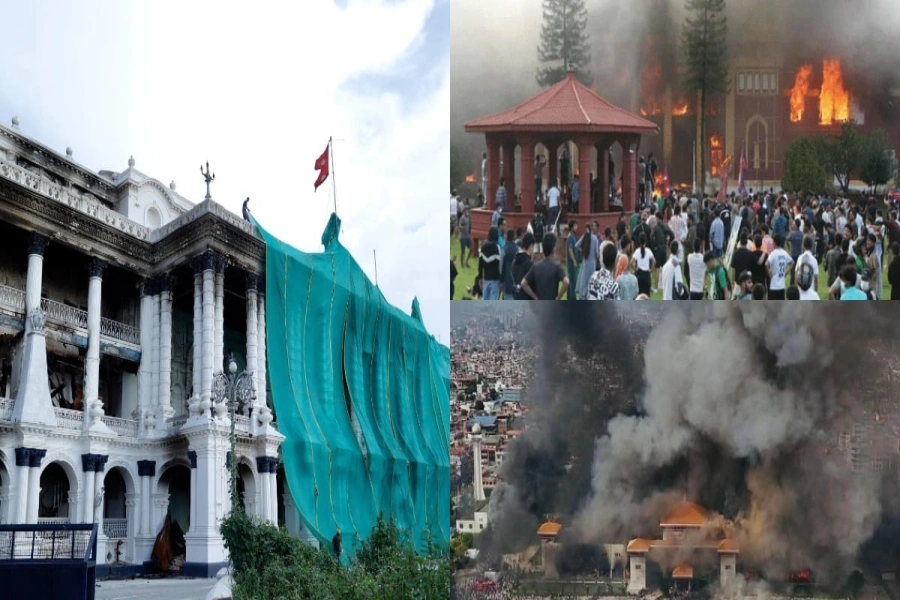
KATHMANDU, Jan 16: Several private and government buildings and other physical structures were vandalized and torched during the Gen Z movement, leaving behind not only visible destruction but also deep concerns about structural safety.
In the aftermath of these incidents, a critical question has emerged: Are fire-damaged buildings safe for habitation, especially in an earthquake-prone country like Nepal? Engineers and seismologists warn that even if such buildings appear structurally intact from the outside, their internal components may have already suffered serious damage.
According to experts, high temperatures generated during fires can significantly weaken construction materials. Seismologist Dr Amod Mani Dixit explains that fire reduces the strength of concrete, weakens steel reinforcement bars, and causes micro-level damage to internal structural elements—damage that is often invisible to the naked eye.
Dr Dixit notes that incidents in which buildings burn continuously for more than 24 hours are relatively rare. However, he stresses that concrete structures exposed to prolonged fire must undergo detailed technical studies before being deemed safe.
“Fire incidents like those that occurred during the Gen Z movement are rare. Buildings burning continuously for such long periods throughout the day are also uncommon,” he said. “There has not been much research on how concrete houses are affected. So, even if we cannot say definitively, the condition of the internal steel must be examined.”
According to Dr Dixit, mandatory technical inspections are essential before people are allowed to reoccupy fire-damaged buildings. Using such structures without proper assessment, he warns, could lead to major disasters in the future.
Nepal lies in a highly earthquake-prone zone, and weakened structures significantly increase seismic risk. Dr Dixit underscores this point with a stark reminder:
“Earthquakes do not kill people; buildings do. People die because they are crushed by the structures we build,” he said. “We experience frequent earthquakes, and many of our structures are weak. Buildings burned on September 9 have become even more dangerous.”
He also emphasized the urgent need for technical inspections at the local level. Although some fire-damaged buildings have reportedly been reopened after only minor repairs, he said such practices are unsafe and irresponsible.
Echoing similar concerns, Rajkumar Thakuri, a firefighter commander at the Juddha Barun Yantra Office in Pulchowk, Lalitpur, said that while burned buildings may be temporarily repaired and services resumed, they remain highly vulnerable if a strong earthquake strikes in the future.
“Some buildings may be habitable after repairs, but even if people live in them now, a slightly stronger earthquake tomorrow could cause even greater damage,” Thakuri said.
Reconstruction of buildings burnt in Gen-Z movement to be compl...
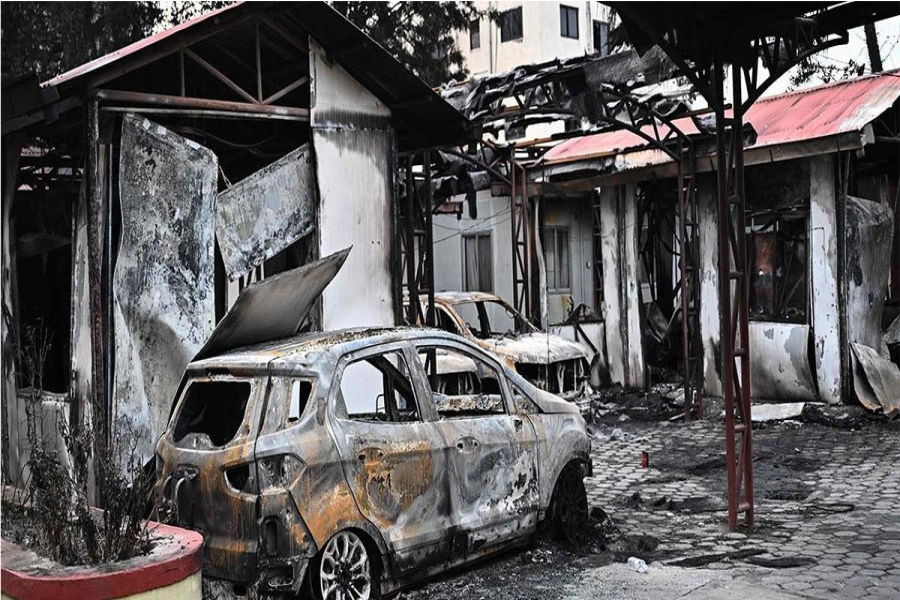
Thakuri said that while extinguishing fires during the Gen Z movement—at locations such as Bhatbhateni, Singha Durbar, the Supreme Court, Hotel Hilton, and various prisons—firefighters observed extensive internal damage. Many of the materials inside these buildings were highly combustible.
According to him, slabs in several buildings had cracked or completely shattered, steel rods were exposed in multiple places, and some structures were no longer suitable for habitation.
“From the places we visited and the fires we extinguished, many buildings had cracked slabs, shattered concrete, and exposed reinforcement bars. In some places, the buildings are simply not livable,” he said.
Thakuri stressed that technical evaluations must be conducted by professionals to determine whether such buildings are fit for habitation.
“In all the fire incidents we have seen so far, the buildings were not in a condition suitable for living,” he added.
Similarly, senior seismologist Dr Lok Bijaya Adhikari of the National Earthquake Monitoring and Research Center said that any structure exposed to fire becomes structurally weaker and is highly likely to collapse during an earthquake.
“A building that was originally designed to withstand a certain level of force can no longer do so after a fire,” he said. “Prolonged fire damages the mortar and concrete used in construction, making immediate occupancy risky.”
Dr Adhikari emphasized that load-bearing pillars must be tested, rather than focusing solely on walls or surface repairs. He also highlighted the importance of understanding whether buildings were originally constructed in accordance with building codes.
Instead of merely repainting burned buildings, he said, their internal components must be thoroughly inspected before reuse.
Dr Dixit further stated that all relevant state mechanisms, departments, and technical experts should be mobilized as a unified workforce. He noted that research and assessment of fire-damaged structures cannot be effectively carried out by a single group alone.
He urged the government to assess each burned building individually, based on its condition and nature, and to deploy expert teams to determine whether repair, strengthening, or complete reconstruction is required.
Dr Dixit also warned that black soot, chemical residues, and dust remaining inside burned buildings can pose long-term health risks. Doctors say children, the elderly, and people with respiratory conditions are especially vulnerable.
Why torched buildings can be risky
Structural weakness: High heat reduces the strength of concrete and can weaken or deform internal steel rods.
Sound outside, weak inside: Even if a building appears intact externally, serious damage may be hidden within walls and slabs.
Health risks: Smoke residue, black carbon, chemicals, and dust can cause respiratory, skin, and eye problems.
Electrical hazards: Burned wiring, switches, and pipelines increase the risk of fires and electric shocks.
Meanwhile, the government has announced plans to complete the reconstruction of government buildings and structures damaged during the vandalism carried out in the name of the Gen Z movement on September 9 within two years.
According to Rabindra Bohara, Director General of the Department of Urban Development and Building Construction (DUDBC), the department plans to complete reconstruction within two years for buildings marked with green and yellow stickers, excluding those tagged with red stickers.
He said the contract process would begin from mid-January, with an initial estimated cost of around Rs 84 billion. The department has classified damaged buildings into three categories. Buildings marked with red stickers are currently unfit for use and require full reconstruction; there are 134 such buildings, 44 of which fall under the DUDBC’s jurisdiction.
Similarly, 134 buildings sustained minor damage, 125 of which fall under the DUDBC’s jurisdiction and have been marked with green stickers. Additionally, 176 buildings suffered partial damage; 100 of these are under the DUDBC’s jurisdiction and have been marked with yellow stickers. Engineers have recommended strengthening these structures to restore them to their original condition.
Responsibility for reconstructing federal government buildings damaged during the Gen Z movement vandalism has been assigned to the DUDBC and the Federal Secretariat Construction and Management Office (FSCMO).
Former Minister for Physical Infrastructure and Transport Kulman Ghising, while marking the completion of his first 100 days in office, had announced that reconstruction of buildings damaged during the Gen Z movement—particularly those marked with red and green stickers—would be initiated immediately.
A report states that all seven provinces were affected during the Gen Z movement. According to the report, physical structures and other properties in 54 districts and 262 local levels were damaged.
Overall, government property worth Rs 84.45 billion was damaged, with 68 percent attributed to the federal government, 10 percent to provincial governments, and 22 percent to local governments.
The report further states that 2,168 institutions were affected and 2,671 buildings were damaged, with estimated losses of Rs 39.31 billion in buildings alone. Additionally, 12,659 vehicles were damaged, resulting in losses worth Rs 12.93 billion. Damage to government and public sector property is estimated at Rs 44.93 billion.
Losses in the private sector amount to Rs 33.54 billion, while the community and other sectors suffered damages worth Rs 5.97 billion.
Under the jurisdiction of the FSCMO of the Ministry of Urban Development are 51 buildings, including the President’s Office, the Prime Minister’s residence at Singha Durbar, ministerial residences, and the Parliament building.
The report also notes that 77 people lost their lives during the Gen Z movement, including 20 on September 8, 37 on September 9, and 20 thereafter. A total of 2,429 people were injured during the protests.