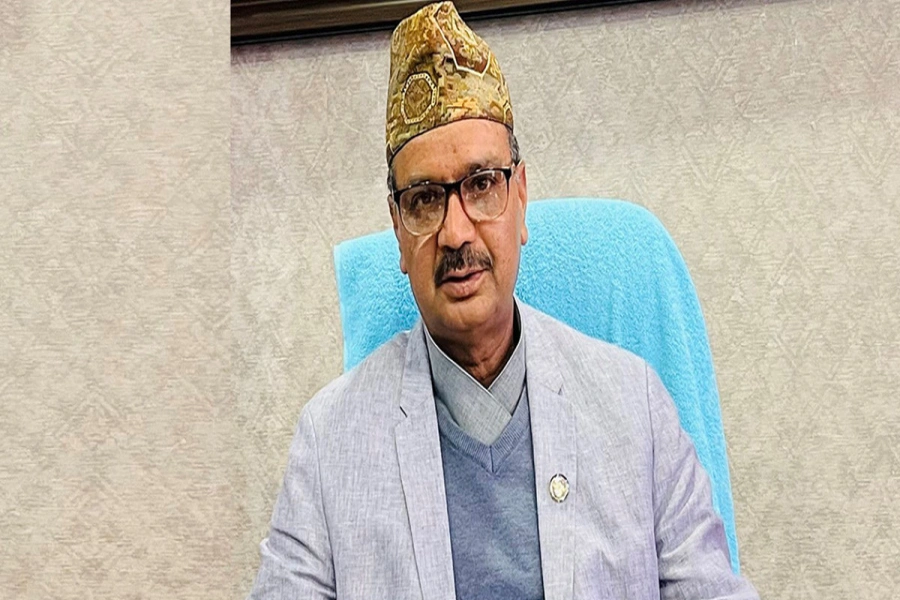
KATHMANDU, Feb 5: Thousands of Nepali workers board planes with dreams of a better future when going abroad for employment. However, behind these dreams, hidden files, syndicates, middlemen, and policy distortions often turn workers’ hard-earned sweat into a business, a reality that rarely comes to light. Labor Minister Rajendra Singh Bhandari has publicly exposed this dark side.
According to Minister Bhandari, whether at the Ministry of Foreign Affairs or within the Labor Ministry itself, files are lost, policies are made under syndicate pressure, and decisions in favor of workers are frequently stalled. He said that when he raised his voice against these distortions, he faced intense obstruction, pressure, and conspiracies even from within the government.
Highlighting the dark realities of foreign employment, Minister Bhandari recounted his experience battling the bureaucracy, manpower syndicates, and recruitment mafias during his tenure.
“The foreign employment sector looks attractive from the outside, but internally it is complex, opaque, and dominated by self-interested groups,” he told Republica, “billions of rupees are transacted in the name of workers.”
He also pointed out that files related to foreign employment in countries like Saudi Arabia, Kuwait, and Israel often get stuck in the Ministry of Foreign Affairs. “If money is paid, files move forward; if not, they remain in drawers,” he said.
NRB floats foreign employment bonds worth Rs 250 million

Minister Bhandari said he had to endure a lack of cooperation from within the government even when decisions were made in favor of workers. At one point, a very important foreign employment file was intentionally delayed by senior officials. “Only when I threatened to involve the media, the Commission for the Investigation of Abuse of Authority, and police officials did the file reach my table within half an hour,” he said, exposing deep-rooted dysfunction within the bureaucracy.
He described reforms related to sending workers to Japan through the Japan International Training Cooperation Organization (JITCO) as exploitative. The directive 2066 BS that limited Nepali workers to this system was eventually abolished. Now, workers can go to Japan through all licensed manpower companies, but middlemen under JITCO still extract huge sums. To end this, a framework with Japan under the JITOO model was prepared, he said.
Syndicates in health checks and orientation
Minister Bhandari clarified that the government took strict action to break the syndicates running health checks and orientation training in the name of foreign employment. “The health check fee had reached Rs 9,500. I reduced it to Rs 6,500,” he said, “it should ideally be zero.”
He said this relief would directly benefit workers and end monopolies in the medical sector.
He also expressed concern over the massive syndicate in orientation training, implicating the Department of Foreign Employment itself. “It’s only an orientation on paper. This has been happening with the department’s collusion,” he said. He emphasized that he was determined to break this syndicate.
Distortions in ‘free visa-free ticket’
According to Minister Bhandari, the main issue in foreign employment is the misuse of the “free visa–free ticket” practice. “This concept was exploited with ill intentions,” he said, “it has pushed workers into more difficulties. I cannot approve agreements that impose financial burdens on workers.”
He revealed that he had confrontations with the Cabinet Secretariat and other secretaries over this issue. Accusing officials of working in favor of middlemen, he said he strongly advanced proposals in the interest of workers, which created discomfort even within the government.
Bhandari said he also took a firm stance against sending Nepalis as domestic workers to Gulf countries, especially Saudi Arabia and the UAE, without guaranteeing their security, respect, and rights. He faced enormous pressure for this position.
Stressing that foreign employment policies should be clear, the minister said, “If Nepalis are sent abroad, let’s send them properly; otherwise, the policy itself can be abolished.”
He noted that despite millions of Nepali youths going abroad, the expected prosperity has not come, and the social impact is deepening. Minister Bhandari admitted that standing against corruption and middlemen came at a personal cost. “I lost 3–4 kilos and endured extreme stress. I stand as a representative of workers’ blood and sweat,” he said.
According to him, foreign employment policies must now be based on procedures, transparency, and workers’ interests, not personal gain. “When Nepali workers land in a destination country, they should be welcomed. Respect boosts their morale,” he said.





_20220130160610.jpg)