

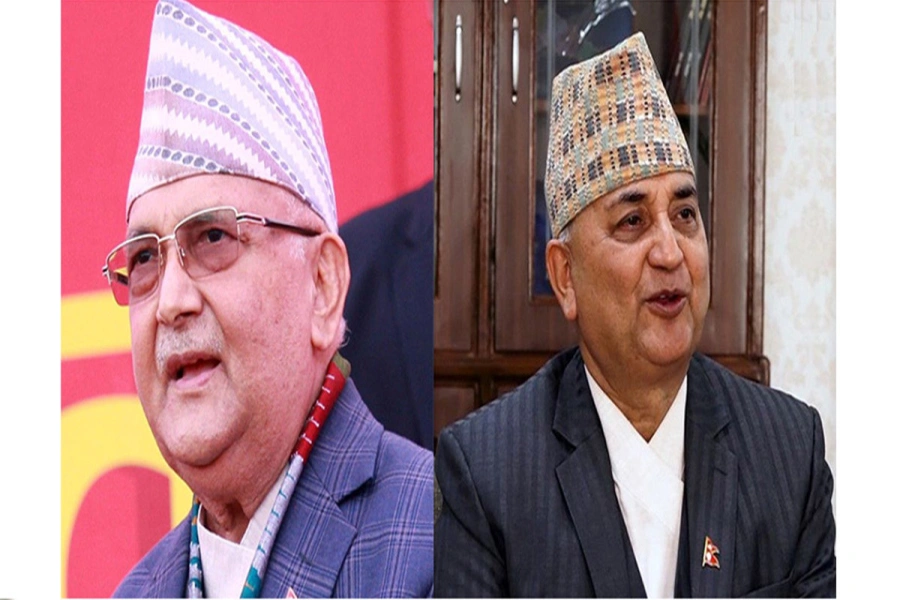
KATHMANDU, Dec 5: CPN-UML Chairman KP Sharma Oli has been attempting to stop Senior Vice-Chair Ishwar Pokhrel from contesting for party chair in the upcoming 11th National General Convention. Oli has urged Pokhrel to avoid a contest, arguing that the country is in crisis and the party is also facing challenges, and therefore, unity is essential.
The general convention is scheduled for December 13–15, and Oli is seeking to become chair unopposed. Pokhrel, however, has said he will move forward, urging Oli to take on the role of a guardian instead. “You should rest, give advice, and ensure a smooth transfer of leadership. It is now my responsibility to take everyone along,” Pokhrel told Oli. But Oli has insisted that the party still needs his leadership and asked Pokhrel to support him. Pokhrel, however, has made it clear that he will not withdraw from the race.
The statute convention held from September 5–7 had already opened the door for Oli to become chair for a third term. As the general convention approaches, Pokhrel and other leaders preparing to contest visited Oli in Gundu, Bhaktapur, on Thursday and expressed dissatisfaction over issues, including delegate selection. Pokhrel was accompanied by Astalaxmi Shakya, Surendra Pandey, and Yogesh Bhattarai. Bhattarai said discussions were held regarding problems seen in the delegate selection process.
“During a general convention, there are always matters that require meetings with the chair. Problems have emerged in the delegate selection process—some places have disputes, and some have complications,” Bhattarai said. “We met with the chair to discuss these issues.”
UML selected delegates across the country last Saturday. Disputes surfaced in districts such as Dang, Bhojpur, and Okhaldhunga. According to sources, Pokhrel’s group objected to the Organization Department’s decision to reject delegates chosen in some districts, including Okhaldhunga, and order re-elections. “Shankar Pokhrel’s group made unilateral decisions in Dang. In Salyan, delegates were chosen while staying in a hotel. We object to this as well,” a source said.
Oli is preparing to amend the party statute again, despite it already having been passed by the statute convention. After Pokhrel’s faction refused to withdraw from the contest, Oli is reportedly considering reverting to the previous structure to accommodate leaders from his own camp. The statute convention had set the Central Committee size at 251 and, following a proposal by Vice-Chair Bishnu Paudel, reduced the number of office bearers to 15. The position of Senior Vice-Chair was removed, and the number of vice-chairs was reduced from six to three.
Leapfrog Technology hosts Design Disco 2 celebrating excellence...

Under the approved statute, there will be 15 office bearers: one chair, three vice-chairs, one general secretary, three deputy general secretaries, and seven secretaries. One of the office bearers must be a woman. The Standing Committee structure has been removed, and the size of the Politburo has also been reduced. The age limit of 70 for being elected to any committee has also been removed. Oli is now working to amend the statute again, as he is finding it difficult to manage leaders within his own faction.
Mixed situations: Disputes in some areas, consensus in others
Delegates for the general convention have been selected. In some places, delegates were chosen through consensus, while in others, agreement could not be reached. The establishment faction has instructed re-selection in places where the results were unfavourable to them. UML held elections for delegate selection in many constituencies. Even leaders aspiring to become Central Committee members were defeated.
In Bagmati Province, Minister for Labor, Employment and Transport, Jayaram Thapa, was defeated in Kathmandu Constituency 4. Of the two delegates elected under the open category, Shreekrishna Shrestha received 241 votes and Uddhav Kharel—former mayor of Budhanilkantha Municipality—received 212 votes. Thapa, considered close to Oli, finished third with 201 votes. Kathmandu Constituency 4 is also the constituency of former President Bidya Bhandari and is dominated by the anti-establishment faction. Badri Bhattarai, Bhandari’s former personal secretary, was also defeated in the open category. He lost after switching camps, arguing that Bhandari was unlikely to become party chair.
Official candidate Rajan Pokharel, Bagmati Province in-charge and a supporter of Oli, also failed to be elected as a delegate.
Two members of the Koshi Provincial Assembly were defeated in Sunsari Constituency 1. Ramesh Kumar Basnet and Bijay Kumar Rai could not secure delegate positions. From this constituency, Asharam Chaudhary, Jayakumar Rai, and Murari Subedi were elected under the open category with 796, 776, and 674 votes respectively. Basnet received 376 votes in Sunsari Constituency 1(A), while Rai secured 391 votes in Sunsari Constituency 1(B).
Chief Minister Hikmat Kumar Karki’s advisors were also defeated. His public relations advisor Rabi Khanal lost in Sunsari Constituency 1, and his personal secretary Kamal Paudel lost in Jhapa Constituency 5.
In Rukum West, Karnali Province Assembly member Tulasa Malla was defeated, securing only 111 votes. Kaushila KC and Himkumari KC won in the women’s category with 204 and 203 votes respectively. In Makwanpur, district chair Shreedhar Pokharel was defeated with 334 votes. He had contested from Makwanpur Constituency 1 under the open category.
Under the open category, former National Assembly member Ram Chandra Rai, considered close to Ishwar Pokhrel, also failed to secure a delegate position. In Arghakhanchi’s Shitganga Municipality, Deputy Mayor Geeta Bhat Chhetri was defeated. Deepa Acharya, Sushma Shrestha, Bishnumaya Acharya and Laxmi Gautam were elected in the women’s category.
For this convention, representatives have been selected from most areas, including the seven provinces, districts, central departments, sister organizations, diaspora chapters, special districts, the contact coordination committee, the labor wing, and the central office.
Issues have emerged in eight districts during the delegate selection process. According to the party’s Election Committee, problems were reported in Okhaldhunga, Dhankuta, Tanahun, Dang, Banke, Bajhang, Rautahat and Bara. Complaints were filed claiming that the process did not follow the prescribed procedures, and leaders close to the Oli faction received fewer delegate positions in these districts.
According to Madhab Dhungel, secretary of the General Convention Delegate Management Committee, delegates have been selected from all geographical and non-geographical clusters except in Okhaldhunga and Dhankuta. The two districts were instructed to complete the process within four days, but local leaders are refusing to follow the central leadership’s directives.
Around 2,200 delegates have been selected for the convention. Each House of Representatives constituency has chosen four delegates—under the open, women, and youth categories.
Additionally, 354 members of the Central Committee will automatically become delegates, along with 29 from the Discipline Commission, 30 from the Accounts Commission, 25 from the Election Commission, and 25 from the Advisory Council—totaling 464 automatic delegates.





