Speaking at an interaction organized by Nepal Republic Media on Tuesday, Federation of Nepalese Chambers of Commerce and Industry (FNCCI) President Pashupati Muraraka said that the industrial sector is on the verge of collapse due to the prolonged unrest.
Likewise, economists claim that the blockade for the past three months will hit the economy in the long run. “Not only this year, the ongoing blockade will make negative impact on our economy for at least 4-5 years,” they said.
(As told to Kuvera Chalise, Rudra Pangeni, Kriti Bhuju and Sujan Dhungana)
We should find solution at political level: Pashupati Murarka, President, FNCCI
As the present problem is of political nature, we need to find solution at the political level. People in some parts of Tarai are in agitation. Some of them seem to be in favor of the Indian blockade. First of all we address our internal issue related to Tarai by holding talks with agitation parties. Once internal issues are settled and all of us have united voice, we can then raise strong voice against the blockade. We have not been able to apprise the international community of the blockade as India has been blaming unrest in Nepali side for supply disruption. India has neither announced the blockade, nor has stopped supply from all customs points.
The trend of hitting the streets for even trivial issues is growing in Nepal in recent years. It is a wrong thing. The country won’t have come to this stage had the agitating parties chosen other way to raise their demands. A day of strike inflicts loss of Rs 2 billion on our economy. Unfortunately, strike in Tarai districts is continuing for the past three months. Our economy has already suffered loss of around Rs 200 billion over these months. Importers will have to pay more than Rs 5 billion in demurrage charge alone. Goods worth Rs 100 billion are lying stranded at border crossings.
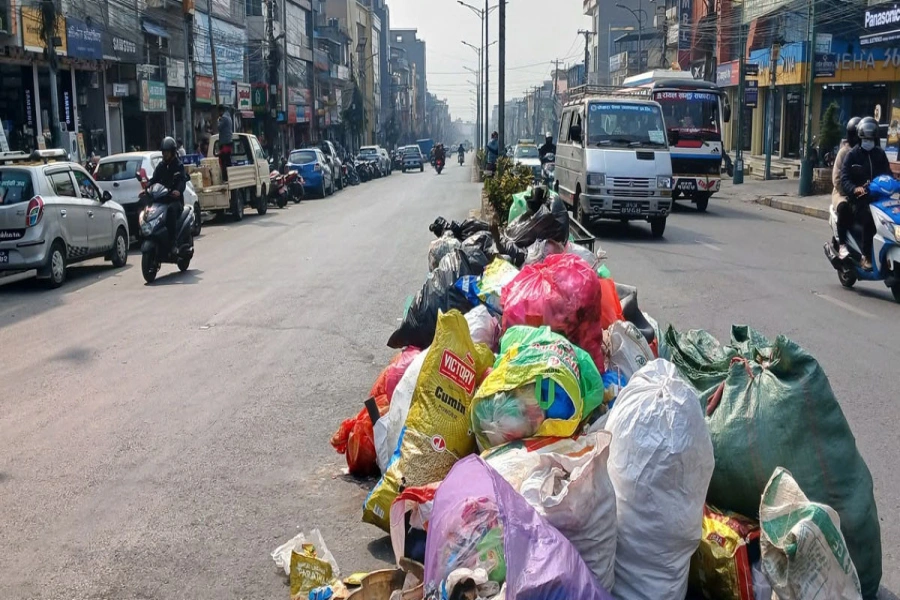
Many industries have already shut operation while others are on the verge of closure due to lack of raw materials. Similarly, development projects have been stopped and works of hydropower projects have been affected due to fuel shortage. Other worrying thing is, shadow economy is thriving. Many industrialists are turning bankrupt. International cargo companies have refused to handle Nepal-bound cargoes. This will make long-term impact.
The need of the hour is to resolve Tarai issues by holding talks and lift blockade through diplomatic channel. Even if the blockade is lifted immediately, it will take at least six months for supply of goods to return to normalcy.
The government should launch different incentives and subsidies to keep the economy afloat. It should help the private sector and industries to pay interest on bank loans. The government should also harness the country’s hydropower potential so that the country’s dependency on fossil fuel can be reduced. Similarly, it should encourage people to use electric vehicles and electric cooking appliances. It will help to reduce import of petroleum products.
Former finance ministers, economists bat for self-reliant econo...
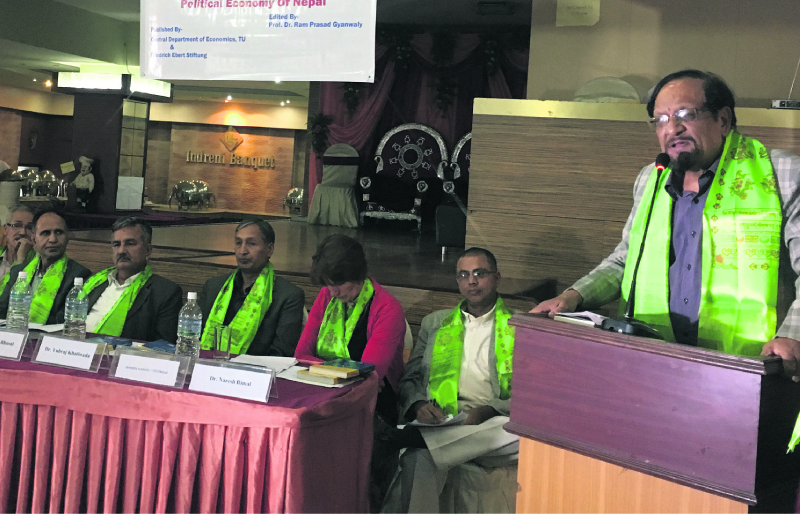
Govt should reach out to international community: Shankar P Sharma, Former Vice Chairman, National Planning Commission
The government should hold talks with dissenting groups, and use diplomatic channel to reach out to the international community and brief them on the situation in Nepal. Such briefing has to be done on regular basis.
If international community is aware of the actual situation in Nepal, they might pile pressure on the government and India. Likewise, we should regularly send briefings, which are also termed ‘non-paper diplomacy’, to organization like World Trade Organization about the rights of landlocked countries. We can use social media, academicians, civil society and other political leaders of India to pile pressure on the Indian government for lifting the blockade. Several Indian media and academicians are already writing about the blockade. As India has been insisting that it is not a blockade, we should tell them regularly that it is indeed a blockade by showing proofs about shortage of essential commodities including medicines and fuels. Likewise, the government should initiate talk with Indian political leaders who are dissatisfied with their government.
The government should also be active in smoothening supply of food, fuel and medicines. It should form a strong monitoring team to control artificial shortage and price hike. The government should make sure that fuel scarcity does not affect supplies to quake-hit districts. Distribution systems should be kept intact as far as possible to control price hike. These should be done by devising short-term plans. The government’s first priority should be to ensure that each citizen get 2,100 calorie food. It should also appeal to international community to airlift medicines.
These are short-term measures. As long-term measures, we should make serious review on why our plan to hydropower projects is not yielding desired results. Hydroelectricity is important from the perspective of energy security. But we also need to look for cheaper fuels available like natural gas near to us. Natural gas, electricity and petroleum are the three options available in the world. We should also go for alternative energy at household level. Solar plants are becoming feasible as price of solar panels are falling in the international market. We also need to boost our food stocks and petroleum reserve. We should have food stock sufficient to feed people for at least six months. Similarly, our petroleum reserve should meet the demand for at least three months. We should also make serious efforts on petroleum exploration. The government should also put trade diversification in its long-term strategy.
Priority should be on energy, food security: Posh Raj Pandey, Former member, National Planning Commission
The government should deal with internal politics first by holding talks with dissenting groups from Tarai. It is necessary, but I am not sure if it is sufficient. Once political issue is solved, I suggest to the government to come up with a mechanism to minimize the impact of the blockade on the private sector and the consumers. The foremost thing to be done is start monitoring the situation by making optimum use of available human resources. This will not only help in regulating price, but will also help in normalizing supply chain. Likewise, the government should introduce relief package for the private sector.
We cannot ignore our trade relations with India given the geographical constraint, cultural ties and taste. But there is a need to diversify trade with other neighboring countries and reduce dependency on India.
The government should immediately come with a plan for energy and food security and incorporate it as a part of national security. Learning lessons from the present situation, it should prepare medium-term and long-term strategy.
Our focus should be on manufacturing products which have comparative advantage. We should import only those products which cannot be produce here. It will increase our economic efficiency. To ensure energy security, the government should diversify energy mix. We have been importing petroleum products worth Rs 110 billion annually. By providing electricity round the clock, we can reduce fuel imports by at least Rs 20 billion. Similarly, LPG imports can be brought down by Rs 25 billion by encouraging people to use electric stoves.
The government should waive off tax on electric and hybrid vehicles so that use of fossil fuel by transportation sector can be minimized. It is also important to enhance storage capacity of petroleum products. We should have fuel reserve sufficient to meet demand of at least 45 to 60 days.
I think the government should also plan for market segmentation. If any company wants to supply gasoline to star hotels and apartment or in any particular region, they should be allowed to do so. But the government should put in place necessary regulatory mechanism.
Likewise to ensure food security, the government should invest in new irrigation projects, announce subsidy for farmers, and promote agriculture sector. It should also review trade agreement with India, monitor supply chain and boost stock of food grains.
To end the blockade and Tarai unrest, the government should know the actual problems and resolve them accordingly. People want to know what the government is doing at present. Is the government analyzing the root cause of the problem?
If Tarai unrest and Indian blockade continues any further, inflation will post double-digit growth. The government won’t be able to mobilize even one-third of the revenue target. Development budget will remain unspent and importers will start leaving Nepali. I think it will take at least 3 to 4 years for the Nepali economy to return to normalcy.