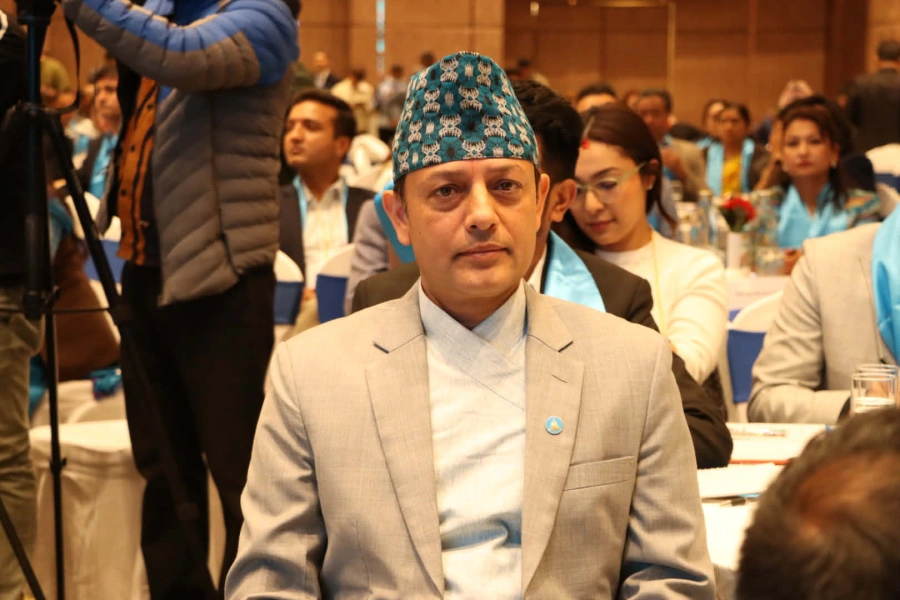
Kriti Bhuju of Republica recently talked to Ramesh Prasad Dhamala, the newly elected president of TAAN, on various aspects of Nepali trekking industry. Excerpts:[break]
What will be your priorities as the newly elected president of TAAN?
First, we are working to make internal management of TAAN transparent, responsible and accountable. Besides, the new executive committee has started works to prepare a mechanism among private sector, government and donor agencies so that the funds provided by bilateral and multilateral donors for the tourism sector can be used effectively.
We have also prepared short term, mid term and long term plan for the betterment of tourism industry as a whole which includes engaging tourists in various activities from the day enter Nepal till the day of their departure. Soon after Dashain, we are organizing ´Bishnumati Clean Up Campaign´ as we believe clean environment is a must for tourism industry. In December, we will promote Nepal among more than 2,500 foreign delegates who will arrive here to participate in the Lion Club´s 41st ISAAME Conference.
Domestic tourists often complain that trekking agencies do not entertain them? What do you say?
It´s the other way round. I would rather say that domestic tourists do not take us as service providers. For this, we will be carrying out awareness campaign to tell people that service providers are not expensive and that they facilitate trekkers.
TAAN has long been working to make Trekkers´ Information Management System (TIMS) card available through online. When will the tourists be able to get it online?
TIMS card will be available online after Tihar. For this, we have already signed a Memorandum of Understanding (MoU) with Nepal Tourism Board (NTB) and Ministry of Culture, Tourism and Civil Aviation (MoTCA). At present, we are testing the software. Besides, TIMS Monitoring and Mobilization Committee has already handed over the report of the study to the new management regarding strength, weakness, opportunity, threat (SWOT) analysis and we are working to make it better as per the findings of the study.
What about exploring new trekking routes?
We are more focused on finding alternative destinations. For that, we are conducting feasibility study mostly in mid and far western development regions which are yet to reap tourism benefits despite having tremendous potentials. We will be promoting agro, festival, water and eco tourism as well as ´farmer to family´ activities while exploring new destinations.
The number of Chinese tourists to Nepal is increasing with each passing year. What is TAAN doing to attract Chinese tourists toward trekking?
We are soon coming up with a specific program for Chinese tourists in association with the Chinese Embassy in Kathmandu. Besides, we are coming up with a package program for the overall development of trekking tourism. The program will include activities like enhancing the quality of guides, providing training on different languages and building capacity of our member agencies.
What are the challenges you see in trekking tourism and what are the new potentials?
Controlling illegal operations in trekking business, maintaining good employer-employee employee relation and investing in social security of the staff are our main challenges at present. We are confident that it can be solved by developing participatory mechanism. Besides, strikes and political instability has affected investment climate in the country and tourism industry can´t stay aloof of it.
As said earlier, many things can be done through proper utilization of bilateral and multilateral funds coming in the tourism sector.
Related story
Trekking agencies urge mandatory TIMS card for foreign trekkers