

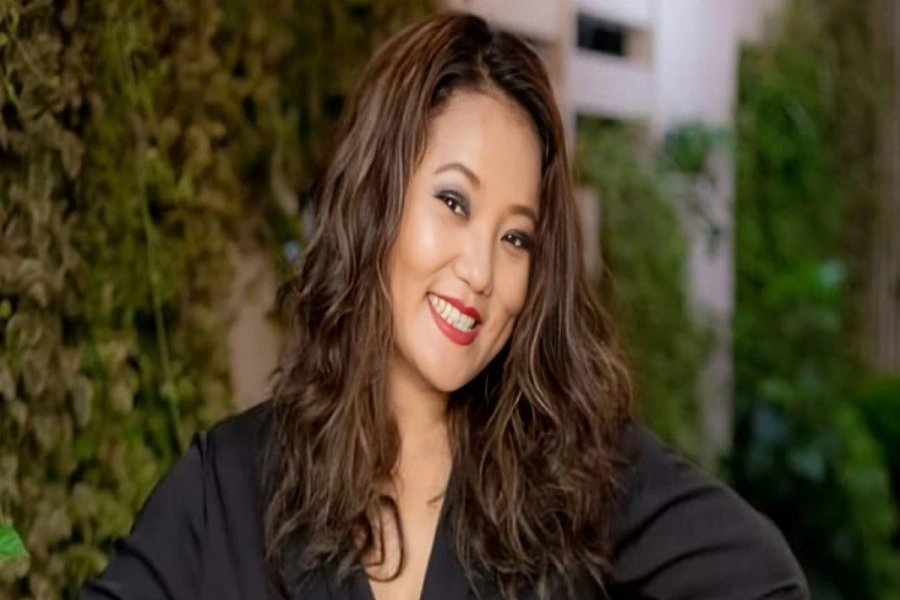
But there’s no reason why they should be. Take Lucky Chhetri, and three sisters who founded the award-winning company 3 Sisters Adventure Trekking in the 1990s. It’s the only 100% female-owned trekking company in Nepal, training and employing solely women guides.[break]
In Nepali society, guiding has always been a traditionally male job, and at first the sisters met stiff resistance. “People did not believe that women could be trekking guides,” says Chhetri. Then, women only worked behind the scenes in menial jobs in the tourism industry. It was considered an unfavorable job for women, because they should stay at home and were considered physically incapable of becoming a guide.”
Overcoming prejudice about whether women could succeed in a physically arduous and mentally challenging profession has been one of the three sisters’ proudest achievements. So is the economic independence their female employees have gained, in addition to increased confidence, and much higher profile and respect in their communities.
These gains have been hard won, but the sisters had one enormous advantage: their father’s backing. “When I did the mountaineering course it was not the norm in my community,” says Chhetri. “However, my father firmly believed that girls should do what they want to do, rather than conform to stereotypes. Unusually at the time, he wanted all his daughters to be bold, self-confident and capable.”

Not all girls in developing countries can rely on this kind of encouragement – and without family support they will often struggle to take part in organized physical activity, particularly as they enter adolescence.
Of course, wherever you are in the world, it’s still something of a surprise to see girls kicking a football. But, for a complex swathe of reasons, in many developing countries it’s hard – sometimes even dangerous – for girls to take part in any sport at all, says Marianne Meier at the Swiss Academy for Development, whose main research area is gender, sport and development.
It is now being recognized, however, that if girls and women can be enabled to engage in sport, the activity itself and the regular access it offers can be a prime method – as with 3 Sisters Adventure Trekking – of realizing a whole suite of development goals.
At Royal Holloway, University of London, Dr Alison Woodcock has undertaken research with Órla Cronin and Patrick Leman, supported by the Laureus Sport for Good Foundation. They have been looking into young people’s engagement with sport in Europe, Africa and South America. She says, “It’s not just the sport that makes the difference to the lives of women. All the best projects for women have a wealth of other activities going on.
“They may provide opportunities to learn about reproductive health, how to speak in front of a group, organize a training session, a trip or tournament, read and write, prepare a job application, use a computer and so on, depending on the needs of their membership and the local context.
“One of the most important factors for young women,” she points out, “is joining an organisation where they can be with other young women who have achieved something and taken control over their lives.
“And good leadership can bring out leadership potential in others, so that leaders are groomed from within the organization and a culture of striving, learning and developing filters down through the membership. So learning to referee a football match, score a goal or climb a mountain is only half the story – these achievements are a metaphor for what can happen in life outside sport.”
Careful work to discover what problems girls face if they want to take part in sports activities is crucial. They face multiple barriers: lack of leisure due to family or work duties; safety concerns when traveling to and from the venue; the risk of sexual abuse from coaches; lack of suitable spaces and equipment including sanitary-ware; few female role models, and cultural disapproval. Without help, these are unlikely to be overcome.
Working gradually to remove, or at least lower, these barriers, has been the approach taken by Sarah Forde, who in 2001 founded Moving The Goalposts, a girls’ youth sports and development program in Kilifii District, Kenya.
A trained football coach herself, Forde decided to use football as a means of tackling gender inequalities specifically because to have females participating in that particular sport would in itself throw up questions about what was a suitable activity for a girl.
Eight years on, using peer recruitment and intense mentoring of those who have come to training sessions, Forde says that 3,000 girls in Kilifi are now playing football. But the project is about far more than sport: girls are organizing sporting fixtures, learning to take authority as referees and training in first aid.
A linked peer education and counseling program offers additional information and support as the girls navigate what Forde describes as their “very difficult and complicated lives.”
Most Moving the Goalposts staff members have by now been recruited from young women who have come up through the project, says Forde, whose book, Playing By Their Rules, details the experiences of teenage girls she has met through the project. Others have gone on to do teacher training and two are working as security guards.
Not all the girls who take part will necessarily have this kind of concrete outcome, Forde explains, but she hopes that they will feel more able to take an active role in their communities through the confidence they’ve gained. “What I would like to see is that those girls and young women become more infl uential in terms of policy and local leadership positions, those things that affect more people.”
So what strategies work to get girls and women from developing country communities involved in sporting activities, and what don’t?
Promoting the gender neutrality of different sports is one, says Meier. “Balls and boxing gloves etc are just stuff. The gender stereotypes linked to different sports are constructed in the heads of people, they are not fact and this needs to be communicated at all levels,” she says.
Claiming the right for girls and women to exercise safely in public spaces is another, she suggests, as is recognizing that imposing “an inappropriate sport on a community can be counterproductive, endangering the whole program and the girls involved.”
“The culture of the organization is absolutely critical to the recruitment and retention of female members”, says Dr Woodcock. “If the organization has a structure dominated by males and an environment where it is acceptable for boys to see girls only as potential partners or objects of ridicule, then the girls are not going to develop the confidence and leadership qualities we have been talking about.
“I’m not saying it’s impossible to integrate young women and young men in one sporting organization – I’m just saying that it needs to be done with careful planning, so that the women are respected and have an equal role in decision-making.”
Where women are enabled to use the physical strength and mental resilience that a fit, active body can create, it seems that their lives can take a dramatically different turn.
At 3 Sisters Adventure Trekking, Lucky Chhetri says that for many of her guides, it is apparent that “for first time in her life she is independent and self-supporting, and is often able to help other family members financially. Some women find that it gives them the opportunity to pay for their further education as well.
“Their new knowledge and skills enable them to confront and transform stereotypes and discrimination that have hindered Nepalese women for hundreds of years.”
All quotes are by teenage girls living in Kilifi District, Kenya, interviewed by Sarah Forde for her book Playing By Their Rules available from www.mtgk.org/playing-by-their-rules.
Development
Related story
ICC T20 World Cup: England set Nepal a challenging 185-run targ...





_20191222200001.jpg)





