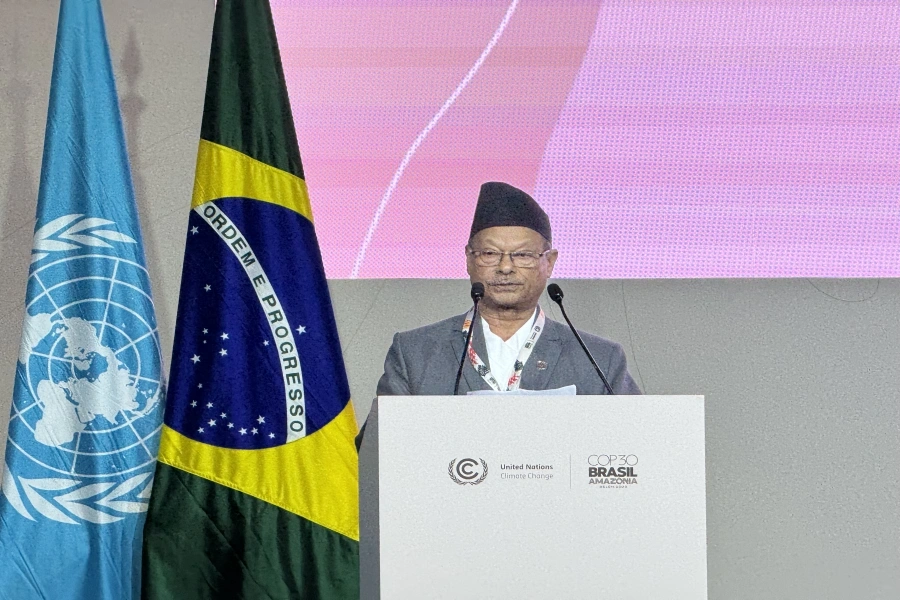
KATHMANDU, Oct 31: Nepal will push for a permanent mountain agenda under the United Nations climate negotiations, a dedicated work programme on mountain ecosystems and a mechanism to rapidly release funds after climate disasters at the upcoming COP31 summit, according to the government’s national position paper, unveiled on Thursday.
The government has identified formal recognition of mountain-specific climate risks, predictable grant-based climate finance and stronger international support for loss and damage as its major priorities for the 31st Conference of the Parties to the UN Framework Convention on Climate Change (COP31), scheduled to take place in Antalya, Türkiye, from November 9 to 20.
The position paper calls for an annual high-level political dialogue on mountains and climate change, a formal UNFCCC work programme on mountain ecosystems, and a scientific assessment of the consequences of temporarily exceeding the 1.5-degree Celsius global warming threshold in mountain regions.
Nepal also wants mountain-specific indicators incorporated into global adaptation and climate finance frameworks so that the particular risks facing the Himalayas are reflected in international decisions and funding arrangements.
The government’s push comes after a series of devastating disasters in Nepal’s mountain regions, including the August 26 flood in the Bhotekoshi-Trishuli river corridor and the October 11 flood along the Budhi Gandaki river corridor.
The position paper describes the Bhotekoshi disaster, which it calls a “Mountain Tsunami”, as evidence of the disproportionate losses faced by a country that contributes negligibly to global greenhouse gas emissions.
Push for permanent mountain agenda
Nepal’s most distinctive diplomatic push at COP31 will be to move mountain issues beyond occasional discussions and establish them as a sustained part of the UN climate negotiation process. Although mountain ecosystems have received increasing attention in recent climate summits, Nepal’s position paper says they remain underrepresented in core negotiating processes, particularly in decisions on finance, adaptation and loss and damage.
The government wants COP31 to initiate a process towards a formal UNFCCC work programme on mountain ecosystems. Such a programme would help address gaps in mountain observation, climate finance and the assessment of adaptation progress.
Nepal will also seek an annual high-level dialogue on mountains and climate change, along with a dedicated scientific assessment of the risks associated with global warming temporarily exceeding 1.5 degrees Celsius.
The paper argues that even a temporary overshoot could cause severe and potentially irreversible damage to glaciers, water systems, mountain ecosystems, infrastructure and vulnerable communities.
Govt prioritizes climate justice, mountain agenda for COP 31
Rapid funding for climate disasters
Another major priority is reforming international arrangements for addressing loss and damage, particularly to ensure that vulnerable countries receive funding quickly after catastrophic events.
Nepal wants developed countries to increase their contributions to the Fund for Responding to Loss and Damage (FRLD), convert outstanding pledges into actual contributions and establish a long-term replenishment strategy based on predictable public finance.
It is also calling for the formalisation and operationalisation of the fund’s Rapid Response Mechanism to enable faster disbursement after extreme events.
The position paper says access to funding should be simplified, including through direct access and direct budget support where applicable, so that countries facing urgent recovery needs are not held back by lengthy procedures and limited institutional capacity.
Nepal’s position follows a provisional decision by the FRLD Board to set aside US$21.6 million for recovery, rehabilitation and reconstruction after the Rasuwa–Bhotekoshi disaster. The government wants this experience to inform a broader international mechanism capable of responding rapidly to disasters that exceed the capacity of affected countries.
Climate finance remains central
The position paper repeatedly stresses that international climate commitments must be backed by adequate, predictable and accessible finance, with a strong emphasis on grants rather than loans.
Nepal’s third Nationally Determined Contribution (NDC 3.0) estimates total implementation costs of approximately US$73.74 billion, with around 85 percent expected to come from international climate finance.
The government says existing financial, technological and institutional support is insufficient to meet the country’s climate commitments and growing adaptation needs.
Nepal will therefore call for new and additional public finance, simplified access to international climate funds, stronger direct-access arrangements for eligible national institutions and greater support for preparing investment-ready projects.
It also supports the decision to triple adaptation finance by 2035 and wants the global adaptation framework to account for the specific needs of mountain countries.
The country’s National Adaptation Plan for 2021–2050 and NDC 3.0 identify priorities across water security, agriculture, infrastructure, forests, health and disaster-risk reduction. The government wants international support to translate these plans into funded programmes, rather than leaving them as policy commitments.
Nepal will further seek transitional arrangements to maintain access to technical assistance and appropriate adaptation support as it prepares to graduate from least developed country status in November 2026.
The position paper argues that graduating from the LDC category does not mean graduating from climate vulnerability, particularly for mountain and glacier-dependent countries.
Stronger action on emissions and adaptation
While emphasising the responsibility of major historical emitters, Nepal will call for urgent, science-based global emissions reductions consistent with keeping the 1.5-degree target within reach and minimising the magnitude and duration of any overshoot.
The government also wants full implementation of the outcomes of the first Global Stocktake under the Paris Agreement, alongside international support for countries implementing their updated climate commitments.
Nepal will highlight its renewable energy potential, particularly hydropower, and promote clean energy as part of the global transition away from fossil fuels.
Its position paper also calls for a just transition that protects jobs, livelihoods, energy access and inclusive development. Nepal wants international support to recognise that climate disasters can destroy renewable energy infrastructure and undermine investments intended to support low-carbon development.
The August floods, which damaged hydropower projects and other infrastructure, illustrate this challenge, according to the document.
On adaptation, Nepal will push for the effective implementation of the Global Goal on Adaptation and the use of the 59 voluntary Belém Adaptation Indicators adopted at COP30. It wants these indicators to reflect glacier retreat, glacial lake instability, changing river flows, food security, ecosystem restoration, resilient infrastructure and early-warning systems.
The government also stresses the need for greater cooperation on glacier and snow monitoring, climate modelling, remote sensing, climate information and multi-hazard early-warning systems, including cross-border data sharing.
Agriculture, inclusion and climate justice
The government’s position paper extends beyond mountain diplomacy and climate finance to agriculture, food security, public health, carbon markets, technology transfer and social inclusion.
Nepal wants international climate action on agriculture to translate into practical programmes for smallholder farmers, including climate-resilient seeds, improved irrigation, weather forecasting, agricultural research and extension services.
It also seeks funding to protect health facilities, drinking water and sanitation systems, strengthen climate-related disease surveillance and improve preparedness in river basins exposed to floods and other hazards.
The document calls for meaningful participation by women, children, young people, Indigenous people, persons with disabilities and marginalised communities in climate decision-making. It also proposes a dedicated COP31 decision on children, including stronger child-responsive climate finance and greater participation in policy processes.
The paper further calls for technology transfer and capacity-building so that developing countries can implement their climate commitments without facing disproportionate financial and reporting burdens.