The so-called “inland tsunami” recently punctured thriving settlements and upended lives in a jiffy. It might be called a jiffy—a mere measurement of time—because it did not allow people to process what was happening. In a fraction of a second, everything changed. The people and their homes are not algebra, to be calculated, reduced to numbers, and turned into sensational headlines.
Now, the August sun has dipped into September. Whatever disaster was meant to happen has happened. Climate justice and climate finance—those are the next questions. For Nepalis, the climate survivors, we need to stand by each other as we always do. But now, what?
Nepal is our home, and our neighboring countries are our neighbors. But after the water recedes, when helicopters stop coming and headlines move on, we are left with what remains. And what remains is us: our people, our communities, our health systems, and our homes. So how do we stand by each other now?
The disaster may have receded from the rivers, but its consequences have not. The next phase of the response is not only about rebuilding roads and houses. It is about tending to the wounded, finding the displaced, preventing disease, restoring medicines and health services, and making sure survivors are not left to face the consequences alone.
The first problem is water. From Rasuwagadhi to Nuwakot and Dhading, the land is now covered with debris, mud, and water. In some places, it has become waterlogged terrain where you cannot walk without sinking into the ground. But beneath this muddy landscape lies another danger.
The flood has contaminated water sources across several districts. Entire valleys were inundated, and the bodies of humans and animals have worsened the situation. With damaged water systems and limited access to safe drinking water, the risk of waterborne diseases such as diarrhea, cholera, typhoid, and hepatitis A and E can rise sharply. What people drink after a disaster can become as dangerous as the water that caused it.
This is where WASH cannot be treated as an afterthought. Temporary settlements need safe drinking water, functional toilets, handwashing facilities, waste disposal systems, and protection of water sources. Clean water is not a luxury to be provided once the roads are repaired. It is one of the first forms of healthcare.
Then comes food, and the problem is not simply having enough of it. Perhaps we should not call those who have lost everything victims. They are climate survivors—people who survived what they did not cause. But survival has its own vulnerabilities.
When food is scarce, noodles, biscuits, and other packaged foods become the easiest items to distribute and consume. In the first few days, they may keep a person alive. But if temporary settlements become home for weeks or months, survival cannot be measured only by calories. Food assistance has to move beyond filling stomachs.
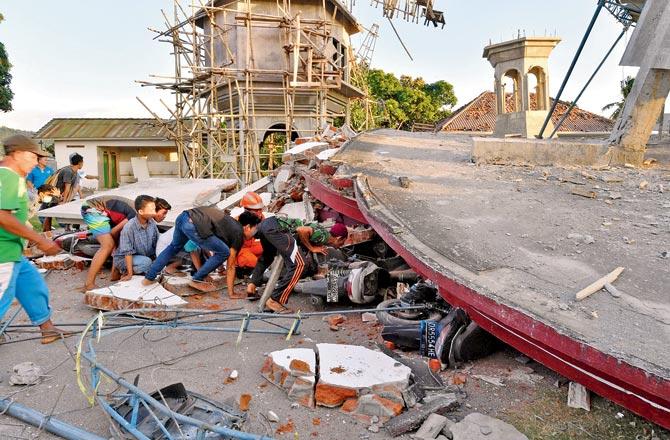
Tsunami and quake survivors eat last bit of food and seethe
Nutritious and locally appropriate food must reach those settlements, with particular attention to children, pregnant and breastfeeding women, older people, and people with disabilities. Communities should also have a say in deciding what they need. Losing a home should not mean losing dignity.
Then there is the wound that cannot always be seen: mental health.
People have lost their lives. Others have lost loved ones, family members, or even entire family lineages. Some have lost their life savings, their houses, their land—everything they had built over years. Behind every number in a disaster report is a person trying to understand what remains of their life.
The need for psychosocial support and counseling will be enormous. People will have to grieve while searching for shelter, food, water, and a way to rebuild. Nepal has already started incorporating psychosocial support into disaster response, but this cannot be a short-term intervention that disappears when the emergency is declared over.
Counselors and psychosocial workers need to reach temporary settlements, communities, and families where the grief actually exists.
Our health workers are survivors of the disaster too. Doctors, nurses, paramedics, public health workers, ambulance staff, community health workers, and psychosocial counselors are expected to keep working while the system around them is damaged. They work longer hours, travel through difficult terrain, sleep with little rest, and sometimes care for people whose stories are not very different from their own.
We cannot expect health professionals to keep giving without taking care of them too. Regular rotation, adequate rest, safe accommodation, food, transportation, protective equipment, and psychosocial support should be part of the emergency response. Those working in the most affected and hard-to-reach areas should also receive appropriate incentives and hazard allowances.
Motivation cannot be built through money alone, but neither can we ask people to work through exhaustion in the name of duty.
But even when health workers are ready to serve, another problem remains: reaching the people who need them.
Disaster response works through clusters for a reason. Affected areas within each district need to be mapped, their needs identified, and services distributed accordingly, rather than according to who can reach a particular place first. People are already saying that some communities are receiving health services while others are being left behind.
Government agencies, private hospitals, humanitarian organizations, and other responding sectors need to coordinate so that one community does not receive overlapping services while another receives none. The response should not become a competition to reach the most visible places. It should be an effort to reach the places that are easiest to miss.
For some people, reaching a hospital now means crossing another bridge, traveling along damaged roads, or walking through land still covered in mud and debris. A hospital may exist on the map, but that does not mean it is accessible to everyone who needs it.
This is where mobile clinics and temporary health camps become essential. Basic medicines, first aid, maternal and child health services, treatment for common illnesses, mental health support, and other essential services need to be brought closer to affected communities instead of expecting everyone to make the journey to a hospital.
And the response must look beyond the places we can easily see. The upper areas of Langtang are also affected when the lower part of Syapru is cut off. When a road, bridge, or settlement is isolated, communities beyond it can disappear from the reach of relief without disappearing from the map. Their supplies of food, safe water, and medicines still need to reach them.
Then there are the health needs that disasters do not erase. People with diabetes, hypertension, tuberculosis, and other chronic conditions still need their medicines. Pregnant women still need antenatal care and safe delivery services. Children still need vaccinations and nutrition. People living with disabilities still need rehabilitation.
A disaster may interrupt a health system, but it does not interrupt people's need for healthcare.
Women and girls living in temporary and overcrowded settlements may face another danger often pushed into the shadows: gender-based violence. When homes are gone, privacy is lost, families are displaced, and support systems are disrupted, the risk of violence, exploitation, and abuse can increase.
Survivors need more than emergency medical treatment. They need safe spaces, confidential reporting mechanisms, psychosocial counseling, post-rape care, and access to protection and legal services without fear or stigma.
These are not separate problems. They are connected. Unsafe water can cause disease. Poor nutrition can weaken vulnerable bodies. Displacement can deepen psychological distress. Broken roads can become barriers to healthcare. A lack of coordination can leave communities invisible. Exhausted health workers can become overwhelmed, while collapsed protection systems can expose women and girls to violence.
This is only one perspective, written from a desk in Kathmandu. There are many such places beyond what we can see from here, many communities waiting for someone to cross the next bridge, climb the next hill, and ask what they need.
The water will eventually recede. The mud will dry. The roads will be rebuilt, the bridges will rise again, and perhaps one day the photographs of this disaster will become old news.
But for the people who survived it, life will not simply return to what it was before. They will carry the loss of their homes, their families, their land, their health, and perhaps parts of themselves that cannot be rebuilt with concrete.
This is where our response must begin again—not with another headline and not only with another relief package, but with a health system that reaches the last person, the isolated settlement, the grieving family, and the health worker who has been standing there since the beginning.
Climate justice cannot end with climate finance. And disaster response cannot end when the immediate emergency is over.
For Nepal, standing by each other now means making sure that no one is left behind in the long aftermath of survival. Because a disaster may happen in a fraction of a second. Recovery will take much longer.