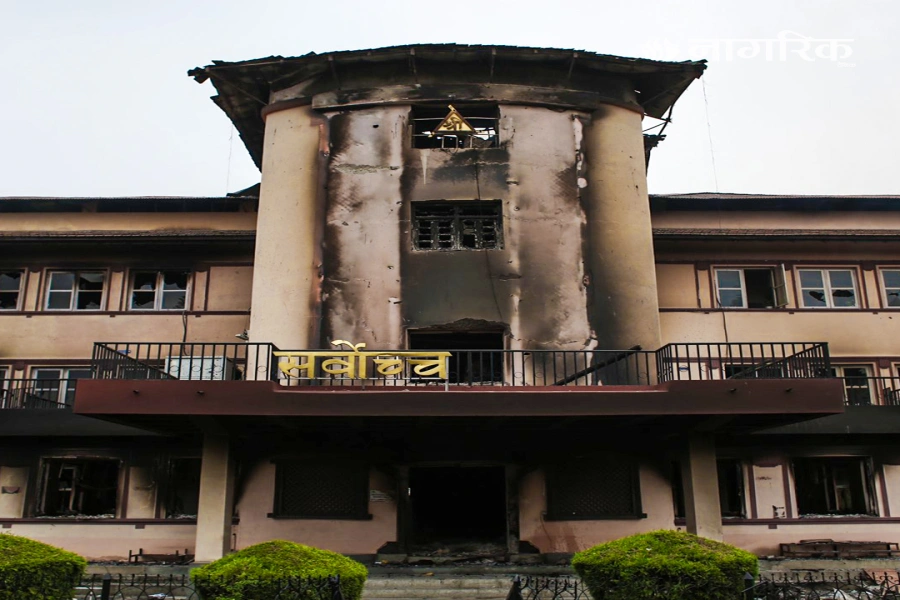
Shrestha had reached the secretariat of the Special Committee in New Baneshwar, where the talks were being held, to hand over the letter to Koirala around an hour before the top leaders signed the final deal on late Wednesday night.[break]
But, the 11-point agreement clearly stated that Khil Raj Regmi, chairman of the interim election government, would resume his work as the chief justice after accomplishing the task of holding fresh Constituent Assembly (CA) elections. “The chairman of the interim election government will return to his previous position after the new prime minister is elected,” read the agreement.
The CPN-UML was also under pressure to ask the chief justice to resign before he was elevated to the top executive post. In the UML, an absolute majority of central committee members strongly opposed the proposal to form a CJ-led government, while the standing committee remained sharply divided on the issue.
Some key leaders, including former Prime Minister Madhav Kumar Nepal, General Secretary Ishwar Pokharel, secretaries Shankar Pokharel and Yubaraj Gyawali and former CA chairman Subas Nembang, among other leaders, were lobbying for CJ´s resignation prior to his appointment as the chairman of the interim election government. On the other hand, UML Chairman Jhalanath Khanal, KP Sharma Oli, Bamdev Gautam, Bidya Bhandari and Bishnu Paudel actively lobbied for the CJ-led government.
A large section of leaders from the NC and UML have opposed the decision to form a CJ-led government claiming that the Maoist-floated proposal has an ulterior motive to drag the Supreme Court into controversy and undermine the independence of the judiciary.
The days ahead will not be easy for Regmi as the legal sector, mainly the Nepal Bar Association, is not in favor of the chief justice heading the interim election government. The lawyers´ umbrella organization Thursday said it would come up with protest programs within a couple of days.
The top leaders of the major forces despite the opposition seemed undeterred though. They decided to appoint Regmi as the chairman of the interim election government without asking for his resignation as the chief justice.
According to a leader involved in the negotiations, the talks team didn´t even discuss if Regmi´s resignation as the chief justice was necessary before he assumed the top executive post.
“We didn´t discuss the issue. Instead, we focused more on finding common grounds so that the CJ-led election government could materialize,” UML leader Bhim Rawal told Republica. He said that if the government and the political leadership succeeded in creating grounds for fresh polls, opposition against the decision of the four major political forces would subside.
On the contrary, the disgruntled groups are relentless in their opposition against the decision. Terming the Wednesday´s agreement an unfortunate deal, former home minister Khadka said NC President Koirala signed the agreement against the party´s official decision. He also accused the leaders of blatantly violating the basic democratic principles of separation of powers and of making a mockery of constitutionalism by amending several provisions of the interim constitution invoking the provision on removing constitutional difficulties.
Asked about their next move, Khadka said they are still holding discussions.
Also, UML Spokesman Pradeep Gyawali believed that the leaders from major political parties will face a tough time from within and outside the party if the CJ-headed government fails to conduct fresh polls. “If they could create a ground for election and lead the country toward a solution, both the party rank and file and the people will soften their protests against the leaders,” said Gyawali.
But some other leaders said that the second-rung leaders were dismayed as top leaders from the major political forces were “pigheadedly” working to form a CHJ-headed government against the voices of majority members in the party. A leader said, “It is worrying that the leaders showed little respect to voices in the party committees.”
Asked about dissenting voices in their parties, both NC President Sushil Koirala and UML Vice-chairman Bamdev Gautam said that dissent is a part and parcel of democracy. “There are always dissenting voices in the parties,” Gautam told media persons after Regmi was sworn-in at the president´s office.
The growing dissent within the parties that signed the agreement and the protests in Regmi´s own fraternity indicate that holding new elections is going to be a tall order for the newly-appointed executive head and the political leaders. Moreover, other 22 political parties that stayed out of the process have already taken to the streets.
Still, holding polls might be possible only if the top leaders of the major political forces manage intra-party dissents within their respective parties and extend sincere support to the technocratic government.
Related story
UML leader Yogesh Bhattarai registers a ‘note of dissent’ over...