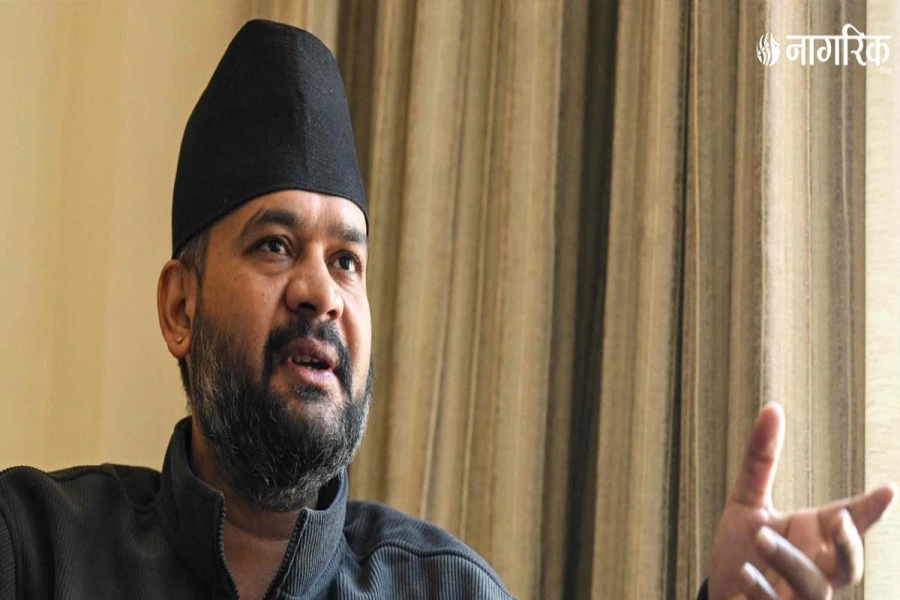
The national cadres´ convention was called with an objective. The convention had to be called in the wake of frequent gushing out of differing and contradictory views on various issues of national interest from responsible party leaders. Last week´s cadres´ convention was called to conclude on those views, which are now synthesized in the official party document. In the convention and the central committee, as expected, we fought a superior quality battle that has led us to a new synthesis.
There were three things that gave rise to the differing views. The first was ideological. Second was the way of looking at our struggle and decisions taken in the past. Thirdly, and the most importantly, the party urgently needed an immediate course of action when the country has already hit the road of making a new and progressive constitution. We needed to trigger discussion on this. To sum up the outcomes of the cadres´ convention, what we can say is we have finalized the immediate course of action of the party, and the ideology-related issues and assessment of our struggle and past decisions will be finalized in the party’s forthcoming national congress. Since the immediate work to be done is the making of the new constitution, our immediate course will also revolve around this.
The cadres´ meet decided that the party´s immediate course should be the "People´s Federal Democratic National Republic". We deliberated on whether this slogan would be too long and impractical. We signed off on this slogan because we needed to have the people´s aspirations reflected in it: Madhesis, Janajatis and various ethnic groups love to see "federal"; everybody wants to see "democratic"; we needed to have "National" because a host of nationalism-related issues have emerged; and, all Nepalis want republic.
New dimension:
By holding the cadres´ convention, we have attempted to add a new dimension to the history of the communist movement because traditionally, communists are guided by the principle of not tolerating differing views to be spilled over on somebody´s will. This tradition has made communists monolithic, which was very much prevalent during Stalin´s time. Mao introduced changes to this, while leading the Cultural Revolution.
In our context, we practiced limited intra-party people´s democracy. Though intra-party democracy was needed the most, we didn´t do enough. So, the cadres´ meet was a step forward in this direction. Democracy shouldn´t be limited only within the party. It has to go down to the grassroots. The demise of socialism can be attributed to this. If we also move ahead in the path of traditional socialism, according to the rule of science, that´s where we also end up ultimately. Since we haven´t come this far for a doom, drawing lesson from the demise of the Soviet bloc, we have to look into how we can protect the 21st century socialism. Why has the capitalism that has lot more drawbacks survived and why does socialism, which is a better system, fall? Because, there is no practice of people´s democracy in traditional socialism, we couldn´t give discontents a way out. So, our exercise has global significance.
In our party´s context, there were differing views right from the grassroots level that reflected in the leadership. Synthesis of the views at the leadership level will now trickle down to the grassroots level.
Time when the differing views start to emerge:
We, as a party, changed our course when we changed the form of struggle. We entered into a new process, by taking a great deal of risk. This led a section of the party – from the top to the bottom – to ponder whether we made a mistake. Questions were raised on the everyday work and behavior of the party and its leaders. Line struggle doesn´t take place at once. First, there are criticisms, self-criticisms. The party debates on why that happened. But, when there is a clear line of such things, this takes a shape. Today, our party has taken a shape, which amounted to a two-line struggle in our party.
There isn´t anything like hard-liner or soft-liner in our party. This is something planted by the media or other quarters. I don´t think I am a hardliner and others are soft-liners. As far as my support to the political papers presented by Comrade Kiran and Comrade Prachanda is concerned, I am certainly in favor of Kiran´s paper. There are ideological and political factors behind this. This depends on which political course is proposed for the party´s future. I think Comrade Kiran´s paper has hit the right chord. I think this is more progressive. Its strategies can transform our society in true sense and can lead the country to a right direction. I can´t spell out specific points of any of the papers for some reasons.
Given the cadres´ votes on the two-line struggle, we have to make a new synthesized paper by merging the both. We have come up with a consensus paper, where a struggle was involved. Had there been no struggle, we wouldn´t have come to this point. The good thing is that the synthesized paper, which rightly represents the present day reality, is better than any individual paper.
CPN-M on international relations:
The meeting didn´t conduct any review of our international policy. However, the new paper has analyzed and reviewed the international context. One of the papers had presented an analysis on the situation of an enemy camp and contradictions of the camp. Another paper had analyzed what the revolutionaries are up to. The synthesized paper has the both.
International Maoists were not satisfied with our party line. Constituent parties of the Revolutionary International Movement (RIM) were of the view that CPN-M had adopted a wrong path by adopting a "bourgeois republic". They had the suspicion that CPN-M abandoned its principles and ideologies. Though they didn´t think that our party was opportunist or revisionist, but they felt that we were in that direction. They have been trying to alert us. We are yet to see what their response would be after we adopt the political course passed by our cadres´ convention.
Contacts with Indian Maoists:
Until some time ago, we used to have meetings, exchange documents with Indian Maoists or "Naxalites", which make a banned outfit there. For some time now, this hasn´t happened in a direct way. This is happening only indirectly. They have been giving open remarks on CPN-Maoist. When two parties are interacting well, they don´t express their views through the media. They coming to open means we are not having close interactions. About one and half years ago, we had organized an international seminar in Kavre. Indian Maoists too had participated in that seminar. We don´t have direct contacts with them after that.
However, CPN-Maoist is still a member of Coordination Committee of Maoist Parties and Organizations in South Asia (CCOMPOSA), of which CPN-Maoist is a founding member. We support or oppose any Maoist movement in an individual country only after looking at on what ground they have waged the movement. Basically, we have been supporting the Maoist movement in India. However, we have also been criticizing their mistakes. Unlike media reports suggest, Indian government so far hasn´t requested us to convince the Indian Maoists to come to the mainstream.
Relation with other parties:
On relation with other parties, we first have to make an analysis of and identify friendly and enemy parties. We have made an assessment of political contradictions. Though the main pillar of feudalism, the monarchy, has fallen, feudalism is still there in the social sector, economic sector and in the politics. Secondly, foreign interference has also dramatically shot up. Nepalis have contradictions with the both. When we deal with any political party, we will try to see if they also have contradictions with these two or they are nurturing the both. This will be the basis on which we will determine what distance we should maintain with each political party.
When we look at Nepali Congress (NC) with this prism, what we see is this party is drifting itself away from representing progressive class or ideologies.
On army integration and UNMIN:
We had invited UNMIN basically for army integration. Standing here, what we see is, practically, army integration is not going to happen any time soon. NC has refused so far to stay in a temporary committee on army integration. There are ample indications that the army integration process can´t go ahead smoothly, thanks to NC´s refusal to stay in the committee. We can´t seal up the integration process by ignoring Congress.
But, even when NC is in the committee, it will definitely try to impose its formula. It will come with the intention of bargaining. So, it won´t again go very smoothly. It will anyway take a zigzag path and take longer time than expected. The integration process has already hit a roadblock, it is already delayed. I don´t think NC will look for an alternative to the army integration by rejecting it altogether.
Having said that, we have to see the army integration process and peace process in isolation, though they are interrelated. We can take them forward simultaneously.
In the face of UNMIN´s term expiring in two months, the question on whether to keep UNMIN seeks immediate answer. It is not a problem related to a principle. This is a practical problem. We don´t want to keep UNMIN here for long, but it is going to be our compulsion.
We haven´t seen any negative role of UNMIN in army integration and the political process. We haven´t found in the UN´s work any biasness or intention to sabotage the process. However, it´s natural for us to have contradictions on certain issues. Extension of UNMIN´s mandate is the necessity of the day.
(As told to Tilak Pokharel, tilak@myrepublica.com)
(Gajurel is the Central Committee member of the CPN-Maoist and the head of the party’s International Bureau.)
Related story
Journalists who perished in the Maoist armed conflict in Nepal
_20230114102317.jpg)


-1200x560-1774606010.webp)
-1200x560-1783685616.webp)