




KATHMANDU, Nov 1: Nepal’s plan to become a ‘tuin’-free country has hit a setback, with the number of cable crossings rising to 24 across the country.
The increase follows the August 26 Bhotekoshi-Trishuli floods, which destroyed numerous motorable and suspension bridges, forcing authorities to install four cable-car-type tuins in Rasuwa and Nuwakot as temporary crossings. Locals have also installed tuins along the Karnali and Mahakali rivers where bridges are unavailable.
Of the 24 existing tuins, 20 are considered risky and four relatively safe. Eight are in the Karnali, 12 in the Mahakali, and four were recently installed in Rasuwa and Nuwakot, according to Shankar Budhathoki, joint secretary at the Ministry of Physical Infrastructure Development and chief of the planning section at the Suspension Bridge Division (SBD) under the Department of Local Infrastructure Development.
Bridges Promised, Tuins Persist
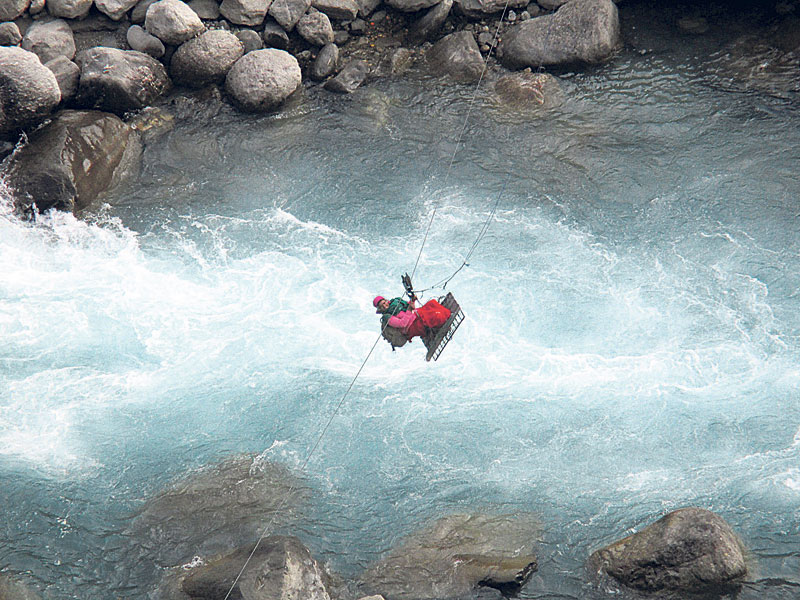
The government’s campaign to eliminate tuins began with a Cabinet decision in 2015. At the time, 143 tuins had been identified nationwide. By 2023, 141 had been replaced with suspension bridges, leaving only two due to technical and administrative hurdles.
The four recently installed crossings are in Syabrubesi, Hakubesi, Devighat and Indrayani in Bidur. Budhathoki said they have become crucial for local movement and relief supplies following the floods, with people sometimes waiting two to three hours to cross.
“Without the tuins, helicopters had to transport relief materials. Now, supplies are being transported through the tuins, significantly reducing costs,” he said.
The government plans to replace the four crossings in Rasuwa and Nuwakot within a year. It also plans to eliminate the tuins in the Karnali within the same period.
Replacing the tuins in the Mahakali, however, requires approval from India as the river forms an international boundary. The government has already sought India’s consent, Budhathoki said.
The two tuins that remained in 2023 were the Pancheshwar tuin in the Mahakali and the Bugadhagad tuin in the Karnali. Construction of a suspension bridge at Pancheshwar requires Indian approval, while the Bugadhagad site falls within Bardiya National Park, where permission to build a bridge had not been granted.
The SBD constructs bridges longer than 120 meters, while shorter bridges are built by the Trail Bridge Support Unit in coordination with District Coordination Committees. Building suspension bridges in remote areas can cost nearly twice as much as in accessible locations, according to the division.





