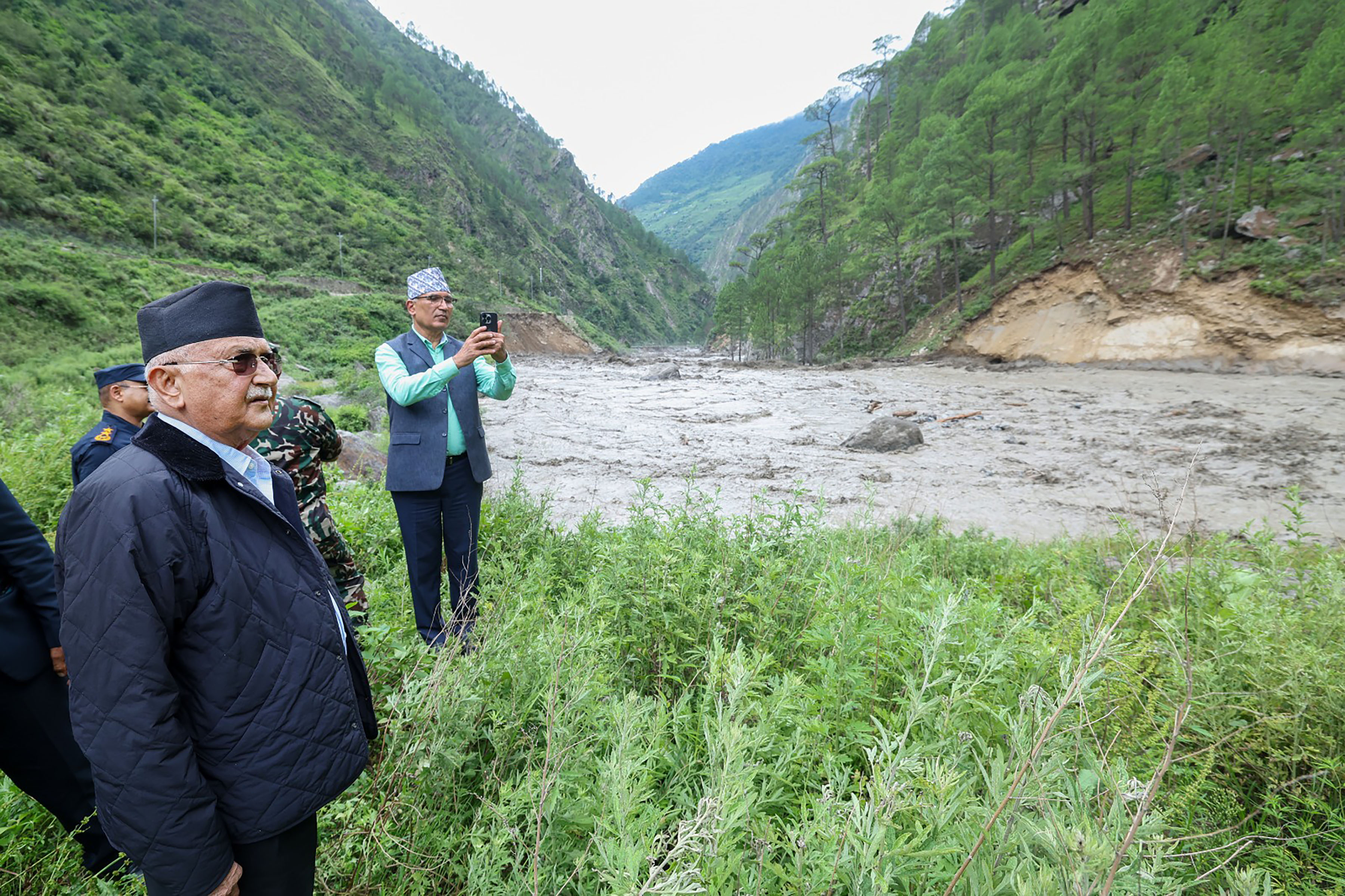
RASUWA, Aug 28: A massive flood triggered by the sudden outburst of a dammed lake in Tibet swept downstream through Nepal’s Bhotekoshi River on Wednesday morning, devastating Timure Bazaar, Syafrubesi, and other towns along the Trishuli River corridor. The disaster destroyed homes, shops, government offices, police posts, customs yards, bridges, and road infrastructure, while leaving a large number of people missing. The flood’s impact extended downstream into Nuwakot, Dhading, and riverbank areas along the Trishuli River.
The catastrophe has raised urgent questions: despite Nepal’s early warning systems and China’s advanced monitoring technologies, why did timely alerts fail to reach Nepali authorities and vulnerable communities?
Cause of the Flood
Preliminary assessments suggest that a landslide blocked the Lhendhe River about 25 kilometers upstream of Rasuwagadhi, forming a temporary lake that later burst. Disaster expert Dr. Basanta Raj Adhikari said limited information and consultations between Nepali and Chinese scientists point to this scenario, though satellite studies are still underway to confirm the exact cause and water dynamics. Climate change specialist Arun Bhakta Shrestha also noted that such sudden glacial and landslide induced events are increasing in the high Himalayas, underscoring the need for stronger early warning systems.
The Missing Hours
Local bodies in Jumla all prepared to launch early warning, pre...

Experts estimate the flood took several hours to travel from Tibet into Nepal. If rising water levels or the lake breach had been detected earlier, alerts could have been issued to border settlements, security agencies, customs offices, and roadside communities. Witnesses in Timure, however, reported receiving no effective warning before the flood struck. Customs officer Rajendra Dhungana said staff felt tremors “like an earthquake” before rushing outside to see a massive surge of water and debris engulfing the area. Hundreds of electric vehicles and trucks parked at the customs yard were swept away, and communication with staff on duty at the Nepal–China Friendship Bridge was immediately lost.
Weak Cross Border Coordination
The incident highlights a critical gap: early warning is not just about technology but about how quickly and effectively information is shared across borders. Shrestha stressed that Nepal lacks adequate monitoring systems in the high Himalayas, while China has advanced facilities. A permanent mechanism for real time data exchange and emergency communication between the two countries is urgently needed. As experts warn, even a few minutes of advance notice can mean the difference between life and death for hundreds of people.
Police Posts Washed Away
The flood damaged three police posts in Rasuwa. According to police headquarters, the Timure Area Police Office was completely swept away, while Rasuwagadhi and Syafrubesi posts also suffered heavy damage. Of 43 officers stationed across the three locations, only 17 were in contact by Wednesday morning, with 26 still missing. Search and rescue operations are ongoing.
Downstream Impact
The flood’s effects reached the Trishuli River basin, inundating markets in Nuwakot including Trishuli Bazaar, Dhunge Bazaar, Devi Ghat, Betrabati, and Tupchel. Water entered Nuwakot prison, and several bridges were damaged. In Dhading, sections of the Prithvi Highway were submerged. Police reported floodwaters extending as far as Malekhu in Galchhi Municipality. Damage to hydropower projects remains under assessment.
Risk Persists
Authorities caution that the danger is not over. China has reported that the upstream lake has not fully drained, meaning Bhote Koshi and Trishuli rivers remain at risk. Nepal’s Department of Hydrology and Meteorology issued an urgent bulletin at 1:30 p.m. on August 26, urging residents along both rivers to stay away from riverbanks and avoid unnecessary movement until further notice.
Rescue and Relief
The government has deployed the Nepali Army, Nepal Police, and Armed Police Force to intensify search and rescue operations. Prime Minister Balen Shah convened meetings with federal lawmakers from affected districts and directed authorities to relocate displaced residents to safe areas. Relief distribution is underway, though damaged roads, bridges, and communication lines have complicated efforts.
Lessons for the Future
The Rasuwa disaster underscores that early warning systems are not merely about servers and sensors — they are life saving mechanisms that must function across borders. The failure to deliver timely alerts raises pressing questions: Was the lake breach detected in Tibet? If so, why was the information delayed or withheld? If not, what improvements are needed in monitoring? Without answers, Nepal risks repeating the same tragedy in future Himalayan floods and landslides.
For now, authorities urge residents in Rasuwa, Nuwakot, Dhading, Gorkha, and Chitwan to remain vigilant, avoid riverbanks, and follow official instructions. Police have also warned against spreading unverified or AI generated misinformation on social media. The immediate priority remains saving lives — but the larger challenge is ensuring that early warning systems truly serve their purpose when the next disaster strikes.