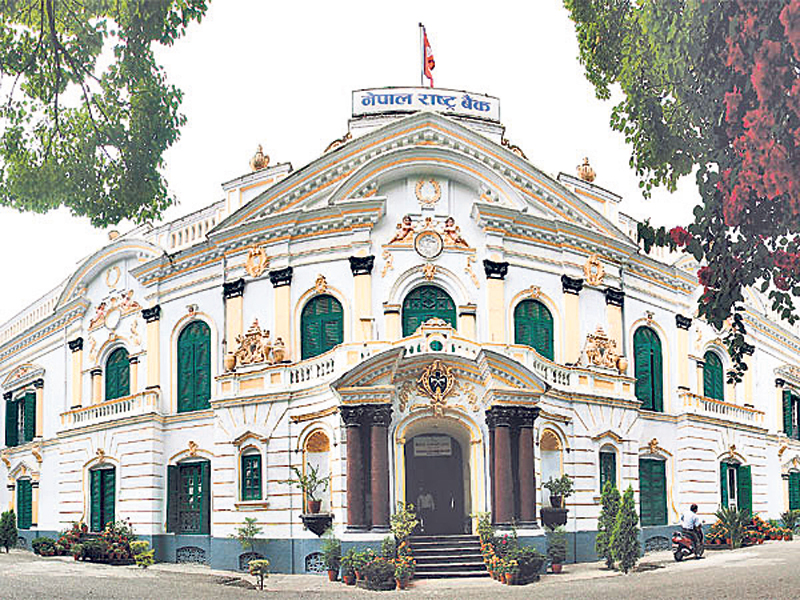
It is well-known that Nepal’s monetary policy is driven by the Nepal Rastra Bank Act of 2002 in which stabilization in the prices and stability in the financial sector and external front are the principal policy goals. It does not foresee any direct role of the policy in economic growth and sustainable development. Instead, it implicitly assumes that the stabilization role will be more than sufficient to create an enabling environment. It is therefore not surprising to see the policy goals broadly on the same line. What is surprising, however, is that there is no explicit mention on the failures of the policy.
In the policy, the inflationary targets fixed are the same as last fiscal year at 7 percent. In the Balance of Payments (BoP) front, a modest surplus at Rs 9 billion has been projected as against a large deficit recorded last fiscal year despite projected surplus of Rs 18 billion. Only marginal difference in the money supply and private sector credit targets is found between the two. Amidst these, whether there are, among others, significantly departed policy instruments that, contrary to the last fiscal year, could enable to translate targets into real achievements is the major area of inquisitiveness.
Although some new initiatives are there in the new policy, more bold steps correcting the failed monetarist approach perpetuating systemic crisis are expected in the full-fledged policy supposed to be announced after the budget.
Definitely, the new policy has made some appreciative attempts, even if modest, at addressing some of the systemic problems perpetuating in the banking and financial system overtime. The priority on productive sector investment and financial inclusiveness with focus on increased access of deprived areas to the financial or credit services are example of this. The upper interest rate ceiling fixed to the commercial banks under various refinancing facilities is also in the right direction. Indeed, the interest rate rebate was being used to derive profit through different unhealthy means. Various additional measures have also been proposed to enhance prudential or regulatory role of the central bank aimed at minimizing risk or enhancing stability in the financial system. But the broad policy directions continued following the same failed monetarist assumptions amidst severity of the systemic crisis posing downside risks. The contradictions and limits inherent in such a policy course coupled with exogenous factors add to the challenges.
Under such a policy course, primarily the unproductive activities including consumerism could flourish. Very cheap interest rate including quick profit-yielding culture through whatever means worked as catalysts toward that end. Such a trend together with the increased inflow in remittances contributed to the proliferation of the banking and financial institutions massively. It indeed created bubble type phenomenon in real estates and stock markets. Some correction was possible in stock market after some steps. In short, casino-type economy thrived with too much urban concentration. Priority sector lending was waved for facilitating that process. Amidst increased trade, both trade and financial capital concentration process amplified on a big scale. It is apparent that the gap between haves and have-nots, too much external dependency and vulnerability of the economy exacerbated immensely at the time of such a policy course, which is still predominant.
Indeed, the stabilization policy was distorted in a way that actually became detrimental to ease supply-side constraints, including growth in agriculture and industry, among others.
The limits of such a course were exposed when widening current and capital account deficit created serious liquidity crisis in the financial system. At the same time, contradictory to the policy priority, two-digit-level price rises were continuing amidst deceleration in the economy. Thus, a very typical and contradictory phenomenon escalated contrary to the premises of the ongoing monetarism led policies. In such a paradoxical situation, the external crisis compelled to impose lending caps in the real state-related activities, including regulation in gold import, which have been continued by this year’s policy also. This means that some stopgap measures have been continued rather than bringing noticeable changes in the policy routes to address the systemic crisis. A decisive policy route of augmenting productive investment, easing supply-side bottlenecks and correcting structural impediments was necessary, which is not explicit in the new policy. It is well-known that the private banks or financial institutions cannot lend in productive sectors, including industry, without sufficient incentive structure. There is no such broad scheme in the policy except some limited isolated refinancing or interest rebate facilities in specific areas. At the most, some attempts to shift responsibilities to the commercial banks have been made in this respect.
Similarly, it seems the financial inclusiveness is somewhat guided by a policy of appeasement rather than by a coherent approach correcting past mistakes. On the one hand, the policy of privatizing Banijya Bank and Nepal Bank Ltd is underway, added by probably new initiatives to privatize Agriculture Development Bank. On the other hand, limited financial inclusiveness policy is being pursued now through the private banks. It will be difficult to make such a paradoxical policy really inclusive and sustainable. It is worth mentioning that the wholesale banking accompanied by micro-credit institutions have failed either to fulfill the gaps left by the government-owned banks or to meet rising credit demand at an affordable interest rate.
The money supply, credit and interest rate policies are regarded as the heart of the policy to control inflation and also to make some positive contribution on the external front. They are again guided by monetarist principles. In this respect, it is instructive to recall that when arguing in favor of monetary policy as opposed to fiscal policy, certain assumptions were advanced by the monetarists. On the assumption of higher marginal propensity to save, higher interest elasticity of investment and low elasticity of demand for money, monetary policy was claimed to be effective in stabilizing economy in the developed and developing countries alike. They viewed that fiscal expansion only crowd out private investment. These are questionable assumptions in the context of the developing countries that too are hardly verified empirically. This means that a revisit is necessary on the ground reality of Nepal. Indeed, it will be useful to institutionalize a system of ex-ante assessment practices of key policy instruments before implementation to know in advance their likely ramifications. Hope, such initiatives are underway in the central bank.
There is another route assumed to play a catalyst role in making monetary policy effective in open economies. The popular Mundell-Fleming model which is also based on the neo-classical market equilibrium framework argues that monetary policy can be effective only if the exchange rate is flexible. In that case also, when the price effect of automatic currency depreciation in a situation of trade deficit is captured, the impact is more or less blurred. In an open economy with a predominant trading partner amidst fixed exchange rate regime, role of the monetary policy in correcting the burgeoning external imbalances becomes quite limited in the context of Nepal.
In summary, drastic monetary policy shift, financial transparency and integrity are the buzzwords today in the aftermath of the financial crisis. Despite this, there are still attempts to force countries like Nepal to pursue the same old-fashioned stabilization-centric tight monetary policy in distorted form without reference to country-specific supply-side and structural-led constraints. Now the time has come that the central bank, unlike in the past, becomes a catalyst of growth and development for making stabilization objective a real success. Although some new initiatives are there in the new policy, more bold steps correcting the failed monetarist approach perpetuating systemic crisis are expected in the full-fledged policy supposed to be announced after the budget.
Related story
Monetary policy to be unveiled next week: NRB Governor Adhikari