During one of his concerts in the US in 2007, an American audience walked up to him and questioned, “I don’t understand why we should watch your concert. Your music is no different from ours, and we don’t understand Nepali. Is it just your language that makes it Nepali music?”[break]
Bajracharya admits it was not the first time that he received such a remark during an international music tour. “We simply shrugged it off earlier,” he says. But that particular time, the comment struck him, and made him think.
“We collectively felt that we had not really ‘contributed’ to the Nepali music industry. To be honest, I was quite proud that Nepali people loved us, appreciated our music and we were really happy with that recognition. But when we looked back at all of it after that striking remark, we felt that we were living in illusion,” Bajracharya affirms.
Back in Nepal, Bajracharya, along with his band members Rikky Shakya, Firoz Bajracharya, Rojan Kayastha and Bikky Shakya, started working on a project with a mission to search for their unique musical identity. “We decided to incorporate the beats and rhythm of traditional Nepali musical instruments into the pop genre. But I admit, we had highly underestimated the load of task that lay ahead us,” he says.
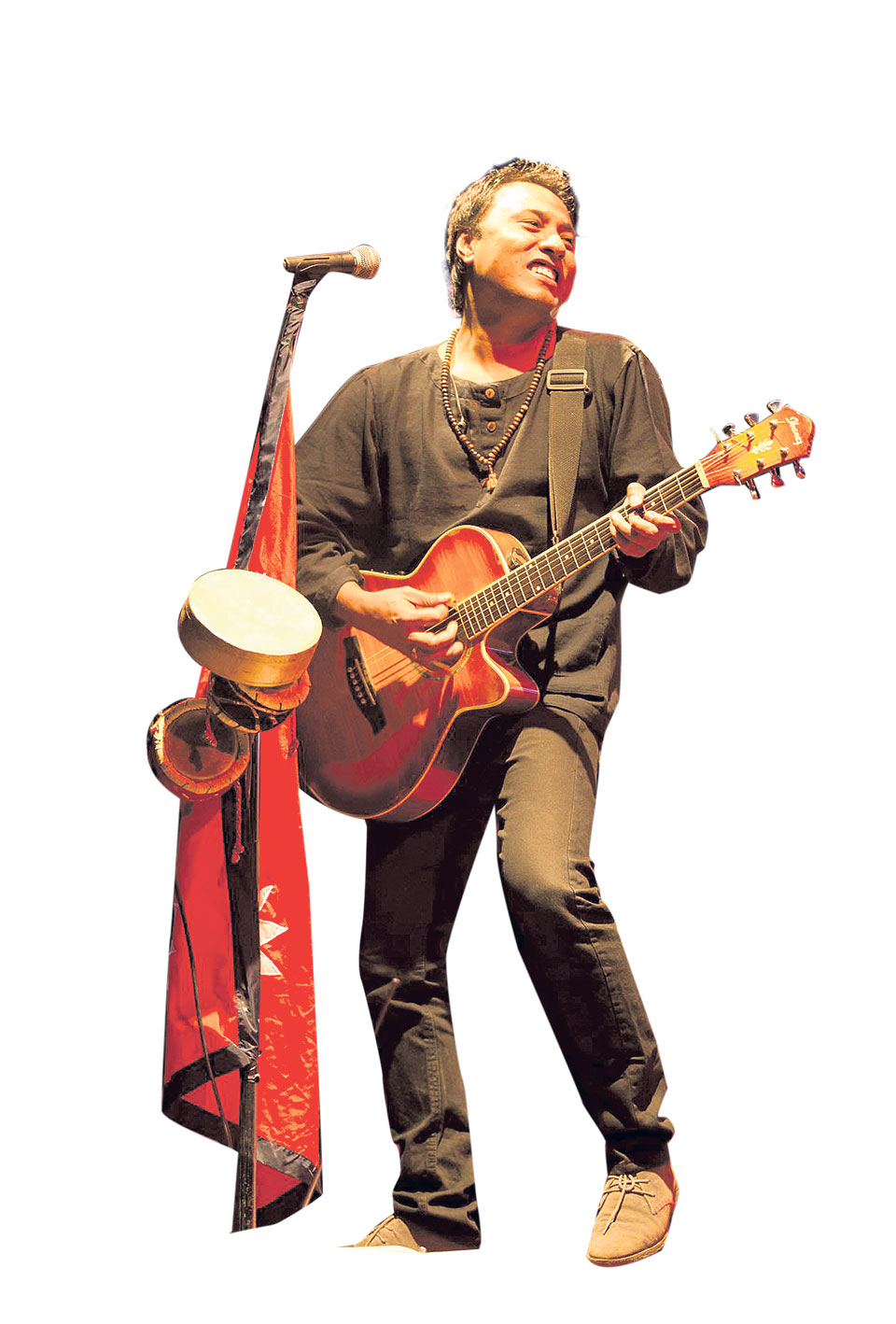
Determined and focused, Bajracharya and his team chose Damaru, a common musical instrument most Nepali children have memories associated with, to start their research. “We chose Damaru because of its simple structure and the fact that it’s mostly played by Jogis and Sadhus. We went to Pashupatinath to jumpstart our project. It took us more than two days to find proper information about this so-called ‘simple’ instrument,” he recalls.
On their further quest to understanding traditional Nepali musical instruments used by various ethnic communities, Bajracharya remembers not being taken ‘seriously’. “The experts tried to get away by providing us with only surface-level information. But when we showed our continued interest, they were rather impressed with our enthusiasm and finally offered us all they knew,” he exclaims.
Lack of documented information and conflicting opinions made their research tedious and often confusing. In the course of time, a project that started off with 19 team members expanded to a whopping 34. Bajracharya explains, “After some time, we realized that we still hadn’t included many significant musical instruments. Our fusion would be incomplete without them. Since we couldn’t assign all the instruments to one individual, we had to embrace more members in the team.” The full-fledged team is now called ‘Cream of Rhythm’, where a wide range of beats and sounds blend perfectly into one balm of rhythm.
However, suspense still loomed above Bajracharya’s head as to whether the audience will appreciate their effort or not. As a trial to their ongoing research, a concert was organized at Patan Durbar Square three years back, where the team performed a medley of Bajracharya’s hit songs ‘Oh Amira’, ‘Kali kali hissi pareki’, etc to which a crowd of more than 10 thousand cheered. “It was our first effort at presenting our fusion of Western and Nepali music with singing involved, and the audiences’ response confirmed that our efforts hadn’t gone in vain,” he says.
The research has been going on for six years now, and Bajracharya believes there’s still a long way to go. However, very soon, Nepali music lovers will get to taste their musical offering. A documentary of their research including music videos of the songs they’ve prepared will also be screened in about a month.
They have also conceptualized a gallery of authentic Nepali musical instruments. “We don’t want to let go of our research just like that. The gallery will be like a one stop for all information on Nepali music. The visitors will be able to not only see unique musical instruments on display but a demonstration of how they are played will also be arranged,” he shares. He further informed that the team is currently lobbying for a free space of about 1700 square feet for its establishment.
“It’s a new beginning for me and my team, and all of us are really excited about it because at the core of it, our effort doesn’t just intend to entertain people. We want to have an identity of our own, and in the process, help conserve our precious musical heritage,” Bajracharya concludes.
Related story
5 Things About Deepak Bajracharya