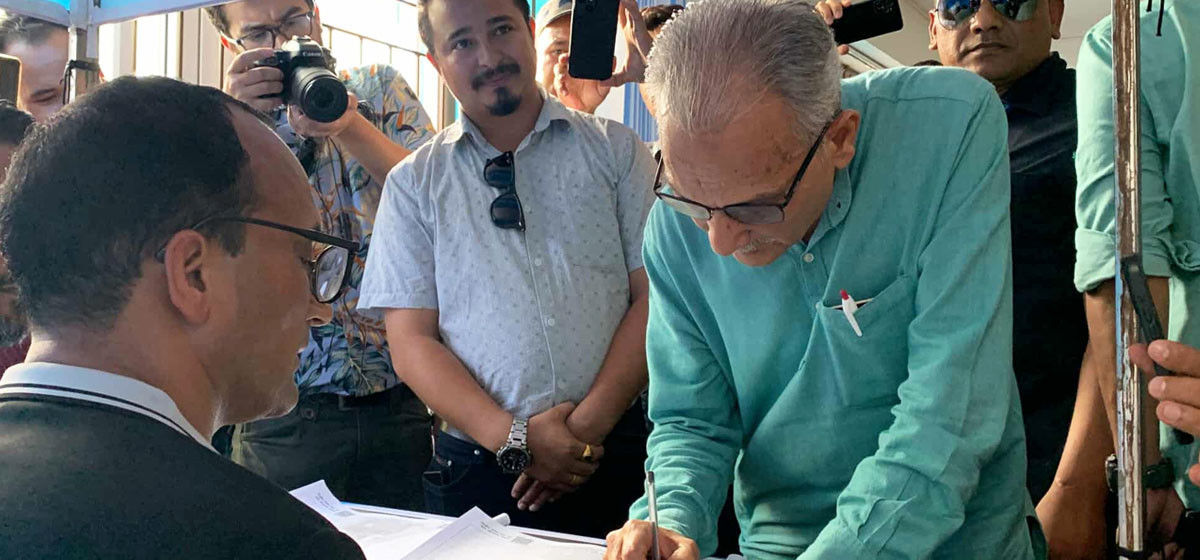
Minister for Information and Communication Technology Sherdhan Rai on Monday said President Bidhya Devi Bhandari will launch the digital signature amid a function on Wednesday.
Digital signature is a government-certified identification code attached together with a message to authenticate digital documents and emails by the sender to verify that the document is actually generated by the sender or the signatory who send the document to ensure that the document sent is not modified.
Though the government had launched digital signature back in 2012, it has not come into implementation yet in the absence of necessary infrastructure.
"Now we have readied all the required infrastructures. We will launch digital signature by providing digital tokens to President Bidhya Devi Bhandari, Prime Minister KP Sharma Oli and Minister for ICT Sherdhan Rai on Wednesday itself," Birendra Mishra, director general of Office of the Controller of Certification (OCC), said.
He also said general public would be able to get digital signature after 15 to 20 days. "There are some legal and payment policy to be discussed before digital signature is issue to public," he added.
Once digital signature is launched, bank and financial institutions, travel agencies and governmental agencies that conduct e-Transaction can be assured on payment security.
"Now that we are launching digital signature, all digital transaction can be authenticated using a digital code," said Mishra.
MINISTRY TO FOCUS ON EXPANDING INTERNET ACCESS IN RURAL AREAS
Meanwhile, Minister Rai said that his main focus would be to make Internet available in every VDC office, health center, school, college, post office, and airport in remote areas.
Talking to officials of Tech Journos Forum on Monday, Rai said that he will focus more on making whole Nepal a IT zone by utilizing Rural Telecom Development Fund (RTDF). "We will lay optical fibers along East-West Highway. Similarly, we will use wireless technology to ensure that the remote areas are connected to Internet," said Rai.
MoICT is also planning to strengthen Nepal Telecom's infrastructure by using RTDF. The government plans to use state-owned telecom operator to provide Internet service in rural areas.
"We are working to auction off 4G frequency at the earliest. For that, we are meeting with officials of Nepal Telecommunications Authority (NTA) very soon," said Rai.
The government is planning to roll out 4G Internet service in urban areas as demand for high speed Internet is growing in recent years. However, telecom service providers are yet to get frequency to roll out 4G service even though NTA had identified spectrum bands for the technology three and half years ago.
Related story
PBL, NCCPL sign agreement for digital signature