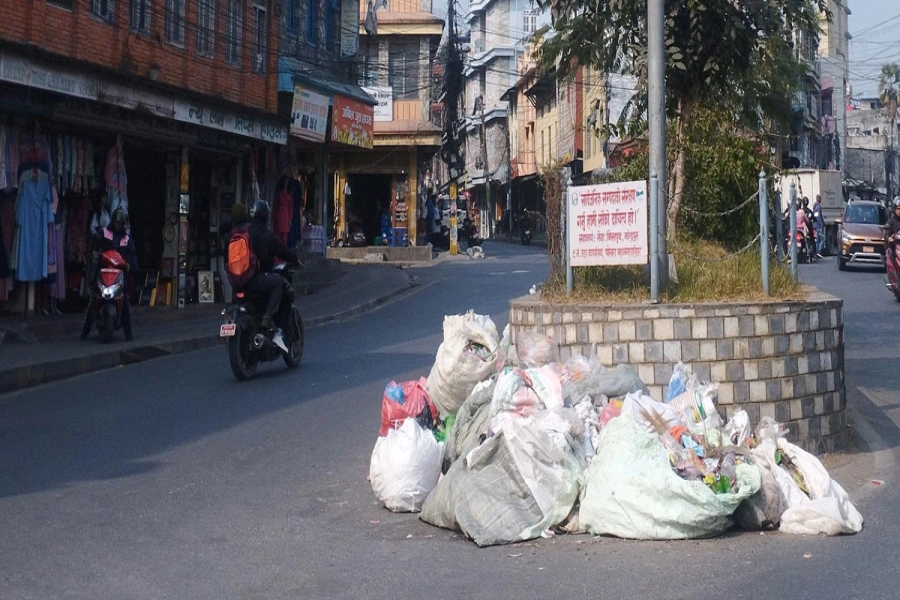
POKHARA, Jan 30: Waste management in the tourist city of Pokhara has yet to return to full operation. Even after more than two weeks, piles of garbage remain visible at various intersections across the city. While the metropolitan city has managed to clear some waste dumped along roadsides, household garbage collection has not resumed, leaving trash piled up inside many homes.
According to the metropolitan city authorities, the problem has escalated due to growing disputes over a new waste management site. Previously, waste was managed at Lameahal in Pokhara Metropolitan City–32, but the site has now reached full capacity, forcing the city to search for an alternative location. As garbage continues to pile up in homes and along roadsides, the entire tourist city has begun to reek of foul odour.
The metropolitan city says it has been unable to collect waste because the Lameahal site is full and a new location has not yet been finalised. Although discussions are underway to identify a new site, no concrete decision has been made so far. While Majuwa in Pokhara–32 has been identified as a possible temporary solution, the matter remains unresolved.
The art of creative reuse : Upcycling waste and upscaling the e...
On one hand, garbage has accumulated on roads due to the lack of a landfill site; on the other, plans to build a modern waste processing centre at the Jhankri khola landfill site in Pokhara–33 have triggered protests from locals. Information officer of the metropolis Krishna Prasad Tiwari said discussions are ongoing to temporarily manage waste in Majuwa after failing to secure a new site. Since Majuwa is located close to Lameahal, the city is considering setting up temporary structures there for waste management. However, even waste disposal at Lameahal has faced intermittent obstructions.
“Lameahal has reached its full capacity. Since we couldn’t find a new site immediately, we had to look for alternatives,” Tiwari said, “Disputes during the process of identifying a permanent site have halted waste collection. Still, efforts are being made to manage waste through temporary arrangements in Majuwa. Waste management could resume within a few days.”
He added that as the city began to stink due to uncollected garbage, waste dumped along roadsides was collected and buried in pits dug within public land inside Pokhara. According to him, pits were dug on land owned by the metropolitan city, where fire engines are stationed, and garbage was buried there.
“When garbage piled up on the roads, the stench became unbearable. So we collected it and buried it to manage the situation. However, waste accumulated inside homes has not been collected yet, and it may take some more time to clear household garbage,” Tiwari said.
The prolonged waste management problem has drawn sharp criticism against the Pokhara Metropolitan City. Public dissatisfaction is growing as garbage remains piled up along roads in the country’s tourism capital. Locals fear that if waste collection does not resume soon, the foul smell will worsen further.
When Pokhara Regional International Airport came into operation, the metropolitan city had shut down the old landfill site at Bachhebuduwa in Ward No. 14 and began managing waste along the Seti River bank at Lameahal in Pokhara–32. Despite local opposition, waste dumping continued there for six months. However, as the site has now filled up, the city has been forced to look for a new location, Tiwari said. He added that the metropolitan city is now focusing on managing waste in Majuwa while prioritising development activities.
Pokhara generates 150 to 200 tonnes of waste daily, excluding industrial and hospital waste. Garbage within the city is collected using 20 vehicles every day. The metropolitan city has assigned waste collection responsibilities to six private companies, which collect garbage from households after charging service fees.