Yubaraj Khatiwada, whose term as the governor of Nepal Rastra Bank ended last week, has earned a lot of appreciation for initiating vital institutional reforms in the banks and financial institutions. But how difficult was this journey? What did he do? What challenges does our economy face at the moment, how to overcome them and what are his recommendations for the new governor? Mahabir Paudyal and Sagar Ghimire caught up with him Wednesday afternoon.
Related story
Making a great first impression at an interview

What were the challenges facing Nepal's banks and financial institutions and business sector when you assumed the post five years ago?
How so? Will you please elaborate?
We had a number of financial institutions expanded but our supervisory capacity had not expanded accordingly. Our on-site supervision was also weak in terms of frequency and quality. We did not have qualified human resources in the higher management of banking industry, which had resulted into anomalies. We had to stop that. So first thing to do was to stop receiving applications for licensing. But since our agenda was also financial inclusion and outreach, we just could not stop licensing "D" class banks. We started on-site supervision on regular basis. There was a provision of field visit at least once a year to see how banks are doing at the field level. We added more supervision departments. We even had to establish problem-bank resolution in order to handle some of the ailing institutions. For this, we adopted the policy of merger and acquisition to allow the banks thought to be 'not viable' and not likely to continue due to various reasons to merge with other institutions. Those not acceptable for merger were helped into acquisition process. Financial stability was under question. Loan was concentrated in unproductive areas like real estate. Banks were heavily engaged in margin lending just to spur share market. We had to set a limit on these fronts. We also brought policy to ensure that small depositors are protected in case of financial crisis. These initiatives helped in building public confidence in financial system.
How about liquidity? This is one gaping problem in Nepal.
I agree. Interest rates were too high sometimes and too low other times. Market was provoked by extreme interest rate policies and banks were short of working capital. So we introduced the policy of standing liquidity facility and financing banks but at the same time also asking them to be very careful in terms of long-term liquidity management. These measures have resulted into a huge deposit accumulation in the banks.
Inclusive economic growth is still a far cry and banks' investment is also limited.
These challenges remain. But there are efforts to address them as well. We want to have economic growth which is inclusive and which is triggered by financial services. For this bank resources must be channelized for economic growth. Banks must invest certain proportion of their resources into areas like agriculture, hydro power, tourism and small and medium industries because these sectors account for about half of the economy. Banks' investment in agriculture and hydro power is just three percent. We have set the rules and directives to mitigate this challenge but the mission has not been achieved. Investment has reached eight percent from three in agriculture and hydro power but it should reach at least 12 percent by July 2015. It is equally important to ensure inclusion and outreach. We may dictate all Nepalis to open bank accounts for populist inclusion but such measure is meaningless unless inclusion guarantees welfare and wellbeing of the people. Inclusion has to be meaningful. People must get better advantage of banking system and get the facility to enjoy the bank credit which is easy and affordable. Much needs to be done to ensure financial stability, both on internal and external fronts. Domestically, we should be vigilant that bank resources are generating output and income, loans are being repaid and banks are running smoothly. Externally, we need to insulate our system or at least cope with some of the likely shocks that may be transmitted through global crisis. Then there is a huge challenge of governance in banking system. Our banks are promoted by businesspeople with multiple interests. We must be able to say to them 'if you want to be a banker leave the business, if you want to stick to business, give banking responsibility to someone else.' We have put in place a set of code of conducts for this but we need to enforce them as well.
Question is also raised about Nepal's compliance with standards set by Anti-money Laundering and Combating the Financing of Terrorism.
Perhaps this is the biggest challenge for us. We have laws, directives, bylaws and regulations for this. We have also set up institutions to take up this issue. But how many cases have we taken up so far? How many culprits have we prosecuted and how many cases won? This will be the biggest test for us in the coming days. Let's not forget inflation is also a big challenge. Though it has come down, it is contingent on so many other factors. We need to keep inflation rate as low as possible.
Remittance growth is nominal. Won't it have adverse impacts on national economy?
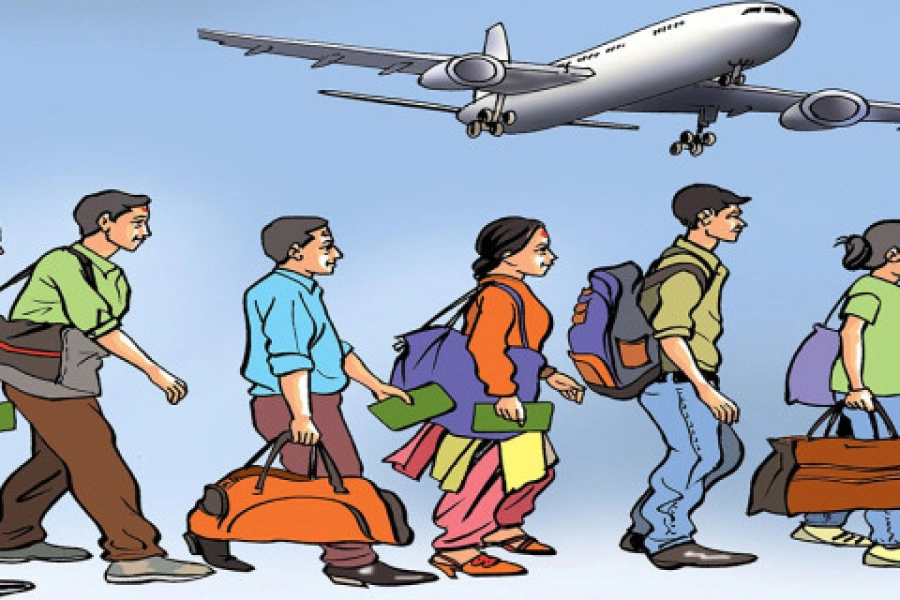
The size and growth of remittance in the past has made us a bit complacent in the economic reforms and the kind of urgency with which we had to address our economic issues. We need to reduce our dependence on migrant workers. We have discussed with several development partners about this. We need to engage our labor force in labor intensive sectors such as agriculture, infrastructure and construction by equipping them with necessary skills and creating jobs in those areas. The outflow of people to the foreign countries should be stabilized. We need to start labor absorbing infrastructure projects in the country.
Some said your attempt to stop releasing money that came in the name of businessman Ajay Sumargi was politically motivated.
I do not want to single out an individual. This case has to do with system misuse, which is not limited to inflows. There are serious outflow issues. Outflow and inflow of money should comply with Foreign Investment and Technology Transfer Act, Industrial Enterprise Act, Foreign Exchange Regulation Act and other such acts. We encourage equity than loan in inflows. If somebody brings in loan, we need to look into where it is being used, whether it is productive, if the loan is to be repaid with interests, whether there are resources to fund it to give exchange facility and so on. The case you have cited is related with loan of inflow. But outflow issues are as much serious. Repatriation proceeds of billions and billions rupees take place. So we are asking them the sources of funding and whether their accounts are being audited. In a nutshell, the case you cited is just one example. There are countless examples of us saying 'no' to the kind of loan being brought into the country from the foreign banks. Foreign Exchange Regulation Act states that if somebody has to borrow from abroad s/he must seek prior approval from NRB. I complied by this provision in that case.
It was also revealed that some Nepalis had illicit money in Swiss banks. What initiatives did you take to investigate this?
There could be many Nepalis with their bank accounts abroad. Some of them may be working abroad, earning money and maintaining their bank accounts there. But when they return to the country they should get their money back home from those accounts within 35 days of arrival. Otherwise, this money becomes illegal. I had my account in foreign bank too but I closed it within 35 days of coming back to Nepal. But there could be cases of Nepalis who have earned here (illegally) and put in that money in the secret accounts in the foreign banks. These cases must be investigated.
What did you do to take investigation process ahead?
I asked my colleagues in NRB to get the detailed information about the suspected account holders including their citizenship status and family history. We took two-pronged strategies. We wrote to Swiss bank for information and also asked Ministry of Finance and Department of Anti-money Laundering to start investigation. There is third aspect to this process as well, that is legal agreement between Switzerland and Nepal regarding exchange of information on financial crimes. We have to have bilateral agreement in order to exchange information. So we suggested the government to initiate bilateral agreement with Switzerland to ensure that this kind of information is exchanged whenever necessary. Ministry of Foreign Affairs, Ministry of Finance and Nepal Rastra Bank are working together on this at the moment.
But many doubt government will be able to get to the bottom of it. What do you say?
I am hopeful. If India can get the information, why can't we? I have asked my colleagues to remain in touch with officials of Reserve Bank of India to find out the procedures through which they were able to get the information. Nepal has corresponded with Swiss bank as well. After all, there is a precedent of getting the information about secret bank accounts. During the 1990s, there were rumors of royal family members stashing money in various Swiss banks. We wrote to the Swiss banks asking them how much money they have in those banks. And guess what we found? We were told that there were only few thousand pounds in their accounts. We reported the same to Nepal Trust. So sometimes we tend to blow such cases out of proportion. Yet this is a very tricky issue. Those who stash illicit money in the foreign banks are no fools. They don't keep their money in their own names. They find agents to work for them. I still say the investigation is possible. Information can be obtained. However, let me also tell you Swiss bank issue is only the tip of the iceberg. Nepalis are engaged in a large volume of transaction of illicit money amounting to billions of dollars according to one report.
Finally, what are your recommendations to the new governor?
An outgoing governor would naturally expect his successor to continue with the credible and time-tested policies, steps and measures introduced by his predecessor. I believe the policy direction set during my term was tested and he will continue with it. The level of financial complexities has grown and challenges in dynamic financial systems have multiplied. This demands the new governor to become more forward looking in this globalized banking system. We must be having gloves in hands to tackle any new challenges and all those challenges I mentioned earlier. Most of all, he should be very professional. One's political affiliation is often tested in this position. I am confident that he will pass this test. I wish him all the best.