Climate change is making natural disasters in Nepal more frequent and devastating. After each major disaster, Nepal repeatedly invests in rebuilding much of the same infrastructure without fully recovering its returns. The situation is reminiscent of the Greek myth of Sisyphus, who was condemned to push a giant boulder uphill, only to watch it roll back down before reaching the top. In Nepal, however, this is not mythology but a reality with enormous economic costs.
Following a series of glacial collapses and flash floods, the August 26, 2026, Bhotekoshi flood is considered Nepal's worst natural disaster since the 2015 earthquake. It has resulted in more than 1,400 confirmed deaths, thousands of people missing and the displacement of 1.6 million people. The disaster alone has caused an estimated $4 billion to $5 billion in damage, equivalent to nearly 15 percent of Nepal's GDP, threatening to consume resources needed for long-term development and reconstruction.
For a poor, least-developed country like Nepal, financing the reconstruction and rehabilitation of flood-devastated areas will be extremely difficult, if not impossible, without substantial external support. Amid severe macroeconomic headwinds and mounting public debt, the government faces the difficult task of balancing emergency reconstruction with essential public services such as health and education. It must also mobilize resources to rebuild infrastructure destroyed during the Gen Z protests. Restoring all these damaged structures will take years and require enormous financial resources.
Public debt hits Rs 2.8 trillion mark
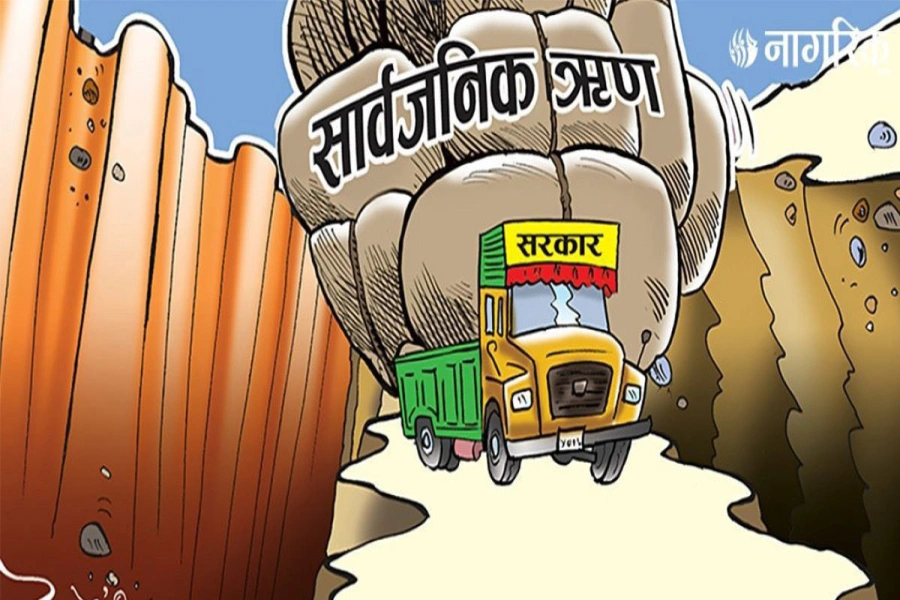
Nepal is already grappling with broader economic and financial shocks. Poverty and underdevelopment are closely linked to the prolonged economic slowdown. Global trade disruptions, rising trade restrictions and protectionist policies by developed countries, particularly Nepal's neighbours, have widened the country's trade deficit. Major contributors to GDP, including agriculture, real estate, industry, construction, forestry, communications and services, continue to experience stagnation or sluggish growth, limiting their contribution to government revenue. In the 11 years since the 2015 earthquake, government borrowing has nearly doubled, rising from 26 percent to 45 percent of GDP, while debt servicing now consumes nearly 19 percent of public expenditure.
The economic fallout from the floods is expected to further weaken growth. Nepal's economy is projected to grow by just 3.7 percent in fiscal year 2026/27 following disruptions to industry and services caused by the August 26 floods, according to the World Bank's latest development update. A study published in the Four Star Multidisciplinary Research Journal estimates that natural disasters cost Nepal between 0.08 and 2.08 percent of GDP annually in direct losses. Other estimates put the country's annual economic losses at around $218 million.
Earthquakes, landslides, floods and glacial lake outbursts are among the major natural hazards threatening human settlements and infrastructure in Nepal. Although the country cannot prevent these events, it can reduce their impact and prevent hazards from turning into human catastrophes. A hazard becomes a disaster when vulnerable communities and infrastructure lie in its path. Poorly planned development along riverbanks has been a major factor behind the extensive destruction caused by floods. Nepal can recover from recurrent disasters only by shifting from reactive reconstruction to proactive investment in climate-resilient infrastructure. Settlements and infrastructure located in high-risk zones must be relocated.
According to the Rapid Damage and Needs Assessment (RDNA) of the August 26 Bhotekoshi floods, Nepal will need Rs723.31 billion to rebuild damaged infrastructure. Infrastructure accounts for the largest share of the estimated recovery bill, with Rs473.57 billion allocated for reconstruction. Restoring the energy and grid systems alone is expected to cost Rs390.62 billion. Rebuilding the transport network will require an estimated Rs73.34 billion, while homes, public buildings and essential services will need Rs103.54 billion. Trade, businesses, banks and agriculture require another Rs50.77 billion for recovery. The assessment also estimates that Rs94.75 billion will be needed for disaster-risk reduction and river management, while Rs515.4 million has been earmarked for clearing mud and debris.
The floods have severely affected low-income families and small businesses, which face a greater risk of falling into long-term poverty because they lack the savings to replace lost assets. Disrupted supply chains and job losses have further undermined livelihoods, prompting increased migration as people move to safer areas. Hydropower, transportation, industry, border trade and tourism infrastructure have all suffered extensive damage. Debris flows and floods have damaged major hydropower projects, taking roughly 12 percent of Nepal's power-generating capacity offline and threatening lucrative electricity exports to India and Bangladesh.
Disruptions to major cross-border trade and transport corridors have also affected imports and exports, interrupted the movement of commercial goods and reduced business turnover. These setbacks are likely to lower government revenue from customs duties, value-added tax, excise duties, income taxes and other trade-related sources. Local industries have suffered severe damage, while tourism, particularly along the Langtang trekking route, has come to a prolonged halt.
Nepal struggles to keep its economy steady because recurrent natural disasters destroy infrastructure faster than it can generate economic returns. The actual cost of reconstruction cannot be assessed solely on the basis of immediate physical damage or the expense of replacing existing structures. Reconstruction must go beyond restoring what was lost. Damaged infrastructure should be rebuilt to higher safety standards and made more resilient to future disasters.
The total reconstruction bill could therefore exceed $6 billion. Government revenue is barely sufficient to cover recurrent expenditure, leaving Nepal heavily dependent on domestic and international assistance to rebuild flood-devastated infrastructure and settlements. Substantial financial resources and development financing are urgently needed to ease the country's balance-of-payments pressures and debt burden. Nepal needs a multi-pronged approach that addresses energy, infrastructure, international financing and long-term resilience.
With public debt having risen significantly following past disasters, Nepal should seek grant-based assistance and debt restructuring from bilateral partners, particularly India, China and the United States, as well as multilateral development agencies. Such support would be preferable to excessive commercial borrowing that could further destabilize public finances. Nepal must also invest more in scientific forecasting and early warning systems. Development partners should consider debt-service suspension facilities for the country in recognition of its severe exposure to natural disasters.
Following the catastrophic floods, the government is preparing to implement reconstruction plans under the guidance of the National Disaster Risk Reduction and Management Authority. Relevant ministries have developed plans to move beyond immediate relief towards restoring and rebuilding long-term physical infrastructure under the 'Build Back Better' principle. Several friendly countries, national and international organizations, and individuals have already begun providing financial assistance to rebuild and rehabilitate flood-affected settlements and infrastructure. Their humanitarian contributions to rescue, relief and recovery efforts during the immediate aftermath of the floods are highly commendable. Nepal's diplomatic missions abroad must also play a more active role in engaging foreign governments and development partners to expedite financial assistance for reconstruction.
The author is a former Government of Nepal and UNDP official, the author of three books, and a freelance writer who regularly contributes to Republica.