The price index of agricultural supplies has rocketed. Rice, pulses, sugar, and meat have become dearer, and the population is feeling the brunt of the country’s rising inflation.
Kiran Rai came to Kathmandu from Okhaldhunga in 2005 because he thought there would be “more scope in the capital.” Four years later, the 20-year-old doesn’t regret his decision yet, but is struggling to sustain in the pricey capital.[break]
A student of arts at Pashupati Multiple Campus, Rai attends his classes in the morning and works a 10-hour shift at a shop in Pashupati Plaza. With a
base salary of Rs 3,000 and additional financial help from family, he manages his rent and groceries.
“In the last three years, the prices have increased by 20 percent,” complained Rai, recalling the first time he brought his groceries: the prices of pulses, cooking gas and chicken has only scaled up.
The scenario
According to a report based on the first six-month data of 2009/10 by the Nepal Rastra Bank (NRB), Nepal’s central banking body, the year-on-year inflation measured by the consumer price index dropped to 11.8% in mid-January as compared to 14.4% during the same period last year. But the price index of food and beverage prices shows no relief.
There is still an increment of 18.1% - a 0.2% drop from last year - with the price of sugar and sugar-related products rising by a staggering 77.5%, pulses by 36.7%, spices by 34.8%, vegetables and fruits by 29.2%, and meat, fish and eggs by 22.8%.
Though inflation is low and there is an economic growth of 3.5% percent in the country, the contributing factors for the Gross Domestic Product (GDP), which correlates to the standard of living, is still slumping, said Bishwambher Pyakuryal, senior economics professor at Tribhuvan University’s Central Department of Economics.
“The service sector has declined, agricultural production is low, and the manufacturing sectors aren’t very encouraging,” he said.
Rai’s criticisms of the government and its policies resonates with similar notions. He complained about the unemployment rate and lack of qualified jobs. In Nepal, some 400,000 new workers are joining the labor market yearly but the institutional arrangement can only accommodate 10% of the total workforce.
If unemployment is one factor that is crunching the costs of living for many, there are also other economic factors that contribute to the rising prices of goods and the shrinking monetary value that makes people’s lives tricky.
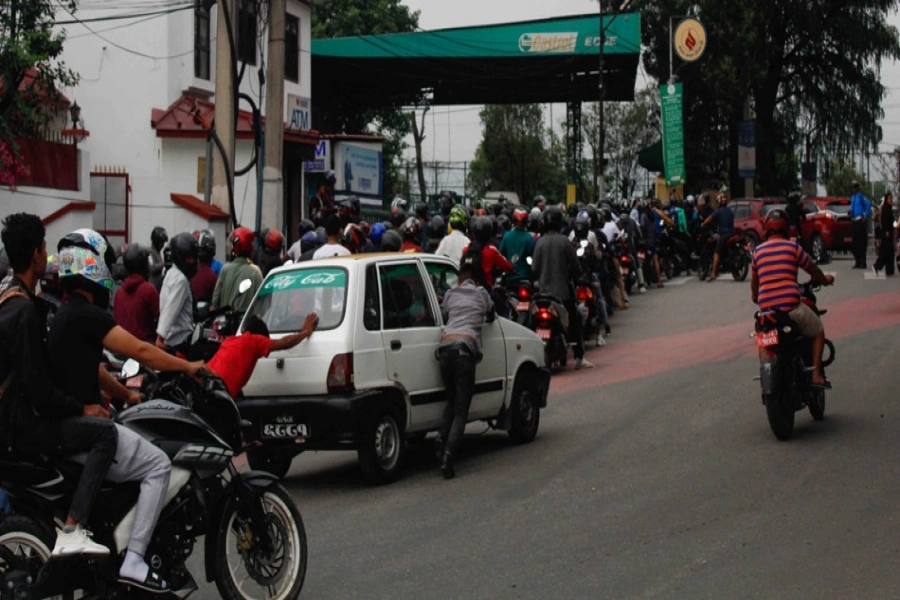
Pyakuryal cited the country’s political instability, blockages of roads, hikes in petroleum products which ultimately increases transportation costs, all adding to the price rise. Also, due to less rainfall, winter crops have been affected, impacting the agricultural production to the GDP, and concurrently creating scarcity of essential commodities, thus hiking prices.
The effects
Due to rising prices, people are limiting their expenses on basic necessities and even cutting down their food intake.
For people like Rai and many others, his limited income and rising prices has compelled him to compromise. He said meat products are expensive, so he “makes adjustments in terms of meat consumption.”
While a mass of population makes dietary restrictions in the city, the inflation results, directly or indirectly, has led to food scarcity and hunger. Economists predict that the continuing inflation will push the country to poverty, creating food scarcity and malnourished children.
According to the first Nepal Nutrition Report Card recently launched by the Department of Health Services, with support from the United Nations Children’s Fund, UNICEF, nearly half of the children under five (1.7 million) in Nepal are stunted or suffer from chronic malnutrition. [Read more as Smriti Mallapaty reports on Pg 7]
Jagdish Chandra Pokharel, team leader of the Millennium Development Goals (MDG) 2015 and consultant at Goal 1, which plans to eradicate extreme poverty and hunger, looks at the relationship between inflation and the current malnutrition trends in three ways: availability that is related to production, access, and distribution.
“The market price and inflation hampers that, too,” he said. “Inflation on food items impacts access to food for people with limited income.”
While the government is working to halving the poverty rate by 2015, a recent report by UNDP defers the target.
But Pokharel said that to attain Goal 1, there are three indicators to be considered: poverty, hunger, and decent employment for all.
“If we look at the second and third criteria, the goal can’t be met,” he said but affirmed that the decreasing the poverty level would be met.

According to the 2003/04 statistics from the Central Bureau of Statistics, in Nepal, poverty line is determined by the population with a yearly income of Rs 7,696.
Rudra Suwal, director of the population section at the Central Bureau of Statistics, said that the poverty rate and the gap between the poor and poverty line have decreased.
The poverty line during the 1995/96 census concluded at 41.76%, and according to its latest survey in 2003/04, it slumped to 30.85%. The severity or gap has also decreased from 11.75 to 7.55%. He also noted that food consumption per capita per person has increased from Rs 6,802 to Rs 15,848.
According to the MDG Progress Report 2010, the poverty line is estimated at 25.4%.
Citing population growth that also plays a key role in determining the poverty line and the trend of decreasing poverty rate, Pokharel said a part of the goal can be achieved.
“The overall goal achievement [of Goal 1] is difficult to attain but the poverty part can be achieved.”
Outcomes and consequences
Rising inflation and costs of living has made living in the capital “a struggle” for Rai. And it is not only him; many share similar stories.
For Rajkumar Majhi, an employee at Nepal Telecom, sustaining his family of four isn’t easy with the salary he gets.
With rising prices, basic salaries and wages have also increased. According to NRB’s latest statistics, salary and wage rate indices have jumped. The salary index has increased by 18% and the wage rate index by 17.6% compared to last year’s statistic at 12.6%.
But Pyakurel said that due to constraints in the supply side, when there is more import, thus increasing prices, simply increasing wages will not suffice.
During his 12-year service at NTC, Majhi’s salary has increased from Rs 2,000 to 7,000. But his rise in salary hasn’t helped to fulfill the market demand. He said everything he earns is spent, and hence no savings. “Prices have doubled,” he said and feared that it will rise again.
The rise in prices is also an alarm to social and family clashes.
Mahesh Nath Parajuli, a sociology professor at Kathmandu University, said rising inflation means limited expenses, which can result in more dissatisfaction among people. He also said the increase in consumerism has forced people to spend more than their capacity.
“People will not stop having pizzas but refrain from essentials like milk,” he said, adding that it can also result in conflicts in the family.
“Husband and wife can have a fight on how to spend and on what,” he said.
Along with price hikes, the presence of black market and unmonitored pricing by retailers has also added tyranny to customers.
Pyakuryal said the lack of implementation of the Customer Protection Act has further deteriorated the situation, the burden of which the customers are facing.
“Nepal has introduced acts and policies [regarding customer protection],” the senior economist said. “The problem is the absence of implementing these rules. The acts have been non-functional. So consumers pay higher for goods and services.”
If inflation persists, the country will head to a crisis and can turn into a “failed state,” warned Pyakuryal.
In course of time, if inflation continues to rise, Parajuli said that it could impact on the health and education sector too.
“That’s a very long-term effect. We can’t even think about it,” Parajuli said.
But for now, people are already paying the prices.
Related story
A Turning Point