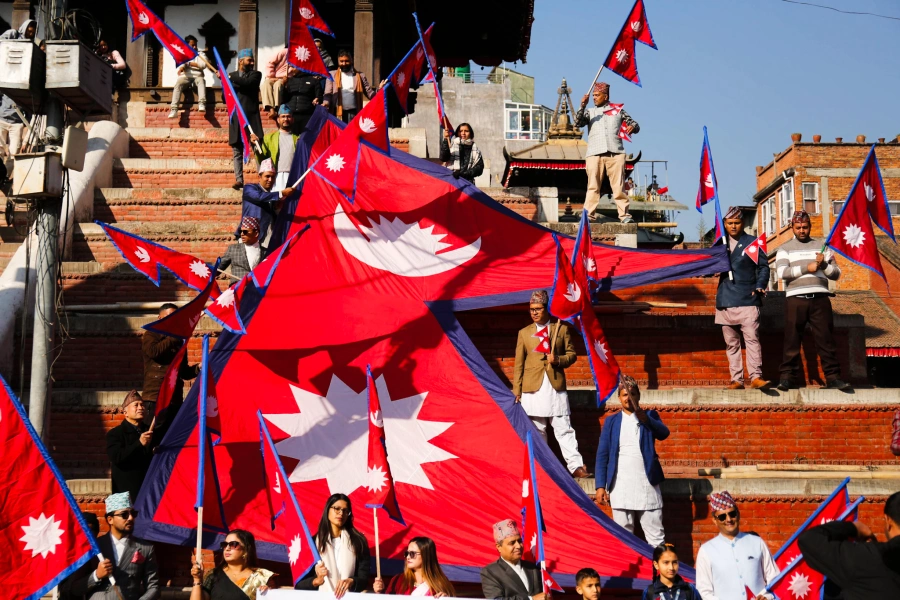
With more than 90 percent of CA members voting for the Federal Democratic Constitution of Republican Nepal, the nation should have been jubilant on September 20th, the historic day of its promulgation. Alas, the nation stood bitterly divided. While the hills and mountain regions celebrated the constitution with candlelight mass rallies, people in Tarai-Madhesh region were unhappy and stepped up their protests.Similarly, a large section of the international community including China welcomed the constitution, which is generally considered democratic, progressive, inclusive and full of fundamental rights that guarantee equity and social justice. India, however, was unhappy and only 'noted' the promulgation of new constitution. It expressed its displeasure that the aspirations of Madheshi people had not been included and imposed an undeclared economic blockade. As a result imports of essential goods and petroleum products have been discontinued for over three weeks now. This action is inhuman, uncalled for and against international norms relating to trade and transit between two friendly countries.
Owing to the Tarai protests which have taken a violent turn and claimed over 40 lives so far, including around a dozen security personnel, and the ongoing economic blockade, life has become extremely hard for common people. There is an acute shortage of fuel and essential goods as a result of the forced closure of vehicular movement. Factories, schools and businesses have closed down, production of goods and services have grounded to a halt and the national economy is teetering on the edge. Growing joblessness has added to the misery of the already struggling poor and vulnerable people. Although there has been some easing of imports from some custom points, the major import corridor of Raxaul, Birgunj is still closed.
It is in our national interest to bring the agitating Madheshi parties on board the new constitution because they are integral players in Nepal. The Tarai had been burning for over six weeks prior to the promulgation of new constitution but no serious effort was made to negotiate with dissenters. The MJF-Loktantrik, the fifth largest party in the CA which was initially with NC, CPN-UML, UCPN (Maoist) in favor of new constitution, had withdrawn its support after the Big Three agreed to a six-province federal model. The model was against the wish of the Tharu community for a separate Tharuhat. Later, when the MJF wanted to rejoin the process, it was discouraged when other leaders did not agree to its proposal that the problems in Madhesh be resolved politically.
On the other hand, the Madhesh-based parties adopted a rigid stand, that unless the agreement reached between the Madhesh parties and GP Koirala—the prime minister during the first Madhesh Uprising in 2007—was not incorporated in the constitution, they would not negotiate. India too made a diplomatic faux pas by sending a special envoy in the last minute to ask our leaders to delay the constitution and accommodate the Madheshis. I had cautioned against rushing through the constitution without meeting the Madheshi demands in my previous Republica article ("A bit longer," September 14).
The leaders made a blunder by ignoring the advice of their CA members from Madhesh who had urged them to resolve the Madheshi issue prior to constitution promulgation. Our leaders could also have used the good offices of India to settle the Madheshi issues, something we have successfully done in the past. Thus, in retrospect, the current impasse could have been avoided with a little more foresight and diplomatic nous.
The way out
It is important that we resolve the impasse immediately. The Koirala government had done the right thing by setting up a negotiating team, which had held constructive discussions with both Madheshi and Tharu leaders. The new government under Prime Minister KP Oli has also expressed its commitment to resolve the Madhesh issues through dialogue and we can expect negotiations with the protesting parties to resume soon. Of the four demands of protestors, those regarding inclusion and proportional representation in all state organs and the fixing of electoral constituencies based on population are genuine, and can be addressed through amendment of the new constitution.
As regards state demarcations, the previous government's proposal that a federal commission be set up to make appropriate recommendation for final parliamentary approval does not seem acceptable to the dissident groups. So we need to think about other alternatives. The fourth demand regarding the right of naturalized citizens to hold important public positions such as Prime minister, President, Speaker and Chief Justice is sensitive and unacceptable to the majority including the Madheshis themselves. I believe current provisions allowing only citizens by descent to hold such posts are appropriate enough. Such provisions are also seen in constitutions of all advanced and democratic countries.
Further, as the government has already decided to withdraw the army, provide million rupees each to the families of those killed during protests and medical services for all those injured, it would be wise for the protestors to come to the negotiating table. As a goodwill gesture, their protests should be stopped at least during the festivities of Dashain, Tihar and Chhath. Continuation of the protests and the concomitant blockade could in the end result in total collapse of the national economy.
As regards India, which has traditional ties with Nepal and which aspires to be a global leader in the near future, it cannot afford to antagonize its supposedly closest neighbor. So it must immediately withdraw its economic sanctions and allow normal flow of goods into Nepal.
The new government, for its part, would do well to review our weaknesses, including our overdependence with India. We need to formulate a visionary and delivery-oriented policy and work towards self-reliance in energy and food by investing on hydropower and agriculture and look to diversify our trade. As a country sandwiched between two giants, we need to maintain a balance with both our neighbors in the spirit of goodwill, interdependence and Panchasheel.
For the present, our leaders must resolve the Madhesh issues immediately and leverage its diplomatic channels with India and other countries to bring back a sense of normalcy.
The author was a Nepali Congress candidate from Dhankuta district in the second Constituent Assembly elections
Related story
The reason behind breaking coconut on auspicious occasions