

When the world paid little attention to carbon emissions and the multisectoral impacts of global warming in the 1970s and 1980s, Nepal’s subsistence farmers were already investing their labour, time, money and knowledge in conserving the forests, soil and biodiversity of the Himalayan mountains. They understood that mountains not only offer opportunities to strengthen long-term livelihood security and promote national economic prosperity but also pose risks and challenges to livelihoods.
During the 1970s and 1980s, industrialised countries emitted large amounts of carbon dioxide (CO2) through their extensive use of coal, oil and natural gas for manufacturing, electricity generation and transportation. Although the oil crises of the 1970s and early 1980s encouraged energy conservation and improved efficiency, industrialised countries continued to account for a large share of global fossil fuel emissions, reflecting their high levels of industrial production and consumption. Their historical emissions also contributed substantially to the accumulation of greenhouse gases in the atmosphere, driving global climate change.
Consequently, despite farmers’ sustained efforts to protect the Himalayan environment through forest and biodiversity conservation, the region has continued to experience rising temperatures driven by global warming. The Bhotekoshi disaster of August 26, 2026, can be understood as a tangible manifestation of the long-term environmental consequences of carbon-intensive development and consumption practices worldwide.
Nepal to push for permanent mountain agenda, faster climate dis...

In the 1970s, concerns were raised about soil degradation in Nepal associated with rapid forest depletion. This was later critically examined through the Himalayan Degradation Theory. In response, the Government of Nepal and international agencies placed greater emphasis on forest conservation through community forestry, which has become a highly successful conservation programme and inspired similar initiatives in many other developing countries.
However, rising global temperatures and carbon emissions have surpassed the capacity of forests to protect the Himalayan mountains and mitigate increasing disaster risks. Consequently, the growing impacts of climate change and climate-induced disasters are turning the Himalayan mountains from vital sources of natural resources into areas of increasing risk and vulnerability. This underscores the urgent need for global efforts to restrict warming to 1.5°C above pre-industrial levels. However, even limiting global warming to 1.5°C cannot guarantee an end to the loss of Himalayan snow and permafrost. Rising temperatures are transforming mountain landscapes, with potentially far-reaching consequences for ecosystems, forests, water resources and the livelihoods of mountain communities.
The growing number of disasters in the Himalayas highlights the limitations of relying solely on national and local mitigation and adaptation efforts to address climate change impacts and climate-induced disasters. National and local governments often lack the resources, expertise and institutional mechanisms needed to translate climate policies and adaptation plans into effective action. This is why countries like Nepal need international support, climate finance and funding from Loss and Damage mechanisms.
The recent decision by the United Nations Fund for Responding to Loss and Damage, announced on October 22, 2026, to provide $20 million, along with $1.6 million in oversight fees, to Nepal for flood relief, rehabilitation and reconstruction in the Bhotekoshi and Trishuli regions is a positive first step. It may also pave the way for other vulnerable and low-income countries to pursue similar claims. However, the future of the Himalayan mountains, their resources and the security of millions of people living downstream depend on global action, particularly by industrialised countries, developed economies and major carbon emitters. Nepal’s weak economic position limits its capacity to build a resilient Himalayan society and sustain the mountain system’s contribution to global climate regulation.
Nepal’s contribution to global warming is negligible, accounting for less than 0.03 percent of global CO2 emissions. Therefore, providing financial and technical support to Nepal is a matter of justice. Nepal deserves environmental justice in recognition of its contributions to forest and biodiversity conservation, as well as climate justice in light of the disproportionate contribution of developed and industrialised nations to carbon emissions and global warming.
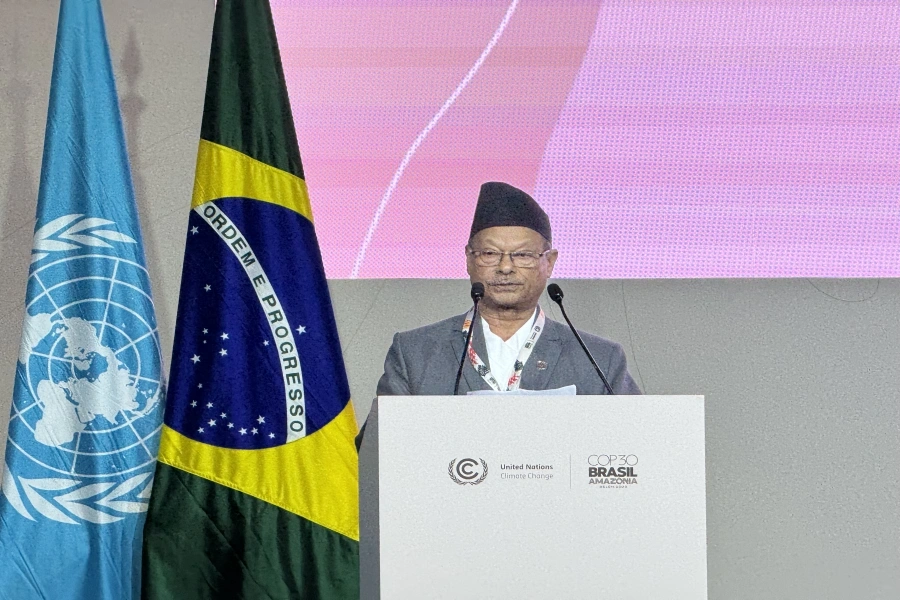
Considering the changing mountain environment, escalating risks in the Himalayas and growing demands for environmental and climate justice, the Government of Nepal, in collaboration with the Government of Bhutan, is explicitly raising the "Mountain Agenda" at the upcoming 31st Conference of the Parties (COP31), scheduled to take place at the Antalya Expo Centre in Antalya, Türkiye, from December 9 to 20.
It is therefore strongly recommended that parties to COP31 give serious attention to mountain-specific issues and strengthen their commitments to protecting mountain ecosystems. The Himalayas provide vital resources and essential ecosystem services to millions of people living downstream. Protecting these mountains is not merely a national or regional priority but a global climate imperative.
Dr Poudel is a geographer associated with ForestAction Nepal and Kathmandu University.






-1793781552.webp)


