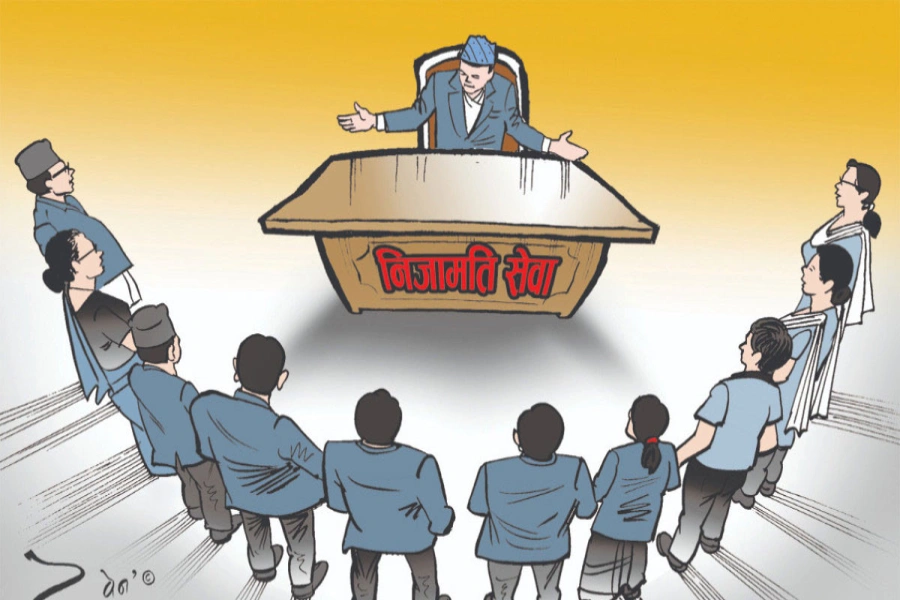
KATHMANDU, June 13: A government proposal to overhaul Nepal's civil service has triggered anxiety, frustration and intense lobbying within the country's bureaucracy, as thousands of senior officials confront the prospect of being forced into retirement years earlier than expected.
At the centre of the controversy is the draft Civil Service Bill prepared by the Ministry of Land Management, Co-operatives, Federal Affairs and General Administration. The bill proposes retiring civil servants once they reach either 55 years of age or complete 30 years of service—a one-time provision that, if enacted, would result in the immediate departure of around 10,000 government employees.
The proposal has effectively split the bureaucracy into two camps. Senior officials who stand to lose their positions are expressing strong dissatisfaction, while younger officers and those unaffected by the measure see an opportunity for accelerated promotions and longer careers.
According to the Civil Service Records Office, Nepal currently has 92,157 civil servants serving across federal, provincial and local governments. If the bill is endorsed by Parliament in its current form, as many as 52 secretaries and 268 joint secretaries would be forced to leave service almost immediately.
Officials said the Ministry of Finance has already approved the draft, which is currently under review at the Ministry of Law. For many senior bureaucrats, the proposal amounts to an abrupt rewriting of the rules under which they joined public service.
Officials affected by the proposed age and service limits have begun raising concerns with Chief Secretary officials, arguing that the government is attempting to push experienced employees out through legislative means. Joint secretaries nearing promotion to secretary appear particularly concerned, as the proposal could end their careers before they reach the top ranks.
Bill bars local units from recruiting civil servants

The draft also seeks to reduce the tenure of secretaries from five years to three years and shorten the Chief Secretary's tenure from three years to two.
Government officials involved in the drafting process say the retirement provision is intended as a one-time restructuring measure. Under the proposal, employees who cross the threshold of 55 years of age or 30 years of service would retire when the law comes into effect. Thereafter, the mandatory retirement age would be permanently raised to 60.
At present, civil servants retire at 58, regardless of years served.
What has further fuelled resentment among affected employees is the absence of any special compensation or retirement package for those who would be required to leave service earlier than anticipated.
A few joint secretaries, who are likely to be affected by the provision, told Republica that the proposal is the outcome of internal bureaucratic manoeuvring. "It seems officials who know they will not be affected and who expect quicker promotions have convinced the political leadership to bring this proposal," a joint secretary complained, while seeking anonymity. "The government should not make thousands of employees suffer and force them out of service just to serve the interests of a few."
Questions are also emerging about whether the proposal can withstand legal scrutiny. Officials at the Ministry of Law have reportedly expressed reservations about the provision, pointing to constitutional guarantees of equality and existing legal protections for civil servants. However, the government leadership has shown no sign of budging.
The debate centres on Section 58 of the existing Civil Service Act, which prohibits adverse changes to salary, pension, gratuity and other service conditions without an employee's consent. The law further states that amendments negatively affecting existing employees cannot be enforced unless written consent is obtained.
Several senior officials argue that employees who entered government service under the understanding that they would retire at 58 should not be forced out at 55. They complain that the government is trying to treat people differently simply because they were born or joined service a day earlier or later.
Arguing that such a legal arrangement goes against the spirit of the constitution and existing laws, they argue that the state cannot deceive employees who entered service through the Public Service Commission under specific conditions.
Behind closed doors, many affected employees have begun discussing possible responses should the proposal survive the legislative process. Some argue that if the government's objective is to reduce the size of the bureaucracy, it should instead introduce a voluntary retirement scheme backed by attractive incentives.
The current debate has revived memories of a major civil service restructuring carried out more than three decades ago. The then government led by Girija Prasad Koirala in the early 1990s had lowered the retirement age from 60 to 58 and simultaneously retired employees who had either reached 58 years of age or completed 30 years of service. Those affected were granted pension benefits as though they had served until age 60.
Former government officials argue that the reform implemented then was applied uniformly, unlike the present proposal. During that time, no one was retired at 58 while others remained until 60. Once the retirement age was reduced to 58, it applied equally to all employees, unlike the one-time provision that the current government plans to introduce.
Former chairperson of the Public Service Commission (PSC) Umesh Mainali cautioned that the proposed retirement provision could trigger a mass exodus of experienced civil servants and weaken governance. He argued that many of those set to retire are among the state's most capable officials and should be viewed as assets rather than liabilities.
Instead of forcing thousands into retirement at once, Mainali suggested voluntary retirement schemes, natural attrition and temporary recruitment freezes. He also warned against repeating past mistakes, saying experienced bureaucrats are crucial for helping governments deliver on their policy commitments.
As the bill reaches its final stages of review, it has turned into a major point of dispute within Nepal’s bureaucracy, raising concerns over fairness, legal validity and the possible loss of experienced officials, even as some view it as a step toward generational change.