LONDON, Sept. 25: Professor of International Law at the University of Leeds, Dr Surya P Subedi, has urged the British government to convene an international conference in London to support Nepal’s recovery efforts.
Addressing a ceremony organized to mark the 25th anniversary of the Britain-Nepal Academic Council (BNAC) at the Nepali Embassy in London on Thursday, Prof Subedi said Britain and Nepal have enjoyed more than two centuries of warm, peaceful and enduring friendship, standing by one another in times of both opportunity and adversity.
“Today, as Nepal seeks to recover from the catastrophic disaster now widely described as the ‘Himalayan Tsunami,’ there is an opportunity for the United Kingdom once again to demonstrate leadership and solidarity with a long-standing friend. I respectfully suggest that the UK Government consider convening an international conference on Nepal, bringing together governments, international financial institutions, development partners, the private sector and civil society to mobilize support for Nepal’s reconstruction and long-term resilience,” said Prof Subedi.
“Such an initiative would build on Britain’s distinguished record of international leadership, including the London Conference on Afghanistan in 2010 and subsequent conferences on Sudan, which helped galvanize international assistance for countries facing profound challenges.”
Prof Subedi, who has also served as UN Special Rapporteur on Cambodia and human rights adviser to the British Foreign Minister, said Nepal would require substantial support to rebuild towns, villages, homes, schools, hospitals, roads, bridges, hydropower facilities and other critical infrastructure destroyed by the tragedy.
A coordinated international response would not only accelerate recovery but also help Nepal build back stronger and more resilient for the future, he said.
Prof Subedi, who is a founding chairperson of BNAC, said such an effort would also serve the cause of climate justice.
“Nepal’s contribution to global greenhouse gas emissions is negligible, but it remains among the countries most vulnerable to the consequences of climate change, including glacial retreat, extreme weather events and increasingly severe mountain disasters. A British-led conference would therefore be both a practical expression of solidarity and a powerful affirmation of the international community’s shared responsibility to support those who bear the greatest burdens of a changing climate,” he added.
The Bhotekoshi Disaster – The Urgency of a Reconstruction Confe...

“I can think of no country better placed than the United Kingdom to lead such an endeavor. It would be a fitting reflection of the deep friendship between our two nations and a meaningful contribution to Nepal’s recovery, reconstruction, resilience and future prosperity,” he added.
Call for international support
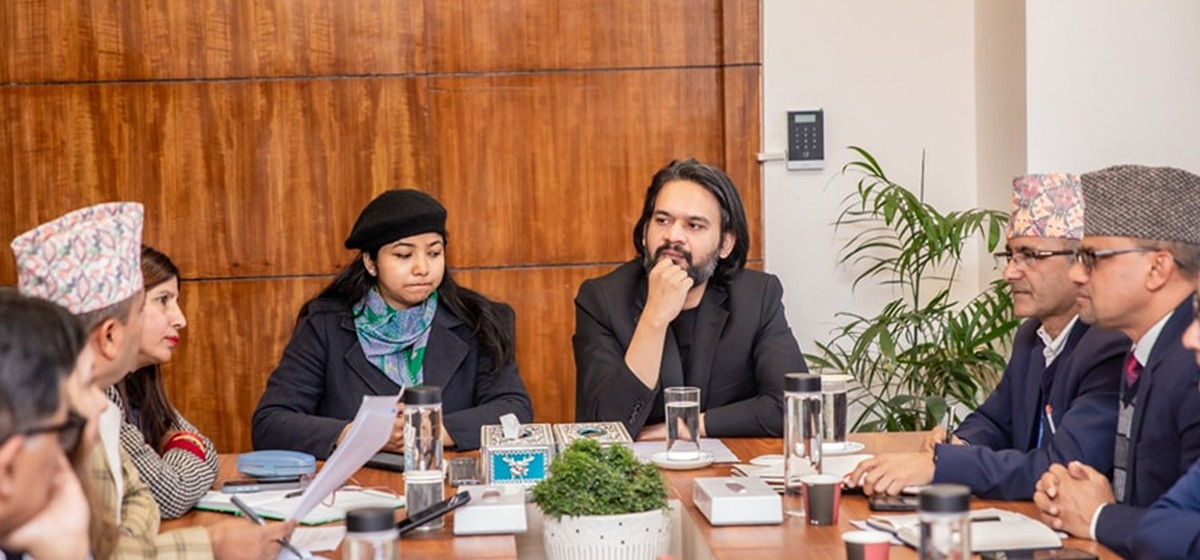
Addressing the event, Member of Parliament from the ruling Rastriya Swatantra Party (RPP), Bidushi Rana, said Nepal needs climate finance, support to strengthen early warning systems and cross-border data sharing to protect lives and property.
Referring to the devastating floods of August 26, which have claimed the lives of more than 1,400 people and left nearly 6,000 missing, Rana called on the international community to support Nepal in its recovery efforts.
“Prime Minister Balendra Shah and Foreign Minister Shishir Khanal are currently at the UN General Assembly carrying this message,” she added.
Rana, who is currently visiting the UK, thanked the British government, British people and lawmakers for their unwavering support and sympathy toward the Nepali people. She also called on the academic community to carry out research that could help save lives in the Himalayan region.
Acting Ambassador at the Nepali Embassy in London, Bipin Duwadi, said Himalayan countries, including Nepal, were facing disproportionate impacts of climate change.
Quoting the Post-Disaster Economic Assessment conducted by the Nepal government, Duwadi said the estimated total reconstruction cost for Nepal would be around $5 billion. He called for greater global support for Nepal’s recovery and reconstruction efforts.
“We need huge investment and financial support,” he said.
Prof Ben Campbell of Durham University, who has conducted field research in Rasuwa for more than three decades, highlighted the human and sociocultural dimensions of environmental disasters.
For Tamang communities, performing proper death rituals is a critical cultural obligation; mass-casualty events severely disrupt these sacred rites, leaving long-term psychological trauma.
Prof Campbell observed that changing precipitation patterns mean the hazards are no longer distant risks; mountain slopes directly above settlements are failing, requiring sustained psychosocial healing alongside physical infrastructure rebuilding.
Making a presentation on the evolving nature of climate hazards across the Himalayas, Navin S. Khadka, Global Environment Correspondent of the BBC World Service, argued that current policy and monitoring frameworks remain dangerously outdated.
While international attention has focused heavily on glacial lake outburst floods and efforts to lower water levels in lakes such as Tso Rolpa and Imja, the primary threats have shifted to complex, multi-hazard cascades, he said.
Hazards now include rapidly thawing permafrost, unstable hanging glaciers, steep bedrock failures and thermokarst formations. Khadka cited the 2021 Chamoli disaster in India and noted that the Bhotekoshi-Rasuwa floods in Nepal could be ten times larger.
He highlighted severe operational failures in existing hazard infrastructure, pointing to multimillion-dollar flood-warning installations around Mount Everest that were left unmaintained and had rusted.
Nepal’s National Adaptation Plan (NAPA) requires an estimated $20 billion for effective adaptation. However, global Loss and Damage funds remain severely underfunded, with around $4 billion allocated globally across 190 applicant nations, while international military spending continues to divert resources away from climate adaptation, Khadka said.
Former BNAC Chair Prof Michael Hutt, Prof David Gellner, Prof Sara Parker and Dr Krishna Adhikari also shared their experiences during the program.
Dr Fraser Sugden of the University of Birmingham summarized the main activities of BNAC since its inception. BNAC members also displayed posters on the sidelines of the event highlighting their research findings.
Researchers, academics, students and Nepali community leaders were present at the event.