KATHMANDU, Dec 5: On a hospital bed at the National Trauma Center, 28-year-old Prakash Bohara lies battered and broken, his legs badly injured. Yet, on Tuesday, his face shone with an unusual brightness.
Why?
It was his fifth wedding anniversary.
Prakash, a permanent resident of Narayan Municipality-8 in Dailekh, had taken to the streets demanding good governance and change—and paid a steep price. Police bullets struck him. In the chaos, his white shoe, soaked in his blood, was left behind on the street. That single shoe would soon become the iconic symbol of the Gen-Z movement.
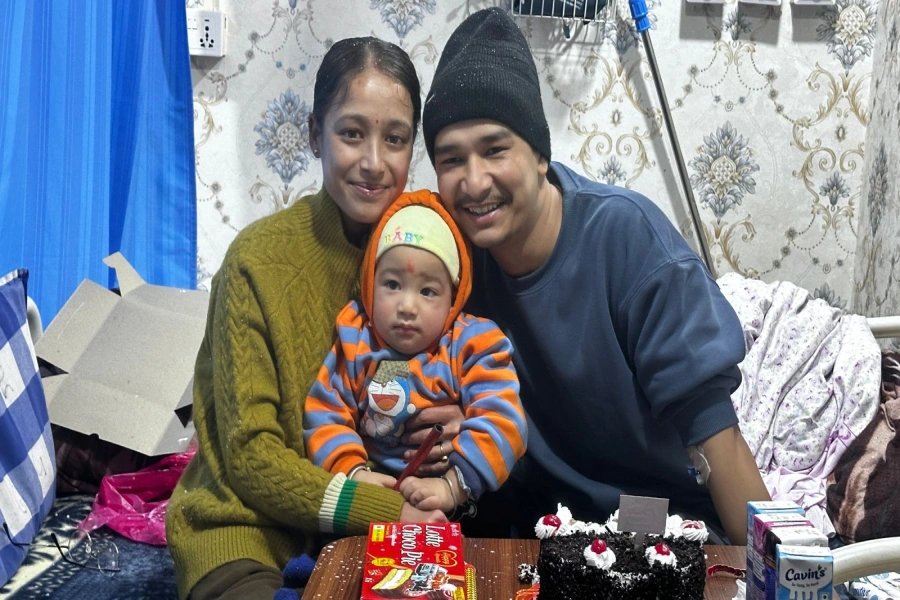
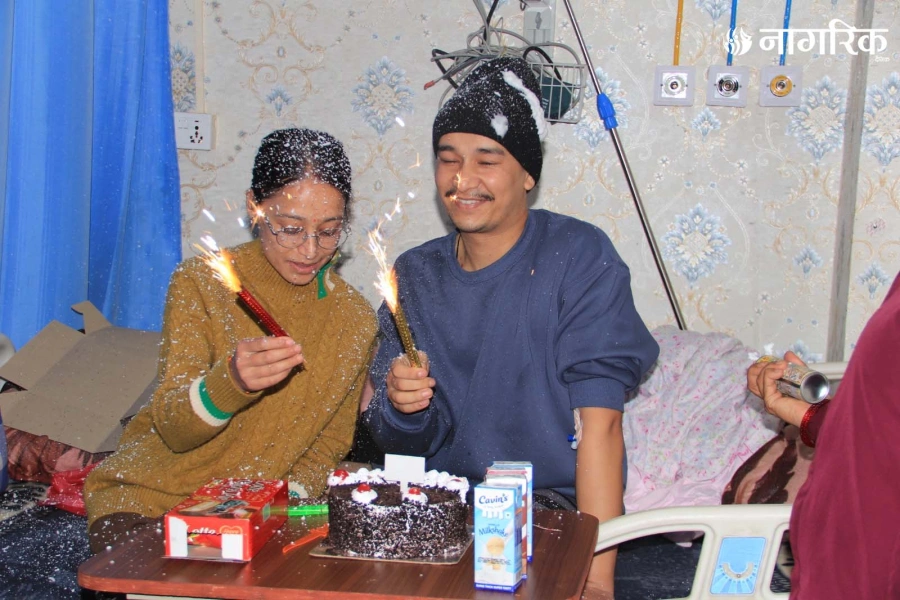
Inside the sterile hospital walls, amid the scent of medicine and the quiet moans of fellow patients, Prakash celebrated five years of love and companionship with his wife, Radhika, cutting a cake in the most improbable of settings.
Love in the midst of pain
Even after five years of marriage, Prakash and Radhika had never celebrated an anniversary. Work, distance, and foreign lands had kept them apart. “We’ve been married five years, but never celebrated,” Radhika said. “Circumstances always kept us apart. But today, even amid suffering, we are together. Being able to celebrate here makes me very happy.”
Prakash, relying on a wheelchair and the hospital bed for support, showed no signs of slowing down. Cradling their 18-month-old son, he cut the cake. Tears filled his mother Nanda Bohara’s eyes as she saw her son’s pain—but there was a spark in her eyes, too, watching her daughter-in-law and grandson smile.
After the cake, Prakash handed out chocolates to other patients and visitors. For a fleeting moment, the trauma center transformed from a place of suffering into a scene of quiet celebration.
September 8: A day that changed everything
Prakash’s life would never be the same after one fateful day: September 8. Around 11 AM, he had joined thousands of youths at Maitighar Mandala, their voices raised for good governance, equal opportunity, and a corruption-free administration. National flags waved proudly. Their patriotism was raw, visible, and unyielding.
By the time they reached New Baneshwor, the atmosphere grew tense. Tear gas filled the air. Prakash and his friends reached the wall of the Parliament building. Protesters began breaking the wall and pulling iron bars—and Prakash was among them.
Then, chaos erupted. Police rifles were trained on the crowd. Bullets struck not just his legs, but his chest and head. “While pulling the iron bar, I was shot in my left leg. I collapsed instantly,” he recalled from his hospital bed.
Five killed in Tulsipur shoe shop fire

Four hours later, the streets of Kathmandu ran red. Nineteen youths lost their lives that day. Hospitals overflowed with the injured; some were treated on the floor, others died on the way in ambulances. Students who left home in their college uniforms that morning, wrapped in national flags, were gone forever.
The iconic shoe
Among the blood-soaked bodies near the Parliament gate lay a single white shoe, abandoned. Stained in red, it became more than a shoe—it became a symbol. It carried the pain, courage, and dreams of an entire generation.
That shoe belonged to Prakash. After being shot, friends rushed him into an ambulance. “My leg was limp. I remember someone saying to remove my shoe before putting me in. I remember it being taken off,” he said.
The right shoe was removed later at the National Trauma Center. In the ICU, he heard the photo of the blood-soaked shoe had gone viral—but he didn’t know it was his. Nine days later, relatives showed him the image, confirming that the shoe had become the Gen-Z movement’s iconic symbol.
 Photo Credit: Dinesh Gautam
A life defined by struggle
Prakash’s life has been a constant struggle. After passing the Health Assistant exam in 2073 BS, he prepared for the Public Service Commission exams. When government jobs eluded him, he worked in various projects and in the health section of Dailekh prison.
But a small family shop and meager farming barely covered expenses. The debt from rebuilding the earthquake-damaged house mounted. Seeing no hope at home, he decided to go abroad. Amid the Russia–Ukraine war, necessity led him and his friends to join the Russian army two years ago.
He fought in Donetsk, witnessing death up close. “I survived fighting abroad, but when I took to the streets for my country’s welfare and good governance, I was shot by my own police,” he said.
After returning from Russia, he planned to go to Qatar. Two months ago, he came to Kathmandu for paperwork. But unemployment and corruption at home wouldn’t let him remain silent—he joined the protest.
Though his gunshot wounds will take time to heal, his resolve for change remains unbroken. “Even after being shot, I feel I haven’t lost anything. The blood I shed has sparked new hope for the country,” he said.
Anger at the government
From his hospital bed, Prakash voiced frustration at the government and political leaders. He said the current administration, formed on the sacrifices of young protesters, has ignored their demands.
“The government we sent doesn’t even recognize us.”
He said the government was built on the Gen-Z movement. “We removed one Prime Minister, appointed another. But now they have forgotten our mandate,” he said.
He has yet to meet the Prime Minister. “Even after 14 days in ICU and moving to HDU, I haven’t met him. The Home Minister and Health Minister came, but gave no concrete answers,” he said.
“Our movement is almost 90 days old, yet the government hasn’t legitimized it. They just delay, saying it’s under process,” he added.
He also criticized the government for failing to act against those who ordered the firing during the protest. “Who fired thousands of rounds? Who ran the government then? Who gave the orders? Where is the answer?”
“We didn’t want elections. We wanted answers.”
Prakash clarified that the protests were not about elections. “They were due anyway. We didn’t protest for the elections. We wanted justice, five years of stable governance, a strong economy, local employment, and to prevent young people from leaving the country,” he said.
He doubts the next government will support their cause. “If the current government isn’t on our side, what will the next one do?”
Sudan and Miraj out of contact
Prakash spoke about Sudan Gurung and Miraj Dhungana, key figures during the protest. He met Sudan only twice—initially at the hospital, but lost contact later. “I don’t know where he is or what he’s doing now,” he said, adding that their conversations were brief and superficial.
He met Miraj just once and heard rumors that he plans to start a party, but Prakash is unaware of the details.
Expressing concern over the Gen-Z movement’s fragmentation, Prakash noted, “We were one team on the streets, but now the movement has split into 50–52 groups. Division weakens us. Our demand and path are the same, so we must stay united.”
He also said forming new parties now is premature. “Change has begun, but rushing into elections isn’t necessary. What we seek is justice and answers—yet 90 days have passed with no action.”
Divisions and hope
Prakash expressed concern about divisions within the Gen-Z movement. “When we marched, we were one team. No royalists, no CPN-UML, no Nepali Congress. But now, it has split into 50–52 groups. I am shocked.”
He urged unity. “Division weakens us. Our demand is the same, our path is the same.”
Some friends discussed forming parties, but he believes it is too early. “Change has begun. That’s good. But forming parties and contesting elections now seems hasty.”
“What we seek is justice and answers. They say it’s in process, but 90 days have passed with nothing.”
Despite his anger, Prakash remains hopeful. “We are upset with this government, but haven’t lost hope. This government exists because of us. We hope it will act.”
He hopes the younger generation will take leadership. “I want to see a new Prime Minister, a new face. The new government must honor the blood of martyrs and the Gen-Z movement. Our cause hasn’t died. Otherwise, another movement may follow.”
Prakash’s health is improving, and he looks forward to returning home soon—ready to continue the fight for change.