KATHMANDU, March 21: A long-simmering border dispute between Nepal and India has resurfaced, posing an early diplomatic challenge for the incoming government led by the Rastriya Swatantra Party (RSP).
The Kalapani–Lipulekh issue, which strained Nepal-India relations in the past, has returned to the forefront after India and China moved to resume border trade through the Lipulekh Pass this year, following a six-year hiatus. Nepal has consistently maintained that the area falls within its territory.
According to India’s Press Trust of India (PTI), preparations for the annual trade session—typically held from June to September—are underway following directives from the Union government. The process began after India’s Ministry of External Affairs issued a No Objection Certificate (NOC).
The PTI report, quoting Uttarakhand's Pithoragarh District Magistrate Ashish Bhatgai, said Foreign Secretary Vikram Misri had written to Uttarakhand Chief Secretary Anand Bardhan, requesting the restoration of trade through the Himalayan pass. The letter noted that India’s Ministry of Home Affairs and Ministry of Commerce and Industry had also granted clearance.
Officials have been instructed to coordinate with Chinese counterparts, with local-level contacts to be shared to facilitate the resumption of trade during the 2026 session.
Speed up testing

The move follows an agreement reached between India and China during Chinese Foreign Minister Wang Yi’s visit to India in August 2025, at the invitation of National Security Advisor Ajit Doval. A 12-point agreement issued after the visit confirmed the reopening of border trade through three designated points: Lipulekh Pass, Shipki La Pass, and Nathu La Pass.
While China’s official statement did not explicitly mention Lipulekh, it referred to the Pulan-Gunji route, which passes through the disputed area.
This is not the first time Lipulekh has figured in bilateral agreements between India and China. A similar understanding in 2015 had triggered strong protests from Nepal, which responded by sending diplomatic notes to both countries asserting its claim over the territory.
In May 2020, the K P Oli-led government in Nepal reinforced its position by issuing a new political map that included Limpiyadhura, Lipulekh, and Kalapani and subsequently amended the Constitution to formalise the change. During his visit to China in September 2025, then Prime Minister KP Sharma Oli also raised the issue with Chinese leaders.
Analysts say the renewed development places the RSP—fresh from securing a near two-thirds majority in the House of Representatives—under immediate foreign policy pressure. “This is a test case for the new government,” said former ambassador Dr Dinesh Bhattarai, who also served as foreign relations adviser to former Prime Minister Sushil Koirala. “A government is defined by continuity in key policy matters. The RSP-led government must engage both India and China on this sensitive issue.”
Dr Bhattarai recalled that the Koirala administration had sent a note verbale to both countries in 2015 protesting the Lipulekh agreement, though it received no response. He added that Koirala had also raised the issue directly with Indian Prime Minister Narendra Modi.
When the dispute resurfaced after the India-China agreement in August 2025, Nepal’s Ministry of Foreign Affairs reiterated that Limpiyadhura, Lipulekh, and Kalapani—east of the Mahakali River—are integral parts of Nepal as per the Constitution.
“It is well known that the Government of Nepal has consistently urged the Government of India not to carry out any activities such as road construction, expansion, or border trade in that area,” the ministry said in a statement, adding that Nepal’s position has also been communicated to China.
The MoFA emphasised that Nepal remains committed to resolving the boundary dispute through diplomatic means, based on historical treaties, maps, and evidence.
India, however, rejected Nepal’s claim. Responding to Kathmandu’s statement, Ministry of External Affairs Spokesperson Randhir Jaiswal said border trade through Lipulekh dates back to 1954 and has continued for decades.
Describing Nepal’s claims as “untenable” and not supported by historical evidence, he said the trade had only been interrupted in recent years due to the COVID-19 pandemic and other factors.
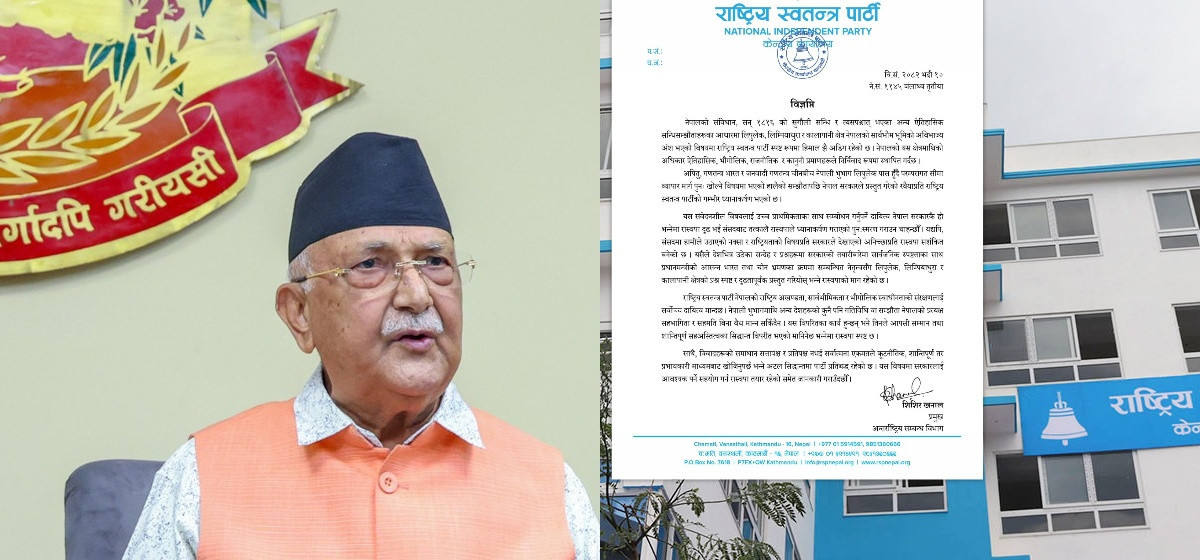
Comments from RSP leaders were not immediately available. But when the dispute surfaced following the agreement between New Delhi and Beijing in August 2025, the RSP had criticised the agreement, urging the government to take a firm stance to safeguard Nepal’s territorial claims over Lipulekh, Limpiyadhura, and Kalapani.
Foreign policy expert Dr Nishchal Nath Pandey said the new government faces multiple such challenges and must adopt a proactive and calibrated approach. “It is positive that India-China relations are improving after years of strain,” said Dr Pandey, director of the Centre for South Asian Studies. “However, Nepal must carefully handle such issues using existing diplomatic mechanisms.”
As Kathmandu prepares for a new political transition, the re-emergence of the Kalapani–Lipulekh dispute underscores the complexities of navigating regional geopolitics while safeguarding national interests.